
Quick Answer
To measure an oval dildo, choose one point across the shaft and record three dimensions there: side-to-side width, front-to-back depth, and circumference. Measure both axes at the same cross-section and do not squeeze soft material. Repeat at the head, mid-shaft, and widest insertable point if the shape changes along its length.
Do not treat the widest axis as a circular diameter or multiply it by 3.14 to estimate the girth. An oval shaft has a long axis and a short axis; circumference describes the distance around both. For a real dildo, a flexible tape or non-stretch string is usually the most useful way to measure circumference directly.
Why an Oval Dildo Needs More Than One Number
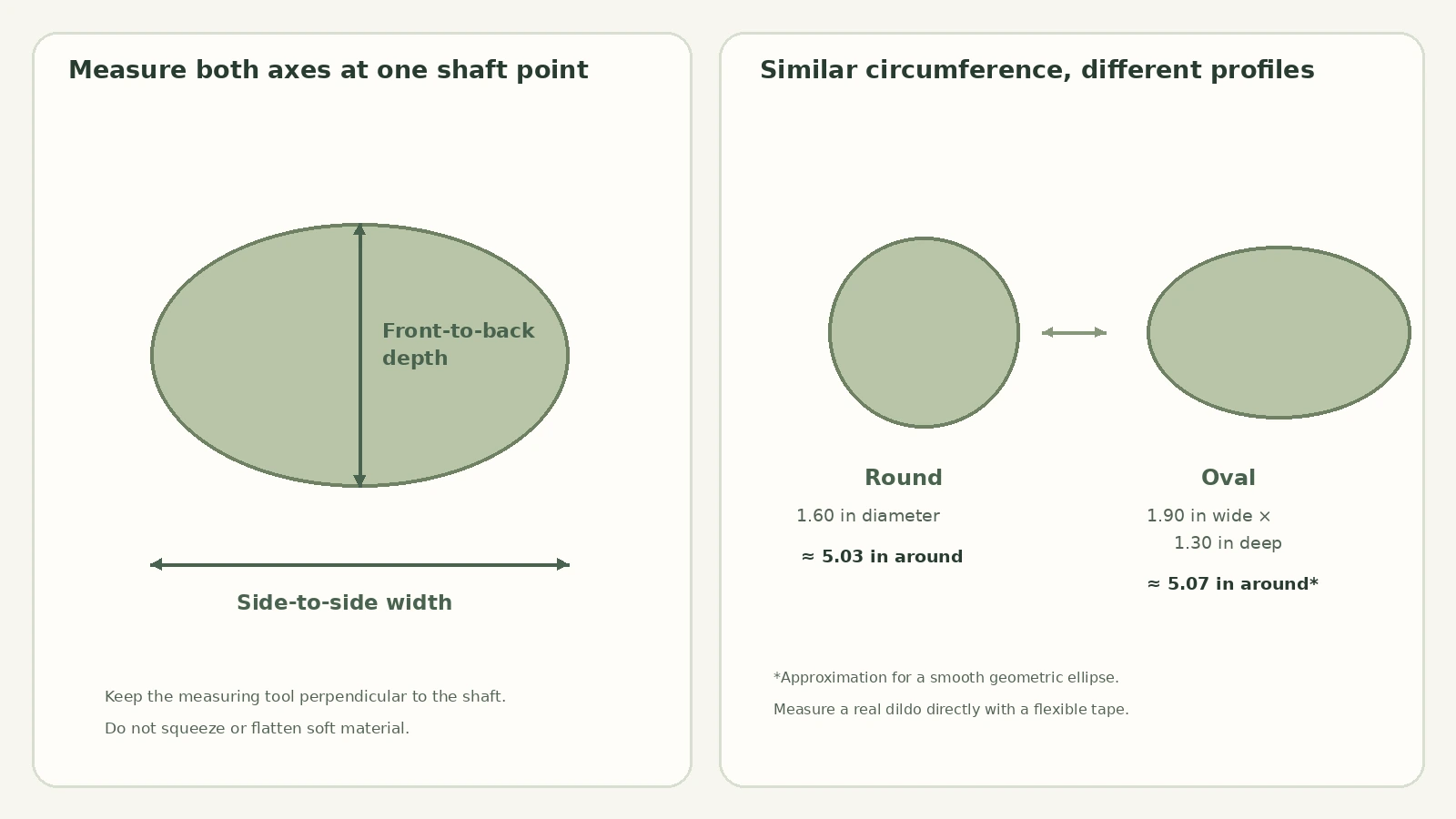
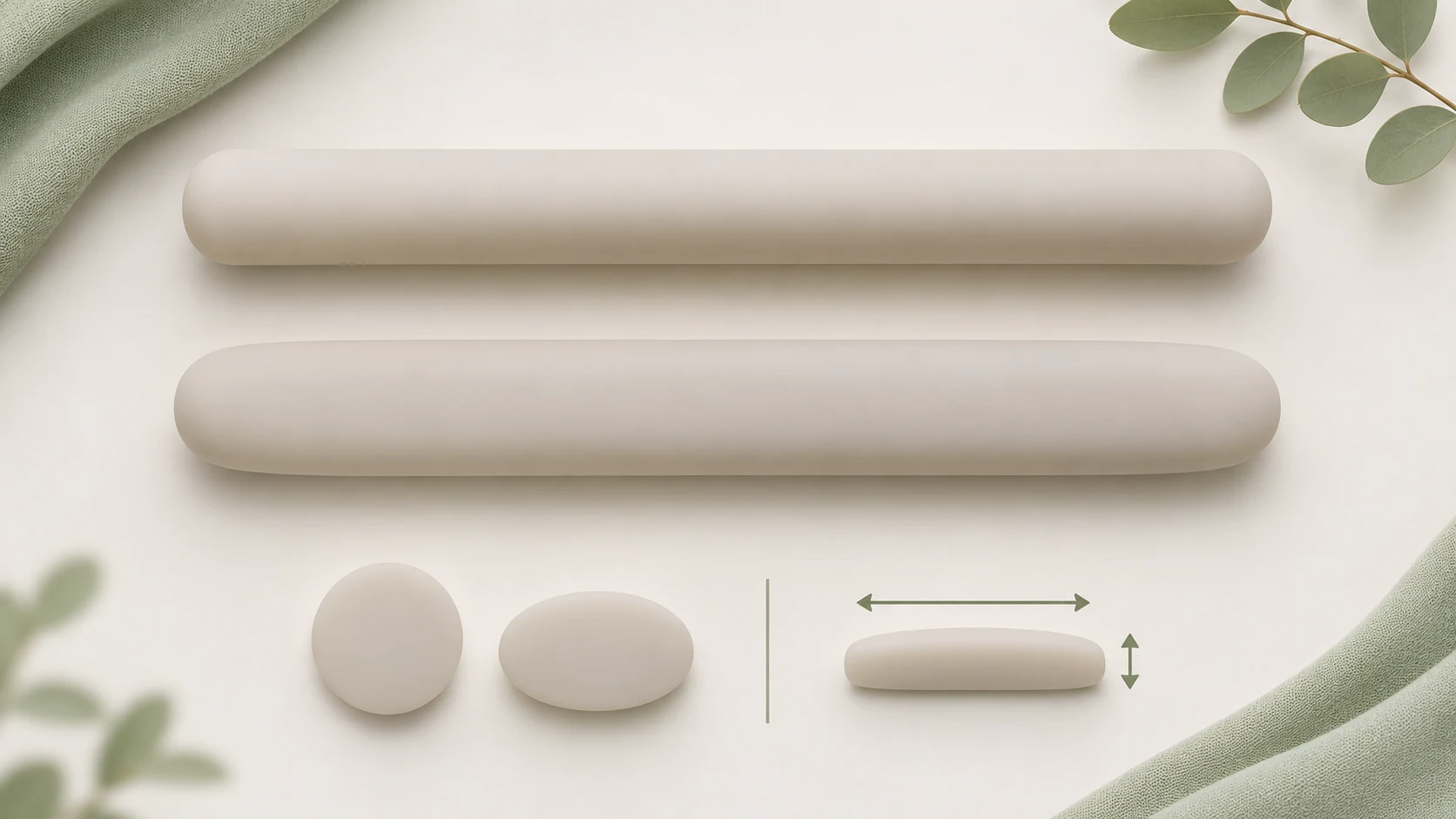
A round shaft has approximately the same width in every direction. An oval shaft does not. Viewed from the end, its cross-section is longer along one axis and shorter along the other.
- Width: the side-to-side distance across the shaft.
- Depth or thickness: the front-to-back distance across the same point.
- Circumference: the distance around the entire cross-section.
For a curved dildo, define “front” before measuring. A practical reference is the direction the head or curve faces. Then measure left-to-right for width and front-to-back for depth. A simple diagram can prevent confusion when comparing product pages.
If a listing gives only one number called “diameter,” check whether the shaft is actually round. For an oval dildo, that number may be the maximum width, which does not show how thin the shaft is along its other axis. Our dildo size guide explains how length, girth, and diameter are commonly presented; this guide adds the missing second axis for non-round shapes.
Measure at One Cross-Section at a Time
Dimensions only make sense when they refer to the same point. If width is taken at the head but depth is measured at mid-shaft, the pair does not describe a real cross-section and cannot be used to calculate an oval circumference.
Useful measurement points include:
- Widest part of the head
- Just below the head
- Upper shaft
- Mid-shaft
- Widest insertable section
- Lower shaft near the base
Keep the base separate from the insertable shaft. A flared or suction-cup base can be wider than the shaft, but it is not the shaft’s girth. For a tapered dildo, repeat the measurements at more than one point rather than using the widest number to describe the whole length.
How to Measure Width and Depth
- Let the dildo rest in a neutral position. Measure at room temperature and do not pull a curve straight or flatten the shaft against a table.
- Choose the point. Mark the cross-section you are measuring, such as mid-shaft or the widest insertable area.
- Measure width. Place a ruler, caliper, or measuring gauge across the left-to-right axis. Keep it perpendicular to the length of the shaft.
- Measure depth. At exactly the same point, measure from the front surface to the back surface.
- Use light contact. The measuring tool should touch the surface without indenting it. This matters especially with soft or compressible silicone.
- Repeat the reading. Take a second measurement and record the units. If the numbers differ, check whether the tool is angled or compressing the material.
For calipers, close the jaws only until they touch the surface. Do not squeeze to make the number settle. Pressure can make both dimensions appear smaller and can push soft material outward along the other axis.
How to Measure Circumference Directly
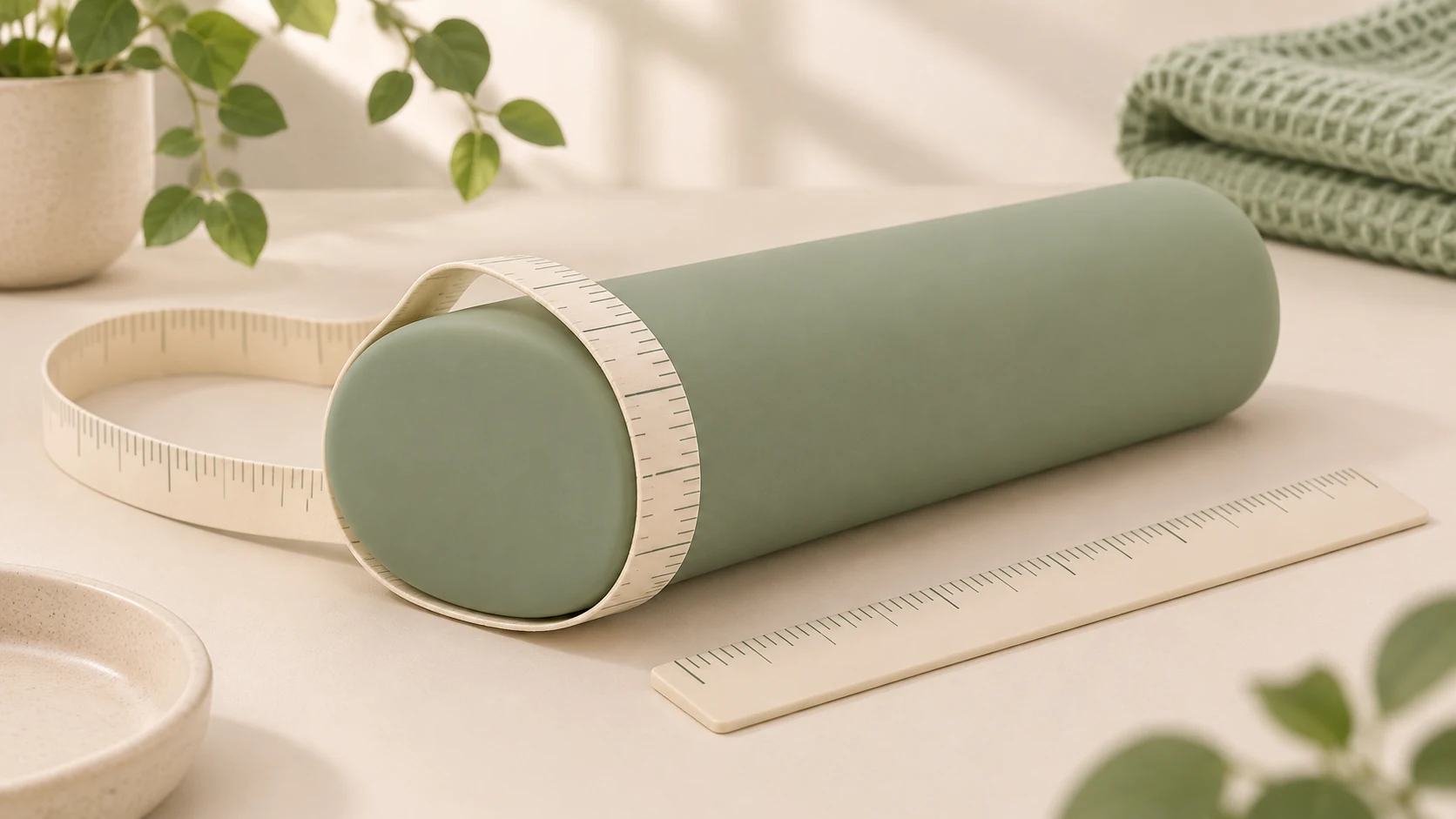
A flexible measuring tape is the simplest option for most shafts. Wrap it around the selected point, keep it perpendicular to the dildo’s length, and let it touch without compressing the material. Read where the tape meets itself and repeat once.
If you do not have a flexible tape, use a non-stretch string:
- Wrap the string around the shaft without pulling it tight.
- Mark where the end meets the standing part.
- Lay the string beside a ruler and measure the marked length.
Avoid elastic cord, which can stretch and give a misleading result. If the shaft has deep ridges or raised texture, note whether the tape follows the surface or bridges over the grooves. The method should be consistent across products being compared.
Why Width × 3.14 Is Not the Oval Circumference
The familiar formula circumference = diameter × π applies to a circle because every diameter through its center is the same. An oval has two different axes, so multiplying only its widest width by π treats it as a circle and can overstate the circumference.
For a smooth geometric ellipse, the perimeter does not have the same simple exact formula as a circle. One useful estimate is Ramanujan’s approximation:
C ≈ π × [3(a + b) − √((3a + b)(a + 3b))]
Here, a is half the full width and b is half the full depth. For example, an ideal oval measuring 1.90 inches wide by 1.30 inches deep has an estimated perimeter of about 5.07 inches. A round shaft 1.60 inches in diameter has a circumference of about 5.03 inches. Those estimates are close even though the profiles look and measure differently.
This calculation is for a smooth mathematical ellipse. A real dildo may have a flattened surface, asymmetry, a seam, or raised texture, so its actual circumference should be measured directly. Wolfram MathWorld summarizes the geometry of an ellipse and its perimeter approximations in its ellipse reference.
Optional Comparisons: Equivalent Diameter and Shape Ratio
Two additional calculations can help describe a profile, but neither replaces the measured width, depth, or circumference.
Equivalent circular diameter
For a true ellipse, a circle with the same cross-sectional area has a diameter of:
Equivalent diameter = √(width × depth)
With a width of 1.90 inches and depth of 1.30 inches, the equal-area diameter is about 1.57 inches. This is an area comparison only. Do not list it as the dildo’s actual diameter, because the oval remains 1.90 inches wide along its longest axis.
Width-to-depth ratio
Divide width by depth to describe how oval the cross-section is:
Width-to-depth ratio = width ÷ depth
- 1.60 ÷ 1.60 = 1.00: approximately round
- 1.70 ÷ 1.50 = 1.13: slightly oval
- 1.90 ÷ 1.30 = 1.46: more noticeably oval
The ratio describes shape, not total girth. A ratio of 1.46 does not tell a buyer whether the dildo is small or large without the underlying dimensions.
Example Measurement Record
The figures below are mathematical estimates for ideal elliptical cross-sections, included to show how dimensions can be recorded. They are not measurements of a specific dildo. Measure a real product with a tape, especially if it has texture or an irregular profile.
| Measurement point | Width | Depth | Estimated ellipse perimeter |
|---|---|---|---|
| Head | 1.70 in | 1.40 in | ≈ 4.88 in |
| Upper shaft | 1.60 in | 1.30 in | ≈ 4.57 in |
| Mid-shaft | 1.80 in | 1.35 in | ≈ 4.97 in |
| Widest insertable point | 1.90 in | 1.30 in | ≈ 5.07 in |
| Lower shaft | 1.65 in | 1.30 in | ≈ 4.65 in |
For a product page, state where each measurement was taken and whether it includes raised texture. A useful listing gives width, depth, and circumference at the widest insertable point, plus measurements at other locations if the shaft changes substantially.
How Shape, Firmness, and Orientation Affect Comparison
Circumference tells you how far around the shaft measures, but it does not show how that size is distributed. A round shaft remains similar after rotation. An oval shaft presents its broader axis in a different direction when it turns.
Firmness also affects how stable a profile remains during measurement and use. A soft dildo may compress under a caliper or tape, so its listed dimensions should be understood as unloaded measurements. Read our guide to choosing dildo firmness or the Shore hardness guide for more on how firmness and flexibility differ.
If the dildo is curved, textured, or asymmetrical, orientation may matter. A handle or harness can keep the wide axis facing a particular direction; a loose circular O-ring may allow the shaft to rotate. Check lower-shaft width and depth rather than matching a harness to the head’s widest measurement. If the dildo shifts during use, see why a dildo may slip or shift.
Common Measurement Mistakes
- Calling the maximum width “diameter” without qualification. That implies a round shaft and hides the narrower axis.
- Measuring width and depth at different points. The two numbers must describe one cross-section.
- Pulling the tape tight. This can compress a soft shaft and understate its circumference.
- Squeezing with calipers. Touch the surface; do not indent it.
- Including the base. A flared or suction-cup base is separate from the insertable shaft.
- Ignoring texture. Explain whether raised veins, ridges, or knots are included in the maximum dimensions.
- Using an estimated value as a physical measurement. Mathematical ellipse estimates do not account for irregular real-world surfaces.
- Comparing mismatched points. Measure both dildos at the head, mid-shaft, or widest insertable section—not one point on one dildo and another point on the second.
Frequently Asked Questions
Can an oval dildo have the same circumference as a round dildo?
Yes. A round shaft about 1.60 inches in diameter measures roughly 5.03 inches around. An ideal oval measuring 1.90 by 1.30 inches has an estimated perimeter of about 5.07 inches. The circumferences are similar, but the widths and depths differ.
Is the widest measurement the dildo’s diameter?
It is the maximum width or major axis. Calling it simply “diameter” can mislead buyers if the shaft is oval. List width and depth separately.
How do I measure circumference on a very soft dildo?
Support the dildo in a neutral position and use a flexible tape or non-stretch string with light contact. Do not pull tightly. Record that the measurement is unloaded and approximate.
Does equivalent diameter predict how the dildo will feel?
No. It compares the cross-sectional area of an ideal oval with an equal-area circle. It does not preserve maximum width, depth, orientation, firmness, texture, or individual preference.
Should a retailer publish all three measurements?
For an oval or irregular shaft, width, depth, and circumference are the clearest set. The listing should also identify the point measured and whether texture is included.
Compare the Whole Profile
An oval dildo is not accurately summarized by one diameter. Measure width and depth at the same shaft point, then measure circumference directly if you can. Repeat at the head, mid-shaft, and widest insertable section when the shape changes.
Use equivalent diameter and width-to-depth ratio only as supporting comparisons. For a buying overview, continue with our dildo size guide, then compare available dildo shapes and designs using dimensions that describe the actual profile.