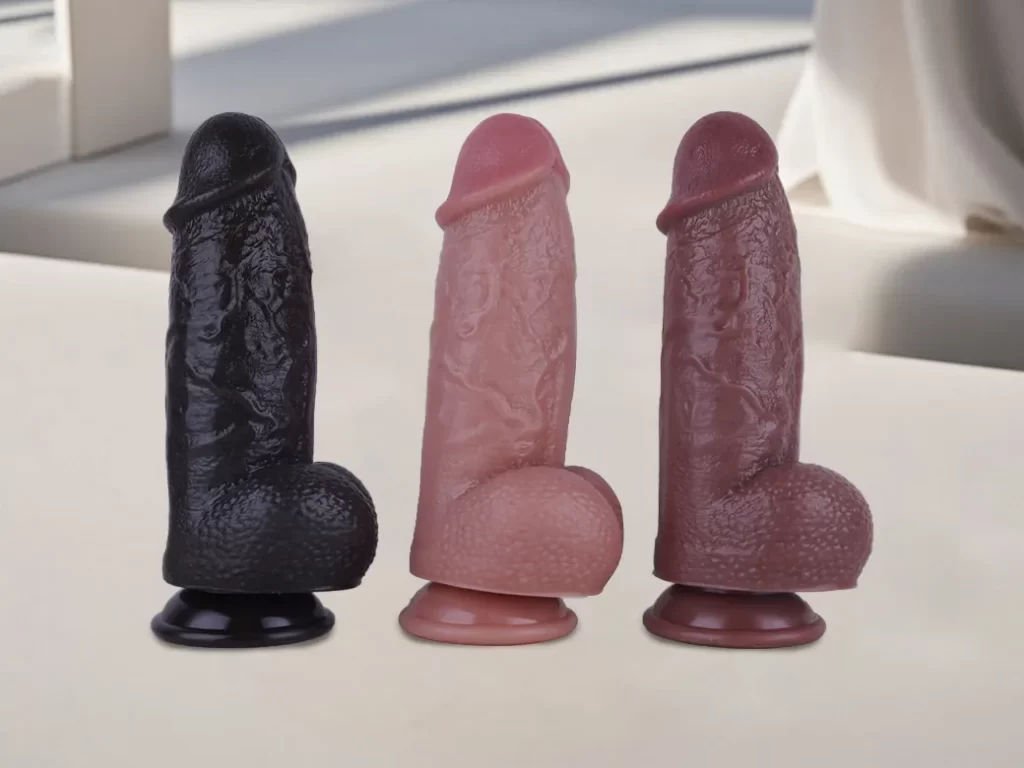


Quick Answer: Soft or Firm?
A soft dildo compresses and flexes more under pressure, which can create a gentler, more forgiving feel. A firm dildo keeps its shape, giving more direct pressure and precise control. Neither is universally more comfortable: the best choice depends on the size, shape, material, intended use, and the kind of sensation you prefer. If you are unsure, a medium-firm design is often a practical middle ground.
Use this guide to compare soft vs. firm dildos, understand what product descriptions do—and do not—tell you, and choose a firmness that feels manageable for your body.
What Does Dildo Firmness Mean?
Firmness describes how much a toy compresses when you press it. Flexibility describes how much it bends. These qualities are related, but they are not identical: a slim toy may bend even if its silicone feels firm, while a thicker design may resist bending despite a softer surface.
Product labels such as “soft,” “medium,” and “firm” are useful starting points, but they are not a universal rating system. Construction, wall thickness, shape, and core design all influence the feel. Some silicone toys use a softer outer layer over a firmer core, often called dual density.
If a listing gives a Shore hardness or durometer number, check the scale and what part of the material was measured. A number alone does not tell you how flexible the complete toy will feel. Read our guide to what Shore hardness means for dildos for a closer explanation.
Soft Dildos: Flexible and Forgiving
A soft dildo compresses more readily and may flex during use. Some people like the cushioned, yielding sensation, especially when they prefer gentle pressure or want a toy that adapts more easily to movement.
When a soft dildo may suit you
- You prefer a more yielding feel instead of concentrated pressure.
- You want extra flexibility for certain positions or angles.
- You enjoy realistic-style designs that move with the body.
- You are comparing toys of similar size and want the one that gives more under pressure.
Possible trade-offs
A very soft dildo may bend more than you want, making positioning or directional pressure less predictable. Softness also does not make a large diameter automatically comfortable. If a toy feels difficult to insert, consider its size, shape, pace, arousal, and lubrication as well as its firmness. See our guide to why a soft dildo can still be difficult to insert.
Firm Dildos: Stable and Precise
A firm dildo resists compression and holds its shape more consistently. That can make it easier to guide, position, or use when you prefer clear, direct pressure. Firm silicone remains somewhat different from rigid materials such as glass or stainless steel; check the product’s material and care instructions rather than assuming every “firm” toy feels the same.
When a firm dildo may suit you
- You want a toy that holds its shape during movement.
- You prefer more focused pressure or controlled positioning.
- You use a harness or a suction-cup base and value stability.
- You already know you enjoy a less yielding sensation.
Possible trade-offs
A firm toy can feel intense because it does not cushion pressure as much. A size or shape that feels comfortable in a soft design may feel more demanding in a firmer one. Start slowly, use lubricant, and pause if you feel pain, numbness, or persistent discomfort.
Soft vs. Firm Dildos at a Glance
| Feature | Soft dildo | Firm dildo |
|---|---|---|
| Compression | Gives more when pressed | Gives less when pressed |
| Flexibility | Often bends more, depending on shape and core | Often holds its shape more consistently |
| Sensation | May feel cushioned or yielding | May feel direct or focused |
| Control | Can feel less precise if very flexible | Can feel easier to position and guide |
| A useful first question | “Do I want more give?” | “Do I want it to keep its shape?” |
How to Choose the Right Firmness for You
1. Start with the sensation you want
Think about whether you prefer a cushioned feel or a more direct one. “Soft” does not always mean comfortable and “firm” does not always mean intense; those are preferences to test against a toy’s size, shape, and design.
2. Consider size and shape at the same time
Diameter, insertable length, tip shape, and curves can affect comfort as much as firmness. If you are new to using dildos or trying a new size, a manageable diameter and gradual pacing can make the experience easier to adjust to. Our dildo firmness buying guide offers a broader overview of firmness levels and selection factors.
3. Think about how you will use it
For hands-free or harness use, a firmer shaft may be easier to direct, though the base and harness fit matter too. A suction cup needs a compatible, clean, smooth surface and a secure seal; firmness by itself does not guarantee that it will stay attached.
4. Read the full product description
Look for the material, dimensions, care guidance, and details about the toy’s construction. Do not treat a firmness label or hardness number as proof that a product is body-safe. For insertable toys, choose a clearly identified body-safe material and follow the manufacturer’s cleaning instructions.
5. If possible, compare the toy gently
For an in-store sample or a toy you already own, press the shaft gently between your fingers and notice how much it yields. Do not bend, twist, or stretch a toy beyond its care instructions. This simple comparison can help describe flexibility, but it cannot identify the material, reveal hidden damage, or certify safety.
Does Material Change How Firm a Dildo Feels?
Yes. Silicone formulations vary, and a silicone dildo may be soft, medium, firm, or dual density. Other materials have their own feel: glass and stainless steel are rigid, while some elastomer blends are more flexible. Compare toys within the same material when you can, and check the product’s material information instead of relying on appearance or marketing language alone.
For toys that go inside the body, Planned Parenthood recommends body-safe, nonporous materials such as 100% silicone, hard plastic, stainless steel, or break-resistant glass. It also advises using water-based lubricant as a broadly compatible option and checking toy instructions before pairing silicone toys with silicone lubricant. Read its sex toy safety and care guidance.
Comfort and Safety Tips for Any Firmness
- Wash the toy before and after use according to its manufacturer’s instructions.
- Use enough lubricant for comfort; water-based lube is compatible with most toy materials.
- Inspect the surface and base before each use. Stop using a toy with cracks, tears, sticky or unusual changes, or other signs of damage.
- For anal use, choose a toy with a flared base or another secure retrieval feature, and use plenty of lubricant. A toy without a suitable base can slip inside and become difficult to remove.
- If sharing a toy, clean it between users or use a new condom on the toy for each person and each body area.
- Stop if you feel pain or irritation. Firmness is a preference, not something to push through.
These points apply whether a dildo is soft or firm. A softer material does not replace good hygiene, and a firmer material does not automatically make a toy more durable or safer.
Common Questions
Are soft dildos better for beginners?
Some beginners like the extra give of a soft dildo, while others prefer the steadier control of a medium or firm design. A moderate size, comfortable shape, enough lubricant, and a slow pace may matter more than choosing the softest option.
Is a firm dildo uncomfortable?
Not necessarily. Some people prefer its stable shape and direct pressure. Comfort depends on the individual, the toy’s size and shape, lubrication, and how it is used. Choose a different option if the sensation is unpleasant.
Does a soft dildo bend too much?
It can, especially if it is very flexible or has a narrow shaft. Check product descriptions for core construction and look for customer photos or demonstrations when available. Remember that shape and length also affect bending.
What is the best all-around firmness?
There is no single best firmness. Many shoppers start with a medium-firm design because it balances some give with shape retention, but your preferred feel may be softer or firmer.
Can I make a firm dildo softer by heating it?
Do not heat a dildo to change its firmness unless the manufacturer specifically says that the product is designed for that. Heat can damage some materials or finishes. Choose the intended firmness when buying and follow the care instructions.
Final Takeaway
Choose a soft dildo if you want more compression and flexibility; choose a firm dildo if you want a shape that stays steady and delivers more direct pressure. If you are between the two, compare moderate or dual-density designs, then weigh size, shape, material, and intended use together. The right firmness is the one that feels comfortable and controllable for you.