


Quick Answer
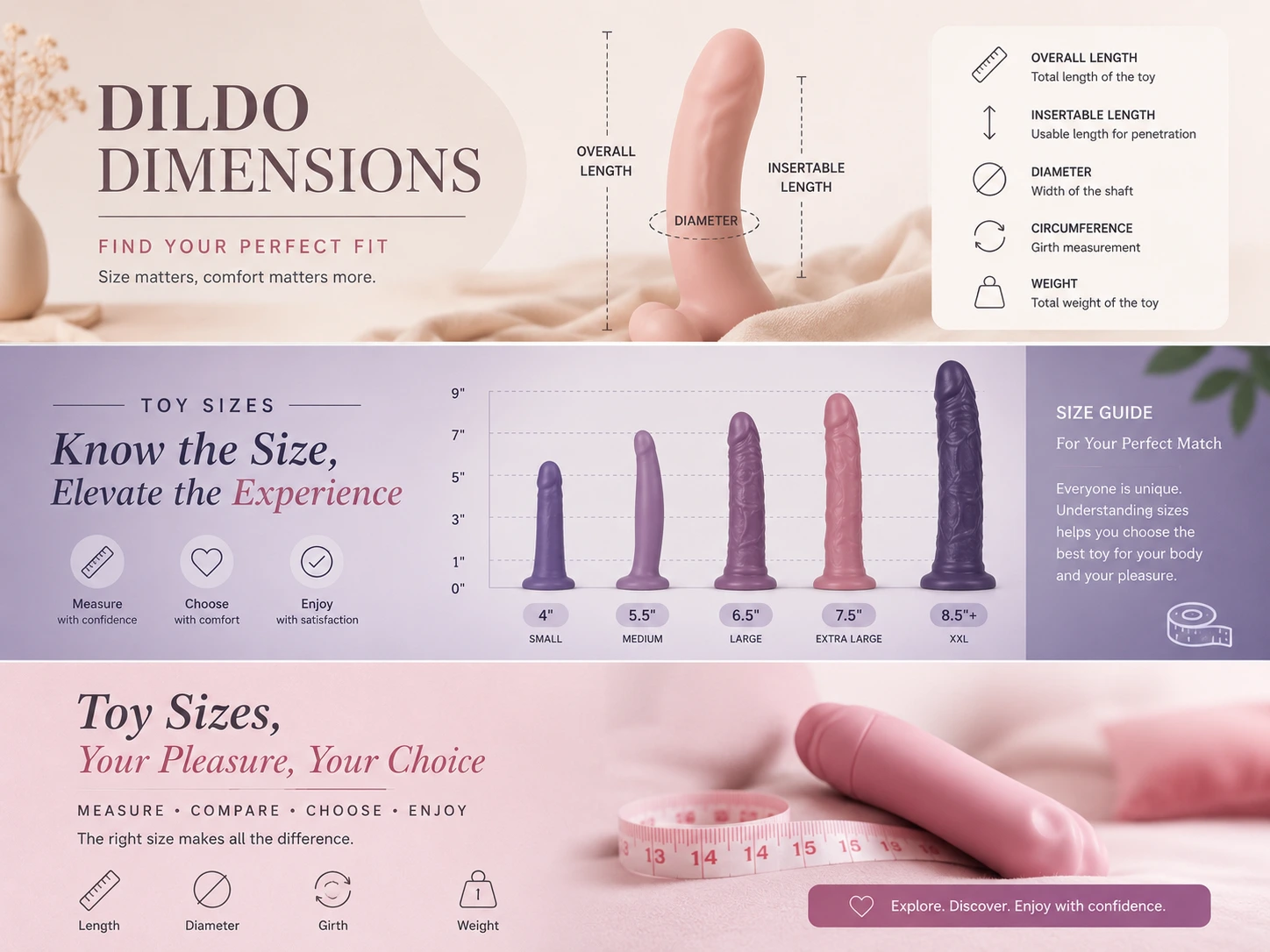
When comparing dildos, the numbers that matter most are insertable length and diameter—not the total length shown in product photos. Total length includes the base and any non-insertable portion of the toy, while insertable length measures the part designed to be used. Diameter determines how full the toy feels and often has a greater influence on comfort than length.
Understanding these measurements makes it much easier to choose a dildo that matches your experience level and expectations.
Why Product Dimensions Can Be Confusing
Shopping online has one major disadvantage:
You can’t hold the toy in your hands.
That means the only way to judge size is through the specifications provided on the product page.
Unfortunately, many buyers focus on a single number—usually the total length—without realizing that it doesn’t tell the whole story.
A dildo listed as 8 inches long may only provide 6 inches of insertable length because the remaining section consists of the base or suction cup.
Learning how to interpret dildo dimensions helps prevent surprises after your purchase arrives.
Total Length vs. Insertable Length
These two measurements are often confused, but they describe different things.
Total Length
Total length measures the dildo from the tip to the very end of the base.
This includes:
- Suction cups
- Flared bases
- Decorative handles
- Any portion not intended for insertion
Manufacturers include total length because it reflects the complete physical size of the product.
However, it doesn’t necessarily indicate how the toy will feel during use.
Insertable Length
Insertable length measures only the portion designed to enter the body.
For most buyers, this is the specification that deserves the most attention.
A realistic example might look like this:
- Total Length: 8 inches
- Insertable Length: 6 inches
Although the toy appears quite large in product photos, the usable portion is considerably shorter.
This explains why two dildos with the same total length can feel very different in practice.
Why Diameter Often Matters More Than Length
When beginners compare products, they usually look at length first.
Experienced buyers often do the opposite.
That’s because diameter has a much greater influence on how full a toy feels.
A 6-inch dildo with a diameter of 1.25 inches can feel completely different from another 6-inch dildo measuring 1.75 inches in diameter.
Even though the length is identical, the increase in width changes the overall experience much more noticeably.
If comfort is your priority, paying close attention to diameter is often more important than adding another inch of length.
Understanding Diameter and Circumference
Some manufacturers list diameter, while others use circumference.
Although they’re related, they describe different measurements.
Diameter
Diameter measures the distance straight across the widest part of the shaft.
This is the easiest specification for most buyers to compare.
For example:
- 1.2 inches
- 1.4 inches
- 1.6 inches
- 1.8 inches
Small changes in diameter can create surprisingly noticeable differences in fullness.
Circumference
Circumference measures the distance around the shaft.
Because it’s a larger number than diameter, it sometimes makes products appear bigger than buyers expect.
If you’re comparing multiple dildos, including ejaculating dildos, luminous dildos, monster dildos, it’s helpful to convert all measurements to the same format whenever possible so you’re making accurate comparisons.
Typical Size Ranges
While personal preference always varies, these general ranges provide a useful starting point.
| Experience Level | Insertable Length | Diameter |
|---|---|---|
| Beginner | 5–6 inches | 1.25–1.4 inches |
| Intermediate | 6–7 inches | 1.4–1.6 inches |
| Experienced | 7+ inches | 1.6 inches and above |
These aren’t strict rules—they’re simply common starting points that can make narrowing your options easier.
Editor’s Insight
One of the most common shopping mistakes is assuming a long dildo will automatically provide a more intense experience.
In reality, we’ve found that diameter has a much greater impact on perceived fullness, while insertable length determines how much of the dildos can be comfortably used. Buyers who understand this distinction usually make more satisfying purchases and are less likely to end up with a toy that feels significantly different from what they expected.
How to Compare Dildo Measurements Across Different Products
One challenge many shoppers encounter is that not every manufacturer measures products in exactly the same way.
Some brands clearly separate total length from insertable length, while others only provide one measurement. Likewise, some list diameter, while others use circumference instead.
Because of these differences, comparing products requires a little more than simply looking at the largest number on the page.
Start With Insertable Length
If a product includes insertable length, make that your primary point of comparison.
Imagine two products:
Product A
- Total Length: 8.5 inches
- Insertable Length: 6 inches
Product B
- Total Length: 7 inches
- Insertable Length: 6.2 inches
Although Product A appears larger at first glance, Product B actually offers slightly more usable length.
This is why insertable length is usually the specification that matters most during everyday use.
Compare Diameter Before Total Length
After confirming insertable length, the next specification to compare is diameter.
Many buyers discover that increasing diameter by just 0.2 inches creates a much more noticeable difference than increasing length by a full inch.
For example:
| Insertable Length | Diameter | Likely Experience |
|---|---|---|
| 5.5 in | 1.25 in | Moderate fullness with manageable dimensions |
| 5.5 in | 1.50 in | Noticeably fuller while maintaining the same usable length |
| 6.5 in | 1.25 in | Additional reach with similar overall fullness |
This illustrates why two toys of nearly identical length can feel very different.
How Different Designs Affect Measurements
Measurements don’t exist independently from design.
The shape of the toy influences how those numbers translate into real-world use.
Realistic Dildos
Realistic models often include:
- A pronounced glans
- Veins
- Gradual tapering
- Sculpted anatomical details
Because of these features, the widest point may not extend across the entire shaft.
Many buyers find that realistic dildos feel approachable even when the listed maximum diameter appears relatively large, since the toy often widens gradually rather than maintaining the same thickness throughout.
Fantasy Dildos
Fantasy designs vary much more dramatically.
Some feature segmented shafts, knots, ridges, or sculpted curves that create multiple points of varying diameter.
When evaluating fantasy dildos, don’t focus exclusively on the maximum width.
Instead, consider how the overall shape changes from tip to base. A gradual progression often feels very different from a toy that reaches its widest point immediately.
Glass and Stainless Steel Dildos
Rigid materials create another important consideration.
Because glass and stainless steel don’t compress during use, their listed diameter represents exactly what you’ll experience.
With flexible silicone, slight compression can soften the perceived fullness.
With rigid materials, the measurements tend to feel more direct and more precise.
Expert Buying Tips
After reviewing countless product pages, one habit consistently separates confident buyers from disappointed ones:
They compare measurements—not marketing photos.
Photography can make dildos appear much larger or much smaller depending on camera angle, lighting, and perspective.
The specifications tell a much more reliable story.
Before purchasing, compare:
- Insertable length
- Diameter
- Material
- Firmness
- Overall shape
Following this order usually provides a much clearer understanding of how one dildo differs from another.
Common Measurement Mistakes
Looking Only at Total Length
The largest number on the product page is often the least useful.
A long suction cup base may increase the total length significantly without adding any insertable length.
Always look beyond the headline specification.
Ignoring Diameter
Many buyers underestimate how much diameter influences comfort.
Adding half an inch of insertable length may produce only a subtle difference.
Increasing diameter by a quarter of an inch, however, often creates a much more noticeable change in fullness.
Comparing Different Measurement Systems
Some manufacturers publish dimensions in inches, while others use centimeters.
Likewise, some list diameter and others list circumference.
Whenever possible, convert measurements into the same unit before comparing products. This helps ensure you’re making an accurate, like-for-like comparison instead of relying on inconsistent specifications.
Editor’s Insight
One habit we’ve developed when reviewing products is to ignore the product photos during our first comparison.
Instead, we begin with the specification table.
Insertable length, diameter, material, firmness, and weight reveal far more about how a dildo is likely to perform than promotional images ever can. Once you understand how to interpret those numbers, comparing products becomes faster, easier, and far more accurate.
Frequently Asked Questions
Which measurement should I pay the most attention to?
For most buyers, insertable length and diameter are the two specifications that matter most.
Insertable length tells you how much of the dildo is designed to be used, while diameter has the greatest influence on how full the toy feels.
Total length is still useful, but it shouldn’t be the deciding factor when comparing products.
Why does my dildo feel different from the listed measurements?
Measurements describe the physical dimensions of a dildo, but they don’t tell the whole story.
Several other factors influence how a dildo feels during use, including:
- Material
- Firmness
- Shape
- Surface texture
- Tapered or rounded tip
- Overall weight
For example, two silicone dildos with the same insertable length and diameter can still provide noticeably different experiences if one is dual-density and the other is solid silicone.
Think of dimensions as the starting point rather than the complete picture.
Is insertable length always shorter than total length?
Yes, in almost every case.
Insertable length excludes parts of the toy that aren’t intended for insertion, such as:
- Suction cups
- Flared bases
- Decorative handles
- Safety bases
This is why a dildo advertised as 8 inches long may provide only 6 inches of insertable length.
Is diameter more important than circumference?
Neither measurement is inherently more important—they simply describe size in different ways.
However, diameter is generally easier to visualize and compare between products.
If a manufacturer only provides circumference, converting it to diameter can make product comparisons much simpler.
Should beginners focus on length or diameter?
For most beginners, diameter deserves slightly more attention.
A moderate insertable length paired with an appropriate diameter usually creates a more comfortable experience than choosing a very long toy with excessive width.
This is one reason many beginner-friendly dildos stay within a relatively modest diameter range while offering sufficient insertable length for versatility.
Do fantasy dildos use measurements differently?
The basic measurements are the same, but fantasy designs often include curves, ridges, knots, or segmented shafts.
As a result, the maximum diameter may only occur at one specific point rather than across the entire shaft.
When shopping for fantasy dildos, it’s helpful to look beyond the largest measurement and consider how the shape changes from tip to base.
Editor’s Recommendation
If we could offer just one piece of shopping advice, it would be this:
Stop comparing the biggest number on the page.
Instead, compare products in the following order:
- Material
- Insertable length
- Diameter
- Firmness
- Shape
- Special features (such as a suction cup or dual-density construction)
Following this sequence provides a much more realistic picture of how a toy will actually perform.
Many experienced buyers spend less time looking at promotional photos and more time studying the specifications. Once you adopt the same habit, choosing between products becomes much easier—and you’re far less likely to be surprised when your order arrives.
Final Verdict
Learning how to read dildo dimensions is one of the most valuable skills you can develop when shopping online.
While total length often receives the most attention, insertable length and diameter are usually the measurements that have the greatest impact on real-world use. Understanding the difference between these specifications allows you to compare products more accurately and choose a toy that better matches your expectations.
It’s equally important to remember that dimensions are only one part of the buying decision. Material, firmness, shape, and overall design all work together to determine how a dildo feels. A well-designed toy with moderate dimensions often provides a far better experience than a larger product chosen solely because of impressive numbers.
Before making your next purchase, take a few extra moments to read the full specification table instead of relying only on product photos. A better understanding of insertable length, diameter, and construction will help you shop with greater confidence, avoid common sizing mistakes, and build a collection that’s genuinely suited to your preferences.