


A five-star average looks reassuring, but it cannot tell you whether a dildo’s size will suit you, whether the listing shows the correct version, or whether the reviewer tried the same material and firmness you are considering. A one-star comment can be equally hard to interpret: it may describe a genuine defect, a shipping problem, a mismatch in expectations, or a product that simply did not fit that person.
Use reviews as clues about a specific buyer’s experience, then compare those clues with the product details. This guide is about reading reviews for one dildo listing. For broader questions about a company’s record and customer support, see our dildo brand evaluation guide.
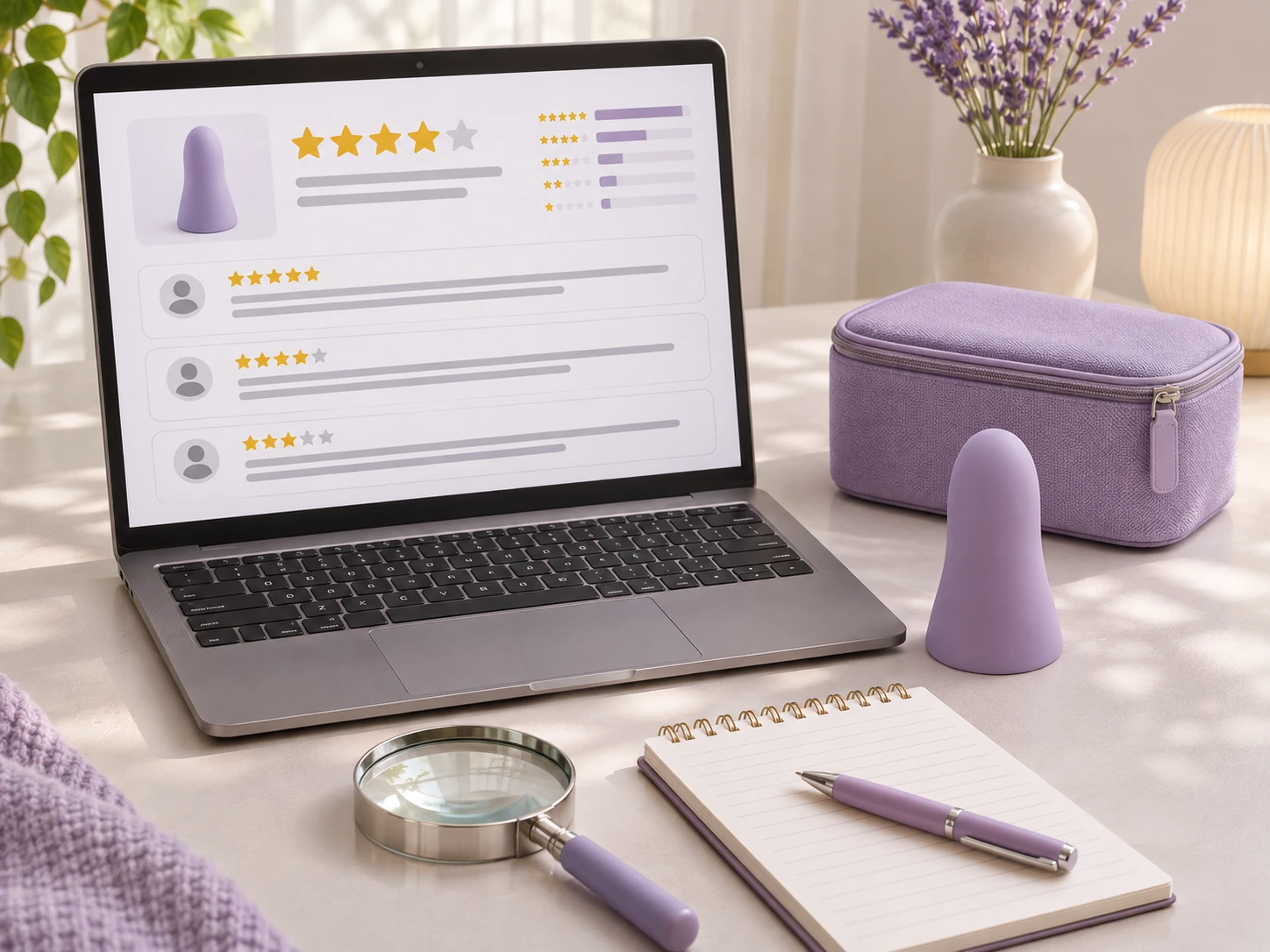
What a star rating can—and cannot—tell you
A star average compresses many individual opinions into one number. It can give you a quick sense of how reviewers rated a listing overall, especially when there are enough relevant, recent reviews to compare. It does not show why people chose those ratings, whether reviews refer to the same variant, or whether the most important information for your needs appears in the comments.
| Review signal | It may help you understand | It cannot establish by itself |
|---|---|---|
| Average rating | How submitted ratings lean overall | Material quality, safety, or personal fit |
| Number of ratings | How much feedback is available on that listing | Whether those ratings concern the selected version |
| Rating distribution | Whether views are mixed or clustered at the extremes | Why each buyer rated the dildo that way |
| Written comments | Specific experiences with size, firmness, care, or function | That the same experience will apply to every buyer |
| “Verified purchase” label | That a platform has attached its purchase-related label | That the comment is complete, unbiased, or representative |
The U.S. Federal Trade Commission advises shoppers to consider the source, read reviews from multiple places, check when they were posted, and avoid relying on star ratings alone. It also cautions that a suspicious-looking review is not automatically fake, and a convincing-looking one is not proof of authenticity. Read the FTC’s guide to evaluating online reviews for general shopping advice.
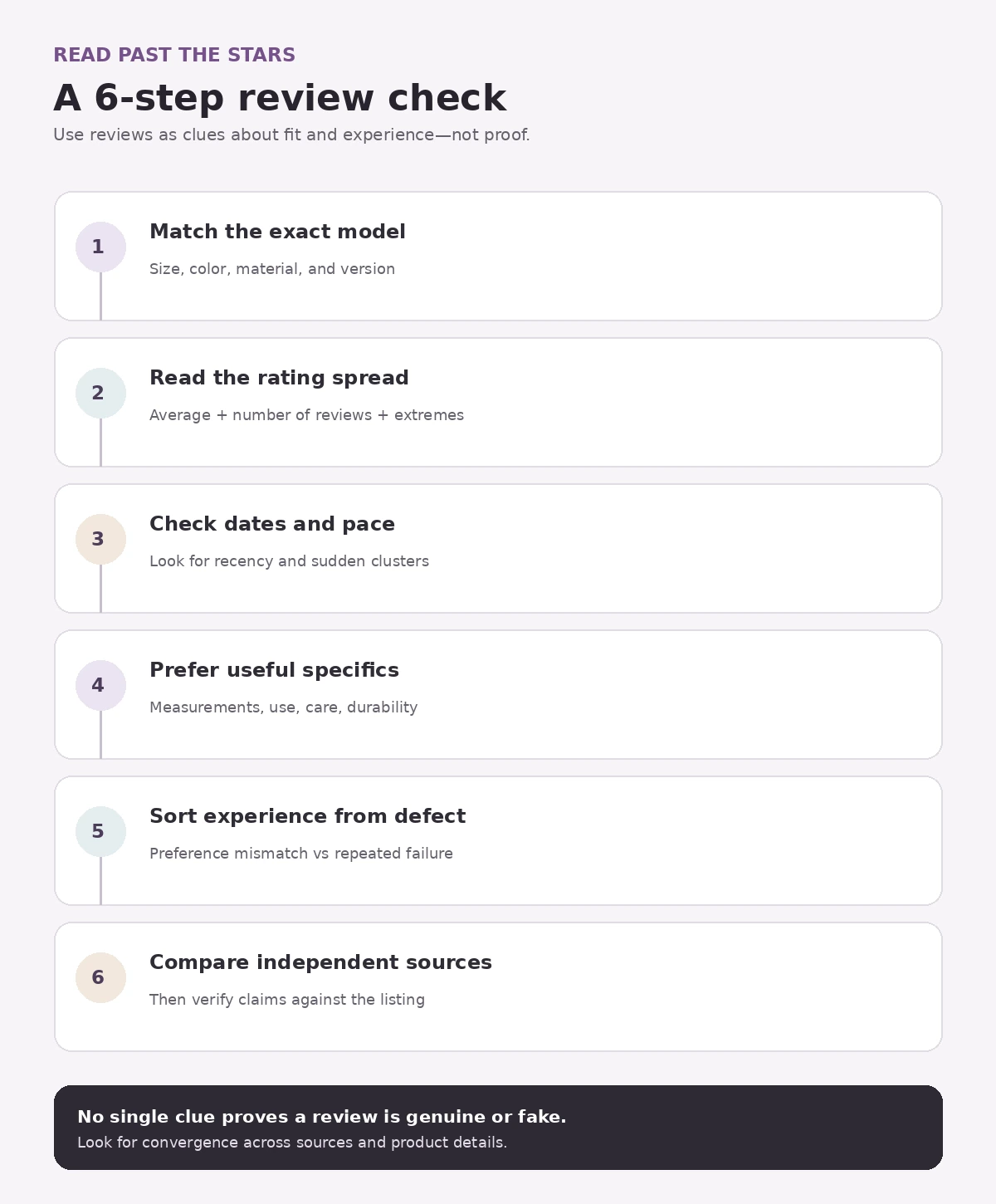
Read the listing and review page in six passes
1. Confirm the reviews match the exact dildo
Before reading the comments, check whether the review page combines several sizes, colors, materials, or product versions. A rating may cover a family of options, even when one variant differs in firmness, dimensions, construction, or intended use. Reviews about a small size cannot reliably answer questions about a larger one, and feedback about a powered model may not apply to a manual version.
Look for the reviewer’s selected size or model in the review itself, in a drop-down label, or in the product title shown beside the comment. If the page does not make that clear, treat the total as feedback about the listing group—not necessarily the exact dildo you plan to order.
2. Look beyond the average to the distribution
Two listings can show the same average while representing very different experiences. One may have mostly four- and five-star reviews; another may have a large group of high ratings and a meaningful cluster of low ones. The spread can tell you where to look next, but it does not diagnose the cause.
Read a sample of high, middle, and low ratings. A four-star comment may explain a useful trade-off that a five-star comment skips. A low rating may identify a recurring issue—or only a preference mismatch. Do not treat the highest or lowest score as the definitive verdict.
3. Check when reviews appeared
Dates help you see whether feedback is current and whether a listing’s history has changed. A recent cluster of reviews can happen for ordinary reasons, such as a sale, product launch, or batch of customers receiving orders at once. It can also be a reason to look more closely at the timing, wording, reviewer histories, and whether the comments actually describe the dildo.
Older reviews may refer to an earlier design, a different seller, or a previous version of the listing. Compare dates with any model updates or changes described on the product page. A long history is useful only when you can tell which version reviewers experienced.
4. Favor specific observations over generic praise
The most useful comments connect a feature to an experience. Look for details about the selected size, firmness, texture, weight, base, flexibility, cleaning, or how the dildo matched its measurements. Useful critical reviews do the same: they explain what did not work and under what conditions.
Short comments such as “love it,” “amazing,” or “not for me” may be sincere, but they provide little evidence for your decision. Repeated wording across many comments can be worth noticing, though identical or enthusiastic language alone does not prove manipulation. The FTC notes that it can be difficult to determine authenticity just by looking.
5. Separate preference differences from product problems
Not every negative review points to a defect. A dildo may feel firmer, softer, larger, smaller, more textured, or heavier than a reviewer prefers while still matching its stated specifications. Another buyer may dislike a shape that works well for someone else. These comments are most helpful when you compare the reviewer’s expectations with your own.
Repeated reports about a concrete issue deserve closer attention: for example, a base that repeatedly fails to stay attached, a charging control that stops working, a surface that arrives damaged, or dimensions that differ from the listing. Look for the same specific problem across independent reviews and check whether the seller or manufacturer has addressed it. A single report can still matter, but it does not show how common the problem is.
6. Note labels, incentives, and reviewer history
Some platforms identify a verified purchase or disclose that a reviewer received a discount or sample. Those labels give context, but they do not tell you whether the reviewer’s opinion is unbiased or whether the experience represents other buyers. An incentive is not automatically evidence that a review is false; the terms and disclosure matter.
If the platform shows a reviewer profile, a history of detailed feedback across different products can offer context. An account with one review is not proof of dishonesty, just as a long review history does not guarantee accuracy. Use these details as small clues, not as a pass-or-fail test.
Translate comments into questions you can verify
A review is most useful when it points you toward a concrete product detail. Before treating a comment as a conclusion, ask whether the listing or seller can confirm the underlying fact.
| Review comment | Question to investigate |
|---|---|
| “It was bigger than expected.” | Are total length, insertable length, and width shown clearly? |
| “It felt much firmer than I thought.” | Does the listing describe firmness or show a useful flexibility view? |
| “The suction did not hold.” | Does the page specify suitable surfaces and how to attach the base? |
| “It was hard to clean.” | Do texture, seams, openings, or construction require a specific care method? |
| “It stopped charging.” | Is this a powered model, and do several recent reviews mention the same fault? |
| “The product looked different.” | Are reviews combined across colors, versions, or sellers? |
Use the product page to verify dimensions, material, care instructions, and intended use. If reviews point to a detail the listing does not explain, ask the seller a specific question before buying. Our guide to checking dildo quality before buying covers the product information worth comparing with review claims.
When reviews disagree, look for the conditions
Mixed feedback does not always mean the reviews are unreliable. Buyers may have ordered different variants, used the dildo in different ways, or wanted different firmness and dimensions. One person’s “too soft” can be another person’s preferred flexibility. Try to identify the condition behind the opinion:
- Variant: Which size, color, material, or version did the buyer receive?
- Expectation: Was the reviewer reacting to a stated specification or to an assumption?
- Use: Does the comment refer to the function the dildo was designed for?
- Timing: Was the review posted after delivery, after repeated use, or much later?
- Support: If something failed, did the seller respond or provide a remedy?
For recurring brand-level issues—such as inconsistent specifications or repeated support complaints—compare more than one listing. Our brand evaluation guide looks at patterns across a company’s catalog and support history.
A practical “clear, check, pause” reading guide
| Reading | What you see | Next step |
|---|---|---|
| Clear signal | Several recent, model-specific comments describe concrete details that match the listing. | Use them to compare the dildo with your own preferences. |
| Needs a check | Reviews are combined across variants, or one important detail is missing. | Confirm the exact model or ask the seller before checkout. |
| Pause | Multiple independent comments report the same serious issue, or review claims conflict with the listing. | Look for a seller response and clearer information before deciding. |
This is a way to organize uncertainty, not a system for labeling reviews as genuine or fake. No single rating, phrase, or reviewer profile can prove that on its own.
A five-minute review routine
- Write down the exact model and variant you are considering.
- Check how many ratings there are and how the scores are distributed.
- Read a few recent high, middle, and low reviews that name the same variant.
- Note repeated, specific comments about measurements, material, finish, use, or durability.
- Compare those points with the listing, care directions, and seller policies.
- If an important claim remains unclear, contact the seller or compare another listing.
For more help writing a useful review after your own purchase, see how to write a helpful dildo review. A well-written review gives future buyers context—such as the exact variant, what the reviewer expected, and which specific details shaped their rating.
Frequently asked questions
Are five-star dildo reviews trustworthy?
Some are useful and sincere; some may be incomplete or misleading. Read the content, check the exact variant and date, and compare with other sources. A five-star rating alone cannot verify the reviewer’s experience.
Does “verified purchase” mean a review is unbiased?
No. It indicates that the platform has attached a purchase-related label under its own process. It does not establish that the reviewer’s opinion is representative, detailed, or free from other influences.
Should I ignore a product with a few negative reviews?
Not automatically. Look at what the comments describe and whether the same concrete issue appears repeatedly. A preference mismatch is different from multiple reports of a similar functional problem.
Can I tell for certain if an online review is fake?
Usually not from the text alone. Timing, wording, reviewer history, and disclosure can provide context, but none is decisive by itself. Use multiple sources and verify factual claims against the listing or seller.
How many reviews are enough to judge a dildo?
There is no universal number. A small group of detailed, relevant reviews may be more useful than many short ratings that combine different variants. Focus on how well the available feedback matches the exact model you are considering.
Use the rating as a starting point
Star ratings can help you decide where to look, but the written experiences explain what the number leaves out. Match reviews to the exact variant, weigh specific repeated observations more heavily than generic praise, and check claims against the product page. That approach turns customer feedback into practical evidence while leaving room for individual preferences to differ.