


A fine line running along a dildo can look like a crack in a close-up photo. In many molded designs, however, a faint, smooth line is simply where mold sections met. The useful distinction is not whether you can see a line; it is whether the surface stays closed, even, and smooth, or shows a gap, sharp flash, peeling layer, or change in material.
This guide helps you inspect seams and mold lines without damaging the surface. It separates common manufacturing marks from issues worth documenting and reporting, while recognizing that construction varies by material and model.
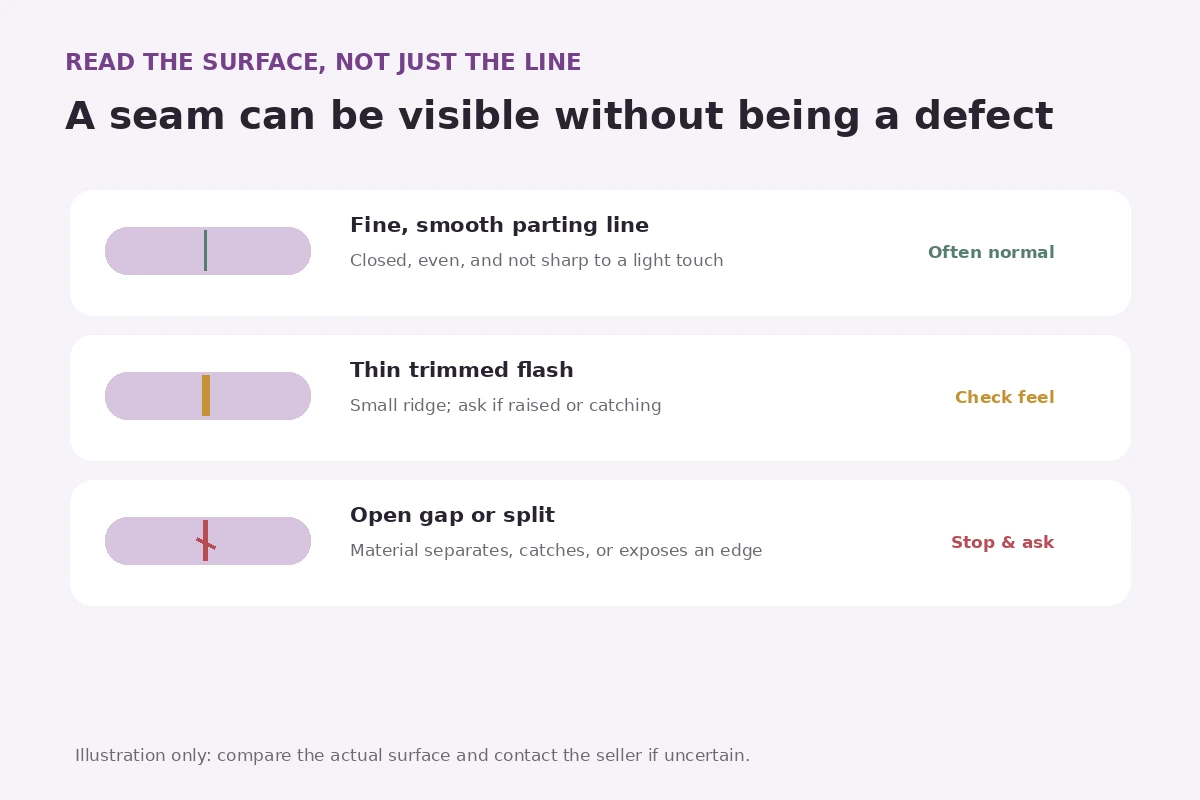
Quick answer: when is a seam normal?
A narrow, consistent, closed line can be a normal result of molding or assembly. It may be visible under bright light yet feel smooth when you lightly pass a clean fingertip over it. A raised ridge, rough burr, open gap, peeling layer, crack, or sharp edge is different. Those signs can point to excess material or a construction problem and deserve a closer look.
Appearance alone cannot confirm the exact cause. A seam’s meaning depends on the material, whether the dildo is one piece or assembled from layers, and what the manufacturer intended for that model. If you are unsure, take clear photos and ask the seller before trying to remove or repair anything.
Know what you are looking at
| Mark | What it may be | What to check |
|---|---|---|
| Mold line / parting line | A line where mold sections meet around a molded shape. | Is it closed, even, and smooth, with no exposed interior? |
| Flash | A thin excess lip of material along a mold edge that may remain after molding or trimming. | Does it feel rough, sharp, or catch lightly on clean skin or fabric? |
| Assembly seam | A joint where separately made parts or layers meet. | Is the joint uniform and secure, or does a gap or lifted edge appear? |
| Crack or split | A break in the surface rather than a closed manufacturing line. | Does it open, widen, catch, or reveal a different material underneath? |
| Texture boundary | A designed transition between smooth and textured areas or between materials. | Does the shape match product photos and remain firmly attached? |
A line can run along the shaft, around the base, or near a design transition. Its location by itself does not establish whether the dildo is defective. Compare the mark with the product images and description, then evaluate its surface condition.
A three-step inspection that won’t stress the material
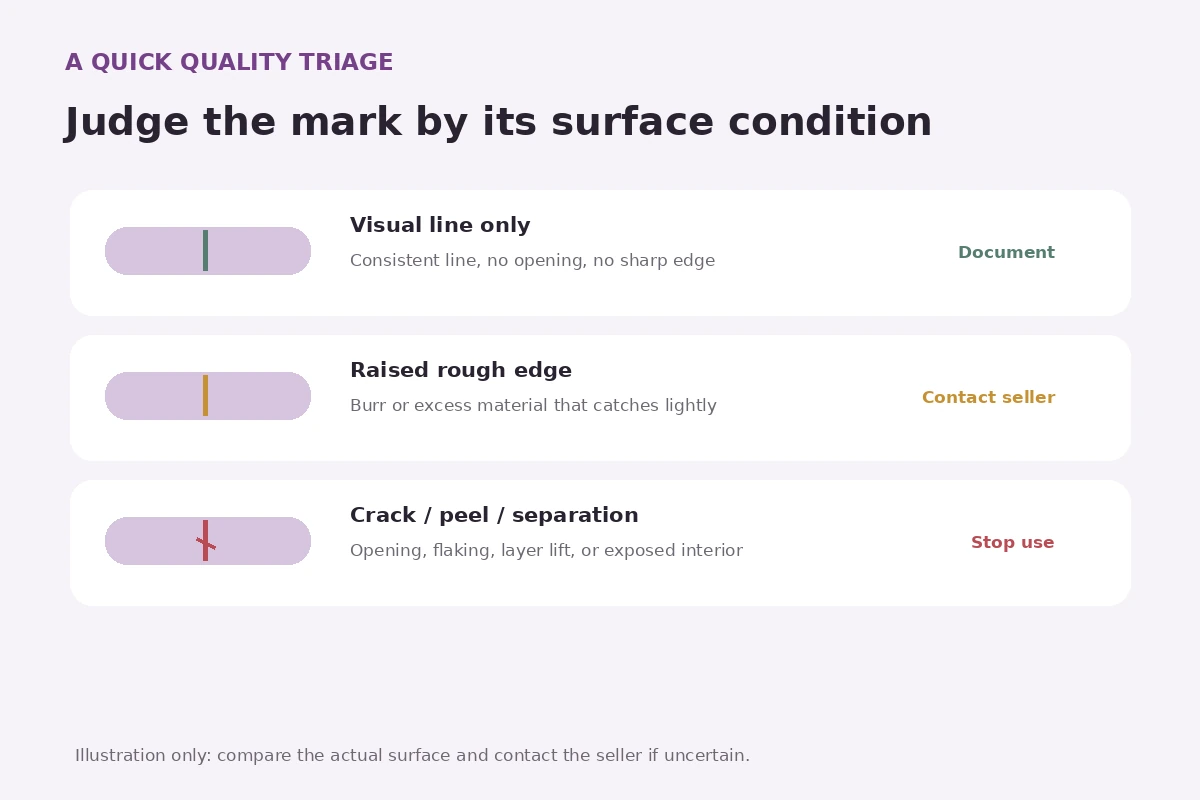
- Use bright, even light. A clean, dry surface is easier to inspect. Rotate the dildo slowly rather than bending or stretching it.
- Look at the whole area. Check whether the line is uniform and closed. Look for nearby holes, bubbles, peeling, color changes, residue, or a change in shape.
- Touch lightly if appropriate. With a clean fingertip, glide across the area without pressing hard. Note whether it feels smooth, raised, sharp, tacky, or open.
For a new purchase, photograph the area before use and keep the packaging and order details. This gives the seller a clear record and helps you explain whether the line is only visible or also rough to the touch.
Normal-looking marks versus signs to report
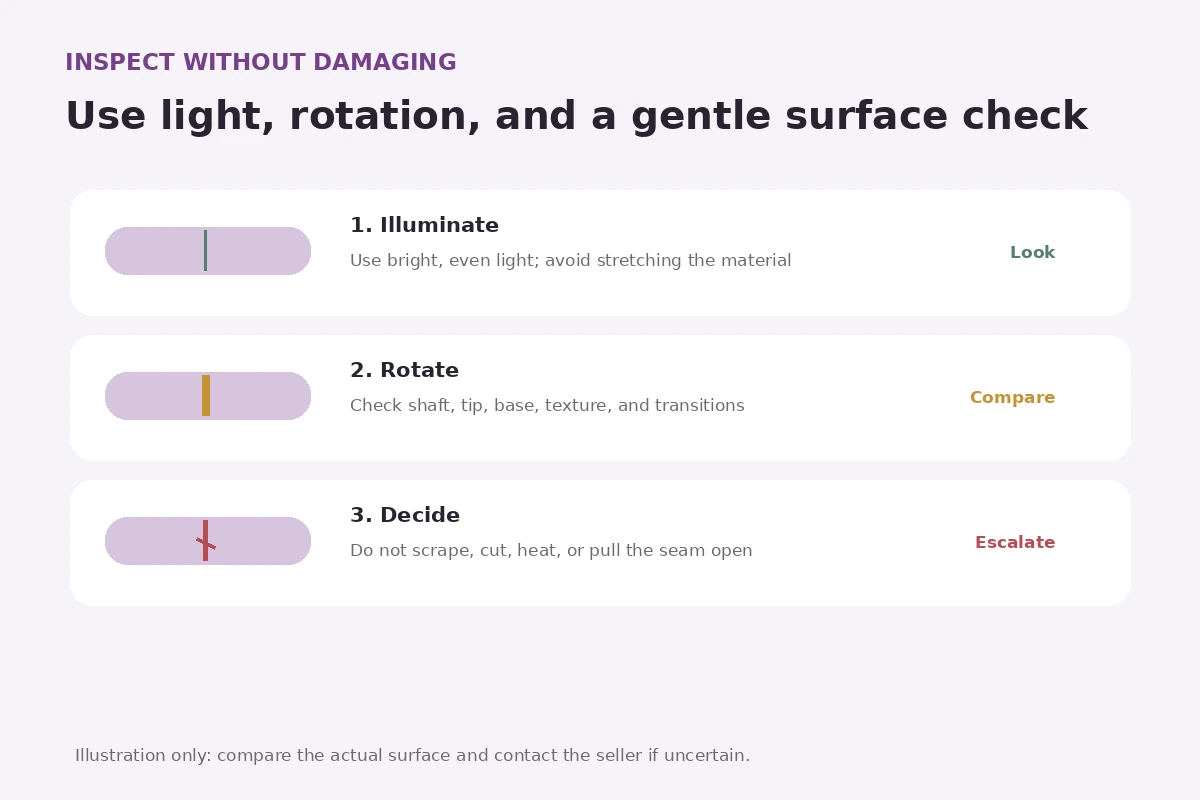
Often consistent with an ordinary molding mark
- The line is narrow and continuous, with no opening or missing material.
- It feels smooth or nearly flush rather than sharp or abrasive.
- It appears consistently along a designed boundary or in a location shown in product photos.
- The surrounding material has the same appearance and feel, with no lifting, cracking, or exposed layer.
A visible mark can still be disappointing if the listing promised a seamless finish. Compare the item with the seller’s description and return policy rather than assuming every line meets the advertised finish standard.
Contact the seller about these signs
- A ridge or burr feels sharp, rough, or catches when touched lightly.
- A seam has an open gap, a lifted edge, or a section that appears to be separating.
- A crack, pinhole, tear, or flaking area interrupts the surface.
- A layered construction has a loose outer layer or a visible gap between layers.
- The mark is accompanied by an unusual sticky or oily surface, strong persistent odor, or unexplained change in the material.
If a surface is open, peeling, sharp, or separating, pause use while you ask the manufacturer or seller for model-specific guidance. A loose seam may be difficult to clean reliably, and home glue or sealant can alter the material. Our guide explains what dildo damage can and cannot be repaired.
Why seams appear in the first place
Molds may be made in multiple sections so the finished shape can be released. Where sections meet, a faint parting line can remain. If a small amount of material extends beyond that boundary, it may create flash that is trimmed or finished during production. The exact process depends on the material, mold design, and manufacturer.
Some dildos also use multiple materials, layers, or assembled components. A boundary between the shaft and base or between outer and inner layers may be part of that construction. It should still be consistent with the design and secure; an expected seam is not the same as an open or shifting joint.
For an overview of how molds, finishing, and inspection fit into production, see how dildos are made. Manufacturing details vary, so the presence of a seam cannot identify a specific production method or prove how thoroughly a particular model was inspected.
How finish expectations differ from a defect
Some buyers expect a perfectly seamless appearance, while a listing may show a faint line in its own close-up images. That is a finish expectation question; it is separate from whether the surface is open, sharp, or separating. Compare the received dildo with the listing’s actual photos and written description, including any note about hand finishing or small cosmetic variation.
A cosmetic mark should not be judged only by how dramatic it looks in a zoomed-in photo. Check whether it changes the surface continuity, catches with light contact, or differs from the same line elsewhere on the dildo. Conversely, a small-looking gap can deserve attention if it exposes an edge or lets a layer lift. Use function and surface condition together, then ask the seller to interpret the exact model.
When the seller says a mark is within its finish standard, ask what that standard means for your specific concern: whether the area is closed, smooth, and intended to be cleanable. Keep their response with the order record in case the condition changes.
What not to do with a rough or open seam
- Do not trim it with scissors or a blade. Cutting can create a larger opening or a sharp edge and may affect the underlying structure.
- Do not sand or scrape it. Abrasion can damage the finish and make the area harder to assess.
- Do not apply household glue, tape, or sealant. These materials may not bond safely or remain compatible with the dildo’s material.
- Do not use heat to smooth it. Heat can deform the surface or affect layers and internal parts.
- Do not repeatedly flex the seam to test it. Pulling at a joint can make a small separation worse.
Instead, photograph the area from a few angles, include one wider photo that identifies where it sits, and contact the seller with the model name and order number. Ask whether the finish is expected for that exact design and what remedy is available.
How to describe the issue clearly
A useful message separates what you see from what you think caused it. For example:
“I received the [model name] on [date]. There is a line along [location]. It is [smooth / raised / sharp / open] when touched lightly. I have attached close-up and full-product photos. Can you confirm whether this finish is expected for this model and advise me on the next step?”
This wording avoids guessing whether the mark came from the mold, trimming, shipping, or later handling. If the dildo is new and unused, check the return policy before washing or altering it, since seller requirements differ.
Related surface changes to distinguish
Not every line is a seam. A cloudy patch, color transfer, white residue, tackiness, or a dent may have a different cause and needs a different inspection. If the surface itself feels unusually sticky or appears unfinished, compare it with our guide to possible silicone cure problems. For a general pre-use check of the shaft, base, and controls, use the new dildo inspection checklist.
Frequently asked questions
Are mold lines on a dildo normal?
A faint, smooth, closed line can be a normal molding mark. It becomes more concerning if it is sharp, rough, open, peeling, or accompanied by other surface damage. Check the exact product description and ask the seller when uncertain.
Should I remove a small flash line myself?
No. Cutting, scraping, or sanding can damage the surface or create a rough area. Send a photo to the seller and ask whether the finish is expected and what solution they recommend.
Can a seam be safe if I can feel it?
Feeling a line does not establish whether it is safe or defective. A slight smooth ridge differs from a sharp edge, opening, or separation. If it catches or irritates, stop and ask the manufacturer or seller.
Does a seam prove that a dildo is handmade or poorly made?
No. A seam may result from mold sections or assembly, and it does not by itself identify the production process or quality level. Look at the finish, construction, and manufacturer’s product-specific information.
What photos should I send to customer service?
Take a clear close-up of the line, a wider photo showing its location on the dildo, and a photo of the model or packaging label if available. Use even lighting and avoid pulling the seam open for the picture.
Judge the condition, not the mere presence of a line
A seam is a manufacturing clue, not a verdict. A smooth, closed line may be an ordinary mark; a rough edge, open gap, crack, or lifted layer deserves a seller’s attention. Inspect gently, document what you find, and leave cutting, heating, or repair attempts out of the process until the manufacturer has clarified the issue.