

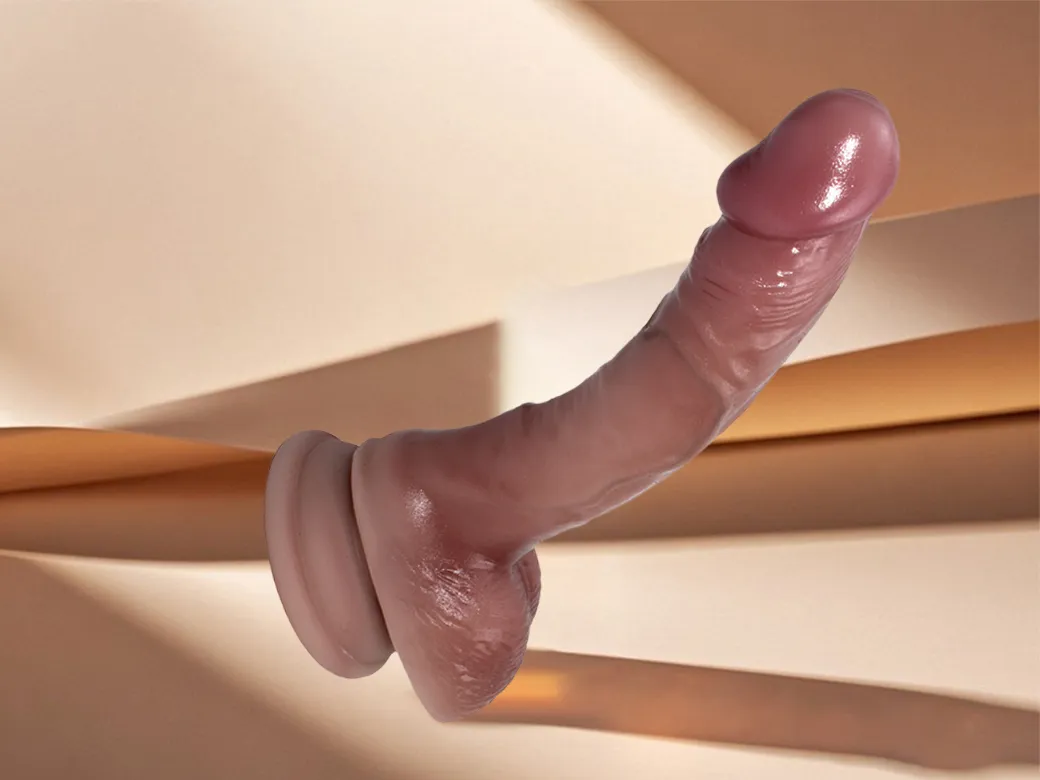
A cable may plug into the same USB adapter as your phone and still be the wrong charger for your dildo. The USB end describes how the cable connects to power; the device end may be a magnetic contact, a proprietary pin connector, or a USB-C port. A battery-powered design may not use a charging cable at all.
Quick answer: Identify both ends of the charging system and the dildo’s exact model before replacing a cable. Magnetic and pin-style contacts can overlap, but their spacing, polarity, and electrical requirements are not universal. USB-C describes a connector shape, not automatic compatibility with every power source or device.
Start by separating the two ends of a charger
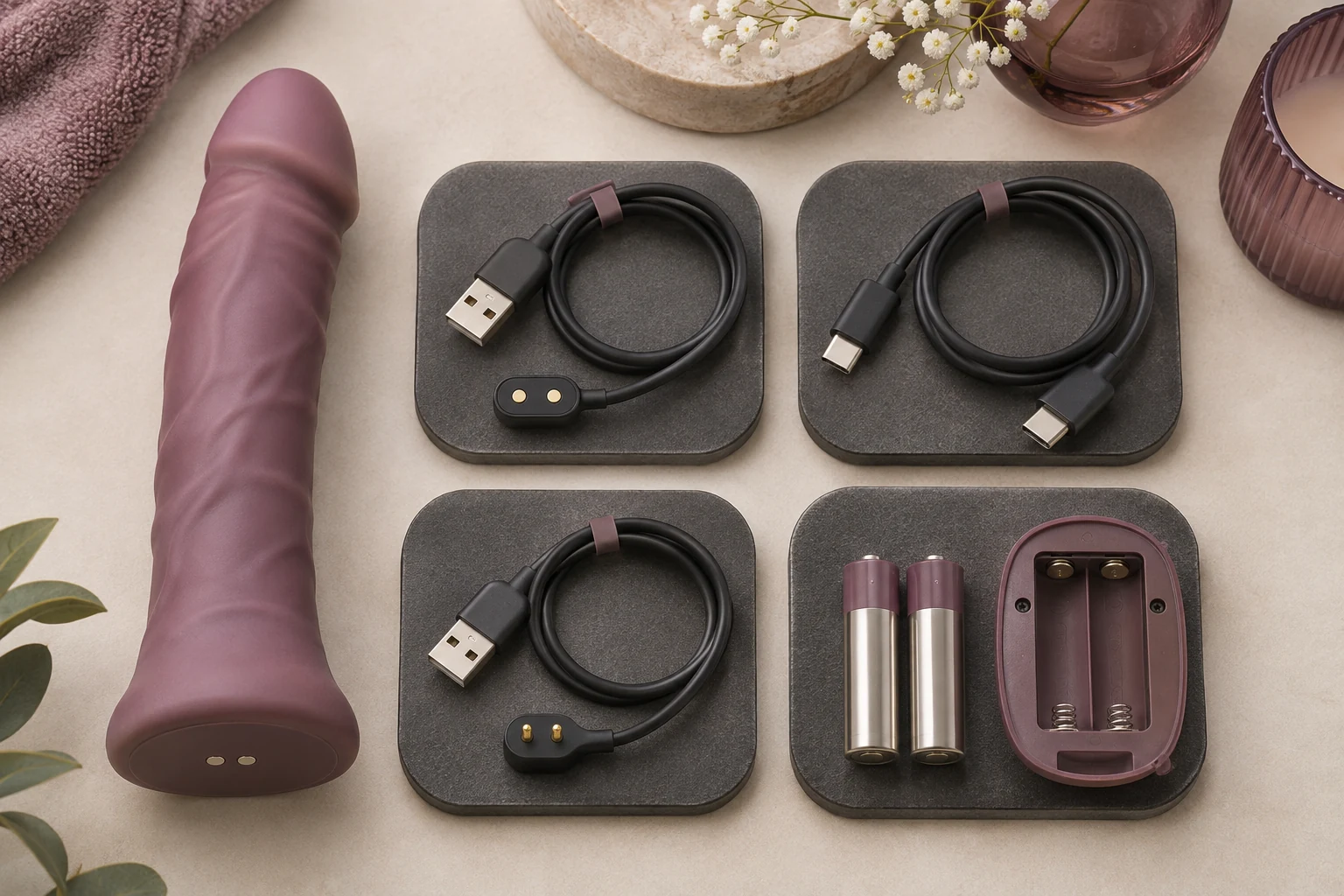
Most charging setups have a power-source end and a device end. The power-source end may be USB-A or USB-C and plugs into a computer, adapter, or other approved source. The device end is the part that connects to the dildo: it may be a direct USB-C plug, a magnetic head, two contact pins, or a model-specific dock.
That difference clears up a common naming problem. A listing for a “USB charger” may mean only that the cable’s power end is USB. The device-side connection can still be proprietary. When shopping for a replacement, match the exact model and connector layout, not just the word USB or the way the cable looks in a photo.
Charger and battery designs compared
| Design | What connects to the dildo | What to verify | Common mix-up |
|---|---|---|---|
| Magnetic contacts | A magnetic charging head aligns with contacts on the device | Contact spacing, position, cable model, and charging instructions | Assuming any magnetic cable will snap on and work |
| Pin or pogo-pin cable | One or more small metal pins touch matching contacts or a dock | Pin count, layout, polarity, and model compatibility | Calling it “standard” because the contacts look similar |
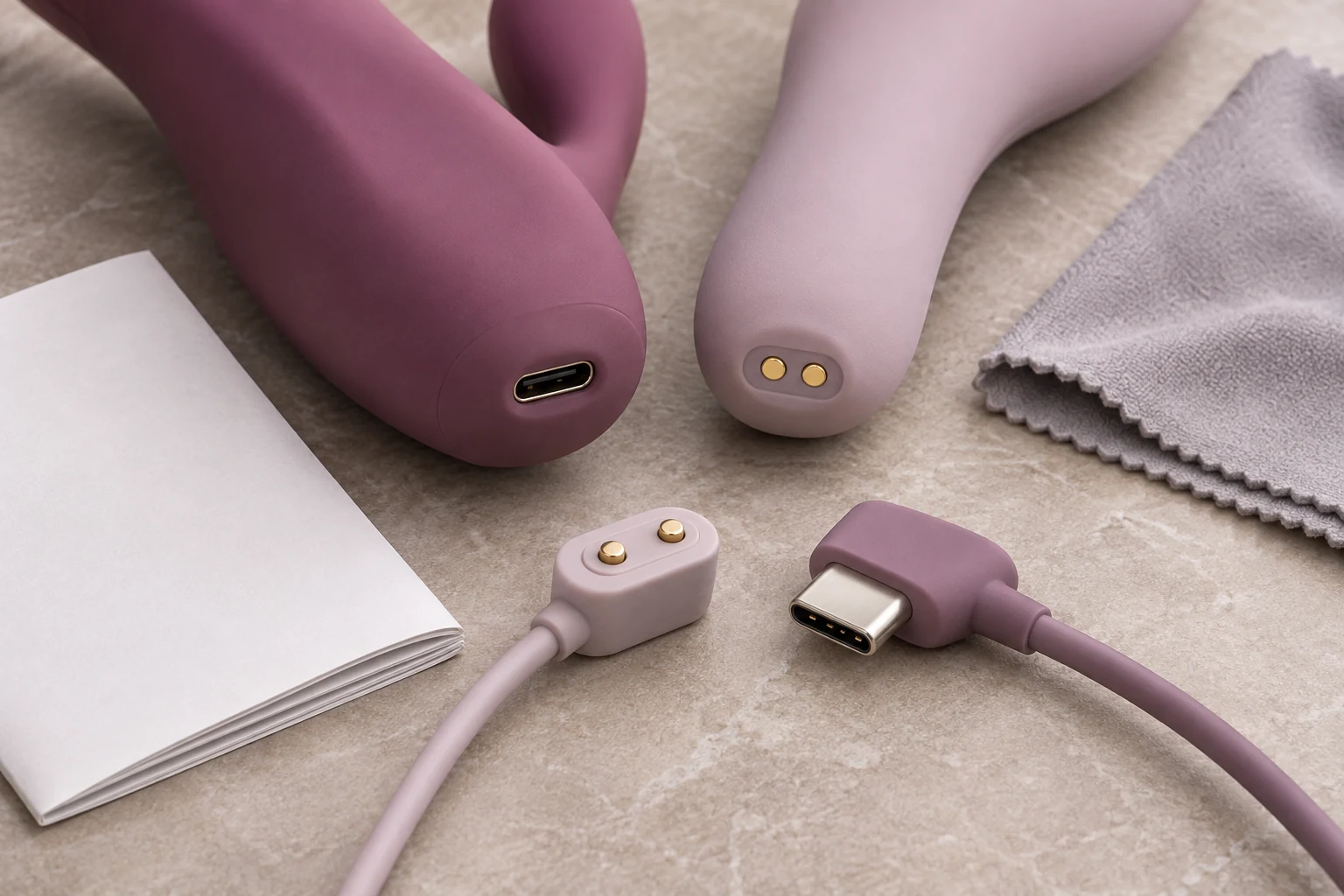
| Direct USB-C port | A USB-C connector inserts into a port on the dildo | That the model is designed for USB-C charging and the port cover is used as instructed | Assuming USB-C means any adapter or cable is approved |
| Replaceable battery | No charging cable; the battery compartment takes specified cells | Battery type, orientation, replacement instructions, and whether cells are rechargeable | Trying to charge a device that is designed for disposable cells |
| Internal rechargeable battery | The battery charges through one of the interfaces above | Correct cable, source, indicator lights, and charge time for that model | Assuming the battery is user-replaceable or the connector is universal |
Magnetic charging: convenient alignment, model-specific contacts
With a magnetic charger, a small charging head attaches to exposed contacts on the dildo. Some systems use two pins; others place contacts or magnets differently. The magnets help hold the head in position, but they do not establish a shared industry-wide standard.
Before charging, align the contacts as shown in the manual and check that the cable sits flat. If it connects only at an angle, slips off, or does not show the expected indicator, do not keep repositioning it while powered. Inspect for moisture, lint, residue, corrosion, bent contacts, or a damaged cable. Use the instructions for the exact model to clean or troubleshoot the connection.
Some brands sell replacement cables that fit several of their models, while others have exceptions. We-Vibe’s charging guidance, for example, describes attaching its magnetic charger to the product’s contacts and keeping the charger unit away from water. That is an example for its own products, not a rule that makes its cable fit another brand. See We-Vibe’s official charging instructions.
Pin chargers: why two similar cables may not match
“Pin charger” often refers to a cable or dock whose small metal pins meet contacts on the dildo. Some pin systems are magnetic, so “magnetic” describes how the connector attaches while “pin” describes the electrical contact points. The terms can describe the same charger from different angles.
Look carefully at the number of pins and their spacing. A cable can seem to fit while placing contacts in the wrong positions or failing to make stable contact. A similar shape is not proof of compatible wiring or electrical output. If the original cable is missing, use the model name or number to find a replacement listed by the manufacturer or ask customer support to confirm it.
USB-C ports: a connector shape, not a blanket guarantee
A dildo with a direct USB-C port accepts a USB-C plug at the device. The port may sit beneath a removable cover or be positioned in a recessed area. Follow the model’s instructions for opening and resealing any cover, and do not charge while the port or device is wet.
USB-C on the device does not tell you everything about supported power input. Check the manual for the recommended source and rating. Avoid assuming that a high-output wall adapter, laptop port, or fast-charging setup is suitable just because the connector fits. USB-C accessories can supply different power levels; use the source and cable the manufacturer specifies.
Also distinguish USB-C on the power end from USB-C on the device end. A cable might plug into a USB-C wall adapter but terminate in a proprietary magnetic connector. The listing should show or name both ends.
Battery designs: rechargeable or replaceable?
Some dildos use an internal rechargeable battery; others take removable cells. An internal battery is charged through the specified port or contacts and usually is not intended for the user to open or replace. A replaceable-cell design has a battery compartment and instructions naming the required cell type and orientation.
Do not put rechargeable cells into a device unless its manual explicitly supports them, and never attempt to recharge ordinary disposable batteries in a charger. If a battery compartment is wet, corroded, cracked, or difficult to close, stop and contact the manufacturer for model-specific advice. Do not pry open a sealed device to reach an internal battery.
Before buying a replacement charger
- Find the exact model name or number. Check the product page, order confirmation, packaging, or manual.
- Identify the device-side interface. Note whether it is USB-C, magnetic contacts, pins, a charging dock, or replaceable cells.
- Compare the contact layout. For magnetic or pin systems, check pin count and spacing—not just the connector’s outline.
- Confirm the power requirements. Use the manual’s stated voltage, current, and approved source. Do not infer these from the cable’s USB plug.
- Check availability and support. Ask whether the exact replacement cable is still sold and which models it supports.
- Keep the original cable labeled. Store it with the device or write down the model it belongs to; similar-looking cables can be easy to mix up.
If you are comparing an older or discontinued model, check cable availability before buying. Our discontinued dildo replacement guide includes charger and support continuity as part of that decision.
Charging habits that help protect the device
- Follow the manual’s charging time, indicator-light meaning, and power-source instructions.
- Keep the charger and charging contacts dry. Wash and fully dry the dildo before connecting a charger if the manufacturer’s directions call for this.
- Do not force a plug, bend pins, scrape contacts with a sharp object, or use a cable that is frayed or damaged.
- Unplug the cable before cleaning. Avoid immersing ports, magnetic contacts, charging docks, or battery compartments unless the manufacturer explicitly permits it.
- If the device becomes unusually hot, smells burnt, swells, or shows a damaged port or battery compartment, disconnect power if safe and stop using it. Contact the maker.
For example, We-Vibe’s published instructions say to wash and dry the device before charging and keep the charger away from water. LELO also states that its chargers are designed for its own products and directs buyers to select a compatible charger type. Follow your own dildo’s manual; a brand’s guidance for one model should not be generalized to another. See LELO’s charger compatibility page.
For general inspection before first use, see our new dildo checklist. If a device stops charging or loses power under use, our guide to thrusting dildo power problems explains what to check without substituting an unapproved charger.
Quick troubleshooting by symptom
| What you notice | Safe first check | When to stop |
|---|---|---|
| Magnetic head will not stay attached | Check alignment and look for moisture or residue with the cable disconnected | If contacts are damaged, loose, or corroded |
| No charging light | Confirm the wall source works and the correct model cable is being used | If the port, cable, or device becomes hot or smells unusual |
| Charging stops when moved | Place the device still on a dry surface and inspect the cable for damage | If the connector must be bent or held at an angle to charge |
| Battery life suddenly drops | Review the manual’s full-charge indicator and charging time | If the device swells, overheats, or repeatedly fails to charge |
Repeatedly plugging in a questionable cable can worsen contact or port damage. If the safe checks do not resolve the issue, keep the charger and model details handy and contact the manufacturer. Do not disassemble the dildo or try a cable solely because it appears to fit.
Frequently asked questions
Can I use any USB-C cable to charge a dildo?
Only if the dildo is designed with a USB-C charging port and the manufacturer’s instructions support that cable and power source. A USB-C plug on the wall-adapter end does not mean the device end is USB-C.
Are magnetic dildo chargers universal?
No. Magnetic attachment does not standardize contact spacing, polarity, or electrical requirements. Use a cable confirmed for the exact model or a compatible model family named by the manufacturer.
Is a pin charger the same as a magnetic charger?
Sometimes the terms overlap: pins describe the contacts, while magnetic describes how the charger attaches. But not every pin connector is magnetic, and similar pin layouts are not necessarily compatible.
How do I know whether a dildo uses replaceable batteries?
Check the manual or product listing for a battery compartment and named cell type. Do not open a sealed rechargeable dildo to look for a battery.
Can I charge the dildo while it is still wet?
Do not connect a charger to a wet device or wet charging contacts. Follow the model’s instructions for washing, drying, and any water-resistant covers before charging.
Match the charger to the device, not the other way around
Magnetic, pin, and USB-C describe different parts of a charging setup, while battery design tells you whether the dildo charges internally or uses replaceable cells. Check the exact model, device-side connector, and power requirements before choosing a replacement. When those details are missing, the manufacturer’s confirmation is more useful than a visual match.