

Start with the design problem you want to solve
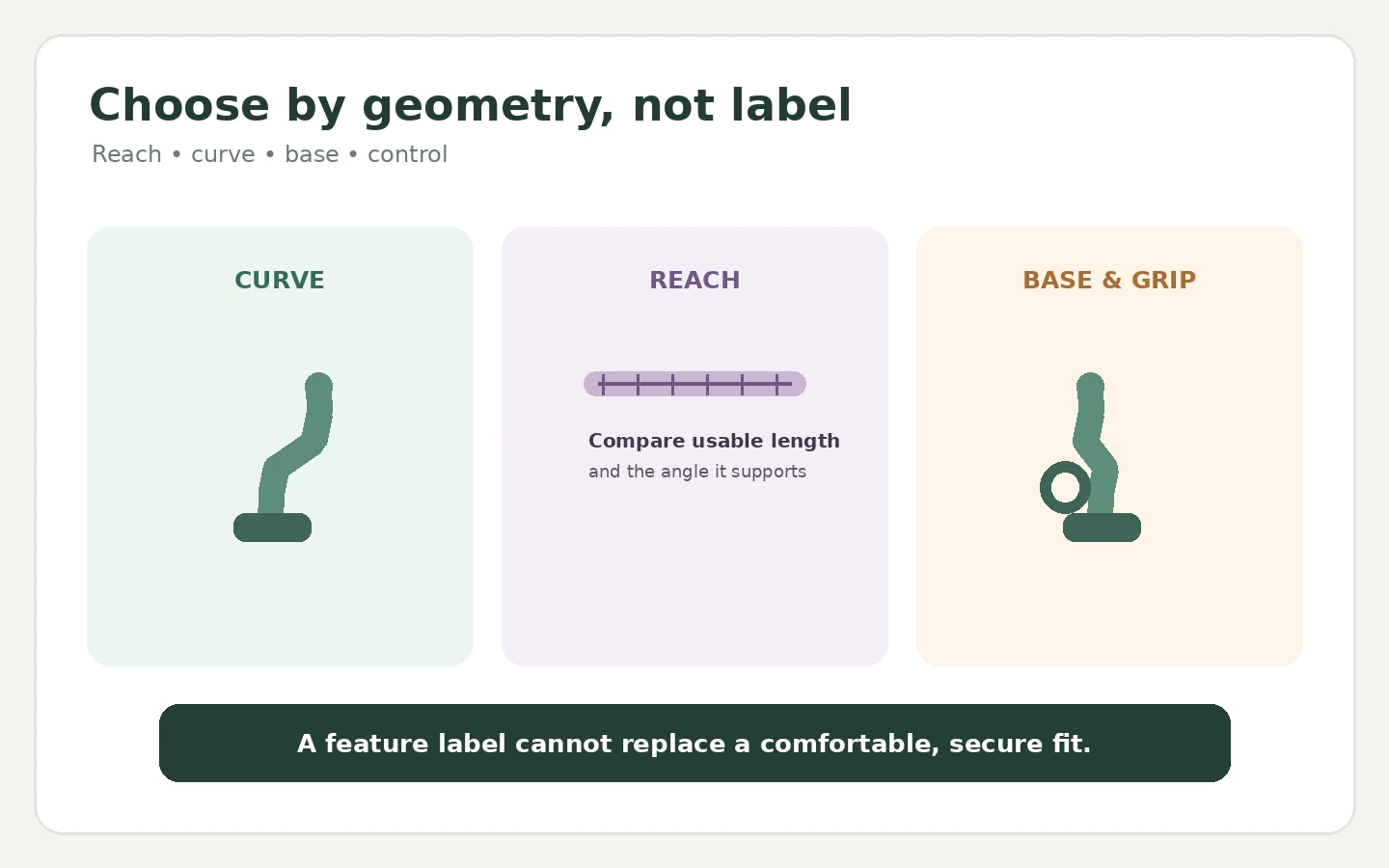
A prostate-focused dildo is not defined by one exact curve or a guaranteed result. People use the term for different designs intended to make angle, reach, or control easier to manage. A curved dildo may suit one person’s anatomy and position but feel awkward to someone else. The useful comparison is therefore not “Which shape stimulates the prostate best?” but “Which design gives me the reach, angle, stability, and control I want?”
The prostate sits below the bladder and in front of the rectum, according to Cleveland Clinic’s anatomy overview. A dildo’s overall length alone cannot predict whether its curve or direction will feel comfortable. Treat product terminology as a starting point, then compare the actual measurements and the way the base or handle can be controlled.
Quick selection rule: Choose by the combination of usable reach, curve direction, shaft firmness, and a secure base or grip. No label can guarantee a particular sensation, and a specialized design is optional if another dildo already fits your preferences.
The four-part fit model: reach, angle, stability, control
| Factor | What to compare | What the listing should clarify |
|---|---|---|
| Reach | Usable or insertable length, not just total length. | Whether the measurement includes the handle, base, or decorative portion. |
| Angle | Curve direction, curve location, and how sharply the shaft bends. | Side-view photos or a clear description of which way the curve points. |
| Stability | Base width, shape, flexibility, and compatibility with a mount or harness if relevant. | Whether the base is designed for anal use, mounting, harness attachment, or hand-held use. |
| Control | Where your hand can hold the dildo, the weight, and how much the shaft flexes. | Handle or loop dimensions, weight, material, and firmness information. |
These factors work together. A long shaft with a curve in the wrong direction may be harder to position than a shorter design with a more useful angle. A flexible shaft may adapt to movement, but a very yielding design can be harder to guide. A loop handle may help with grip, but it does not automatically make the dildo hands-free or suitable for a particular mount.
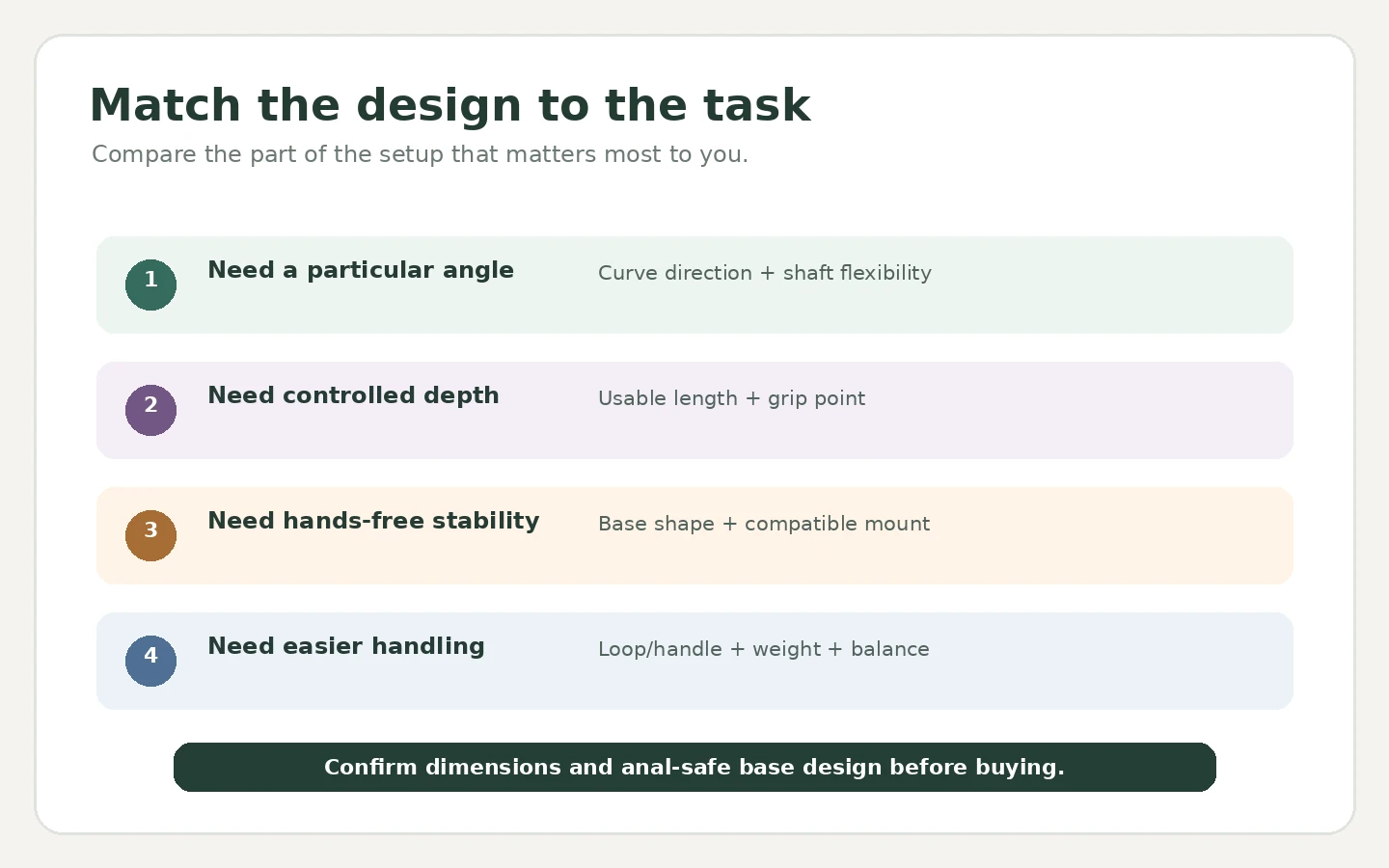
Choose by the challenge you are trying to solve
| Your priority | Start by comparing | Potential trade-off |
|---|---|---|
| Finding a comfortable angle | Curve direction and where the bend begins | A pronounced curve may be useful in one position but feel too angled in another. |
| Guiding the dildo by hand | Grip point, shaft firmness, handle width, and total weight | A broad handle can support grip but may increase overall bulk. |
| Keeping the base outside the body | Base shape and the manufacturer’s stated intended use | A decorative or suction base is not automatically a safe anal stop. |
| Using a hands-free setup | Base geometry and compatibility with the exact mount or harness | Compatibility depends on dimensions and fit; “universal” claims need measurements. |
| Controlling depth | Insertable length, base or handle design, and grip location | Total length can be misleading if the handle or base accounts for a large portion. |
| Reducing effort to hold | Weight, balance, loop or handle, and control access | A feature that helps one grip may be uncomfortable for another; verify dimensions. |
How to read the curve without guessing from a product photo
“Curved,” “prostate,” and “G-spot” are not standardized measurement terms. A photo can show that a shaft bends, but it may not show the curve’s depth, direction, or exact starting point. Look for a side view, a measurement diagram, or an explanation of the intended orientation. If the page shows only a front-facing image, contact the seller for a side profile before relying on the curve as a deciding feature.
Ask three practical questions:
- Which direction does the tip point? Compare the curve from the side and confirm how the dildo is meant to be oriented.
- Where does the bend begin? A curve close to the tip behaves differently from one that begins lower on the shaft.
- How much does the shaft flex? A soft shaft can bend under pressure; a firmer one may hold its shape more consistently. The actual feel depends on material and construction.
For a broader look at shape terminology, read our curved vs. straight dildo comparison and dildo head-shape guide. Those guides cover general shape choices; this article focuses on how to evaluate reach and control for a prostate-oriented purchase.
Reach is not the same as total length
Product pages may list total length and insertable length separately. Total length can include the base, handle, or other non-insertable parts. When comparing two designs, use insertable length to understand the portion intended to enter the body and consider how much of the shaft you actually want to use.
Diameter and circumference matter too. A curved design is not automatically easier to use because it has a shorter reach, and a long design is not automatically more effective. Compare measurements with your comfort preferences rather than assuming that more length or girth creates a better result. Our dildo size guide explains how to interpret listed dimensions.
Measurement check: Before comparing two listings, write down total length, insertable length, widest point, curve direction, and base width. If one seller omits insertable length, do not infer it from the main product photo.
The base is a safety feature and a control feature
For anal insertion, the base must be designed to remain outside the body or provide another reliable way to keep the dildo from being drawn fully inside. Planned Parenthood advises using an anal dildo or other anal product with a flared base or another retrieval feature. Its sex toy safety guide also recommends lubricant for anal use and following the care directions for the specific design.
Do not treat all bases as interchangeable. A broad flared base, a loop, a suction cup, and a harness-compatible base serve different functions. A suction cup may support mounting on a suitable surface, but suction alone is not a substitute for a base designed for anal use. If you plan to attach the dildo to a harness or mount, compare the base’s width and thickness with the opening or attachment dimensions. See our dildo base types comparison for a broader overview.
Firmness, flexibility, and control: three related but different choices
A prostate-focused design may be soft, firm, or somewhere between. Firmness describes how much the material compresses when pressed; flexibility describes how much the shaft bends. A dildo can be firm but still flexible because of its shape or internal construction. It can also have a softer outer layer around a firmer core.
If the curve needs to hold its position, check whether the listing describes a shape-holding core or a flexible shaft. Do not assume the word “soft” tells you how the entire dildo bends. Compare the listed material, construction notes, and any demonstration that shows the full shaft under light pressure. Our soft vs. firm dildo guide explains these feel differences in more detail.
Run a product-page audit before checkout
Use this checklist to compare two candidates. A missing detail is a reason to ask the seller—not a cue to guess.
- Orientation: Can you tell which way the curve points from the photos?
- Measurements: Are total and insertable length shown separately? Is width or circumference available?
- Curve detail: Does the page show the bend from the side and explain where it starts?
- Base purpose: Is the base suitable for the intended use, and are the dimensions listed?
- Grip: Can you hold the base, loop, or handle comfortably? Is the weight stated?
- Firmness: Does the listing clarify whether the shaft holds shape or bends readily?
- Material and care: Is the body-contact material identified, and are cleaning instructions available?
- Compatibility: If using a harness or mount, do the measurements match the attachment?
- Support: Is there a seller or manufacturer contact for questions about fit or construction?
If you are also comparing a collection page, BestDildo’s G-spot and curved dildo collection can be a starting point for browsing shapes. Check each individual listing because the dimensions and base design can differ across models.
Use a low-pressure fit plan
Choosing the shape is only part of the setup. If you decide to use an anal dildo, read its instructions, use compatible lubricant, and keep the base or retrieval feature outside the body. Planned Parenthood’s guidance notes that the anus does not lubricate itself the way the vagina does; use lubricant and follow the dildo and lubricant manufacturers’ compatibility information.
Begin gently and keep control of the angle and depth. Do not force the curve into a position that feels uncomfortable. Stop if you feel pain, bleeding, or unexpected discomfort; if symptoms continue or you have a medical concern, speak with a healthcare professional. This is a product-selection guide, not a treatment recommendation for prostate or pelvic conditions.
Common buying mistakes—and a better check
| Mistake | Why it can mislead | Better check |
|---|---|---|
| Buying by the word “prostate” alone | Marketing labels do not standardize curve, reach, or angle. | Inspect the side profile and the exact measurements. |
| Choosing the longest option | Extra length does not guarantee a useful angle or comfortable control. | Compare insertable length, grip, and desired depth together. |
| Assuming a suction cup is an anal-safe base | Mounting and retention are different design purposes. | Confirm a flared base or other secure retrieval feature for anal insertion. |
| Confusing firmness with flexibility | These describe different properties and can vary with construction. | Look for separate descriptions of compression and bending. |
| Trusting a single front photo | It may hide the curve direction, base thickness, and true scale. | Find a side view, measurements, or ask the seller for details. |
| Assuming the design will treat a condition | A consumer product label is not a clinical recommendation. | For symptoms or treatment questions, ask a clinician who knows your situation. |
Frequently asked questions
What makes a dildo a prostate dildo?
The label usually refers to a design intended to make a particular angle, reach, or grip easier to explore. There is no single standardized curve or dimension. Compare the actual shape and specifications rather than relying on the name alone.
Does a prostate dildo need to be curved?
Not necessarily. Some people prefer a curve; others may prefer a different shape or already own a design that suits them. A curve is one option for changing angle, not a guarantee of a specific sensation.
How much insertable length should I choose?
There is no universal length. Compare the listed insertable measurement with your own comfort and control preferences. Total length may include a handle or base, so do not use it as a substitute for insertable length.
Can I use a suction-cup dildo for prostate stimulation?
Only if the complete design is intended for the use you have in mind and has an appropriate base or retrieval feature for anal insertion. A suction cup is primarily a mounting feature and should not automatically be treated as an anal-safe base.
Is a softer or firmer design easier to control?
It depends on the dildo’s construction, curve, weight, and grip. A firmer shaft may hold its shape more consistently, while a flexible shaft may bend more with movement. Compare flexibility and firmness separately rather than using one as a proxy for the other.
Do I need a specialized prostate design?
No. A specialized label is optional. If another dildo has a shape, size, and base that suit your preferences and intended use, you may not need a separate design.
Choose the specification that solves your real problem
A prostate-oriented label cannot tell you whether a dildo will fit your body or preferred position. Look at curve direction, insertable reach, base security, flexibility, and the place your hand can control it. If those details are clear, you can compare candidates on the features that matter to you. If they are missing, ask before buying instead of letting a product name make the decision.