

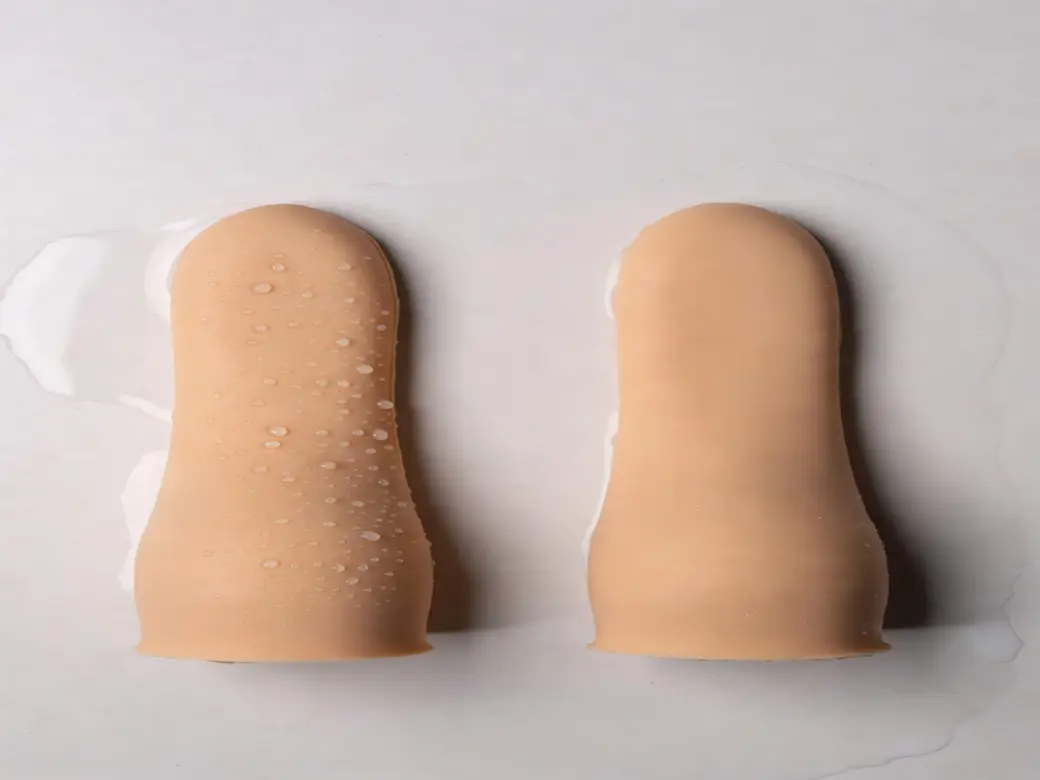
“Waterproof,” “water-resistant,” “splashproof” and “submersible” may sound similar when they appear on a dildo product page, but they do not necessarily describe the same level of protection.
This matters most when you are choosing a vibrating, rotating or thrusting dildo. Water entering the enclosure can damage the motor, battery, controls or charging system. Even if the outside looks completely sealed, the product may have small openings around its buttons, seams or charging port.
A non-vibrating dildo presents a different question. Because it does not contain electronics, its water compatibility is determined mainly by its material, construction and any attached components. A one-piece silicone dildo, for example, does not need an electronic enclosure rating. A dual-density model made with several bonded layers may still require more careful handling.
The safest approach is not to rely on the largest marketing word printed on the box. Instead, look for a specific IP rating and read the manufacturer’s instructions that accompany it.
Quick Answer
Here is the practical difference:
- Water-resistant usually means the product can tolerate limited moisture or splashing. It should not be submerged unless the manufacturer specifically permits it.
- Splashproof indicates protection from splashes but does not mean the dildo can be left underwater.
- Waterproof is a broad marketing term. Its meaning is much clearer when the manufacturer provides a recognized IP rating, permitted depth or exposure time.
- Submersible means the product is intended to tolerate some form of immersion, but the permitted depth and duration may still be limited.
- IPX7 generally indicates protection during temporary immersion under standardized test conditions.
- IPX8 indicates protection during immersion under conditions specified by the manufacturer. It does not mean unlimited depth or unlimited time.
Whenever the product instructions are more restrictive than the wording used in an advertisement, follow the instructions.
Read Every Waterproof Claim in Three Layers
A reliable water-protection claim normally has three layers.
1. The Marketing Description
This is the wording shoppers see first, such as “waterproof,” “bath-friendly” or “shower-safe.” It provides a general impression but may not explain how the claim was tested.
“Shower-safe,” for example, does not automatically mean that the product can be submerged in a bathtub. Likewise, “easy to wash” only confirms that some contact with water is expected. It does not establish that the motor housing can remain underwater.
2. The Technical Rating
A rating such as IPX4, IPX7 or IPX8 provides more useful information because it refers to defined ingress-protection test categories.
The IP system was developed to classify how well an electrical enclosure protects against the entry of solids and liquids. The official framework is described by the International Electrotechnical Commission’s IP-rating guidance and the IEC 60529 standard.
A rating is more informative than the word “waterproof,” but it still needs context. It describes performance under specified test conditions rather than promising that water can never damage the product.
3. The Instructions and Exclusions
The manual or manufacturer’s product page should explain how the rating applies in practice. Look for details such as:
- Whether full immersion is permitted
- Maximum depth or exposure time
- Whether a charging-port cover must be closed
- Whether the controls can be operated underwater
- Whether the product must be completely dry before charging
- Whether the warranty excludes water damage
If a listing says “IPX8” but provides no instructions or manufacturer information, treat the claim conservatively until it can be verified.
Why Manual and Electronic Dildos Need Different Questions
With a solid, non-electronic dildo, the main concern is whether the material itself is nonporous, washable and stable during contact with water.
Glass, stainless steel and properly cured silicone are commonly chosen for washable dildo designs. However, the material name alone does not describe every part of the product. Painted details, decorative inserts, suction cups, bonded layers and surface coatings may require different care.
This is why shoppers should consult a detailed dildo materials guide instead of assuming that every product sold under the same material label behaves identically.
Electronic dildos require another layer of evaluation. Their exterior enclosure must prevent water from reaching components such as:
- Motors
- Rechargeable batteries
- Circuit boards
- Control buttons
- Charging contacts
- Internal wiring
A product can feel seamless in the hand while still depending on internal seals that the shopper cannot see. Its official rating and care instructions are therefore more useful than appearance alone.
How to Read an IP Rating
“IP” stands for ingress protection. A full code may contain two digits.
The first digit describes protection against solid objects and dust. The second digit describes protection against water. If an “X” appears in place of a digit, that category has not been declared in the code.
For example:
- IP67 includes a solid-ingress rating of 6 and a water-ingress rating of 7.
- IPX7 provides a water-ingress rating of 7 but does not declare a solid-ingress rating in that code.
- IPX4 provides a level-4 water-ingress rating but does not state a dust rating.
The “X” should not be interpreted as proof that the product has no dust protection. It simply means that the displayed code does not specify a rating for that category.
For most electronic dildo listings, the liquid-protection digit is the part shoppers need to examine most closely.
Common Water-Protection Ratings on Dildo Listings
| Rating | General type of protection | Practical interpretation | What it does not automatically mean |
|---|---|---|---|
| IPX0 | No rated water protection | Keep the product away from water | It is suitable for rinsing |
| IPX1–IPX2 | Dripping water | Very limited protection from vertical or angled drips | It is shower-safe |
| IPX3 | Spraying water | Some protection from water spray | It can be submerged |
| IPX4 | Splashing water | Usually suitable for incidental splashes | It is bath-safe |
| IPX5 | Water jets | Tested against directed water jets | It can remain underwater |
| IPX6 | Powerful water jets | Greater resistance to forceful jets | It has unlimited immersion protection |
| IPX7 | Temporary immersion | Designed to tolerate limited immersion under stated conditions | It can stay underwater indefinitely |
| IPX8 | Immersion beyond IPX7 conditions | Tested under immersion conditions specified by the manufacturer | It is safe at every depth or for unlimited time |
The table should be used as a reading guide rather than a replacement for the manual. Test categories evaluate different types of water exposure, and real-world conditions may include variables that were not part of the laboratory test.
Why IPX7 Does Not Mean Water Can Never Damage It
An IPX7 dildo is generally a stronger candidate for immersion than an IPX4 product, but the rating is not a lifetime guarantee.
Standardized tests use controlled conditions. A product in everyday use may encounter warm water, soap, bath additives, lubricant residue, movement and repeated temperature changes. Its seals may also be affected by age, accidental drops or improper storage.
Water protection could be compromised if:
- The outer shell is cracked
- A seam begins separating
- A charging cover no longer closes correctly
- The product has been dropped onto a hard surface
- An internal battery compartment has been opened
- The manufacturer’s specified depth or duration is exceeded
If the enclosure looks damaged, do not assume the original rating still applies.
The same distinction is important when following a how to clean a dildo guide. A cleaning method that is appropriate for a solid silicone dildo may not be suitable for an electronic model with only splash resistance.
The Charging-Port Trap
The charging system is one of the most frequently misunderstood parts of a waterproof dildo.
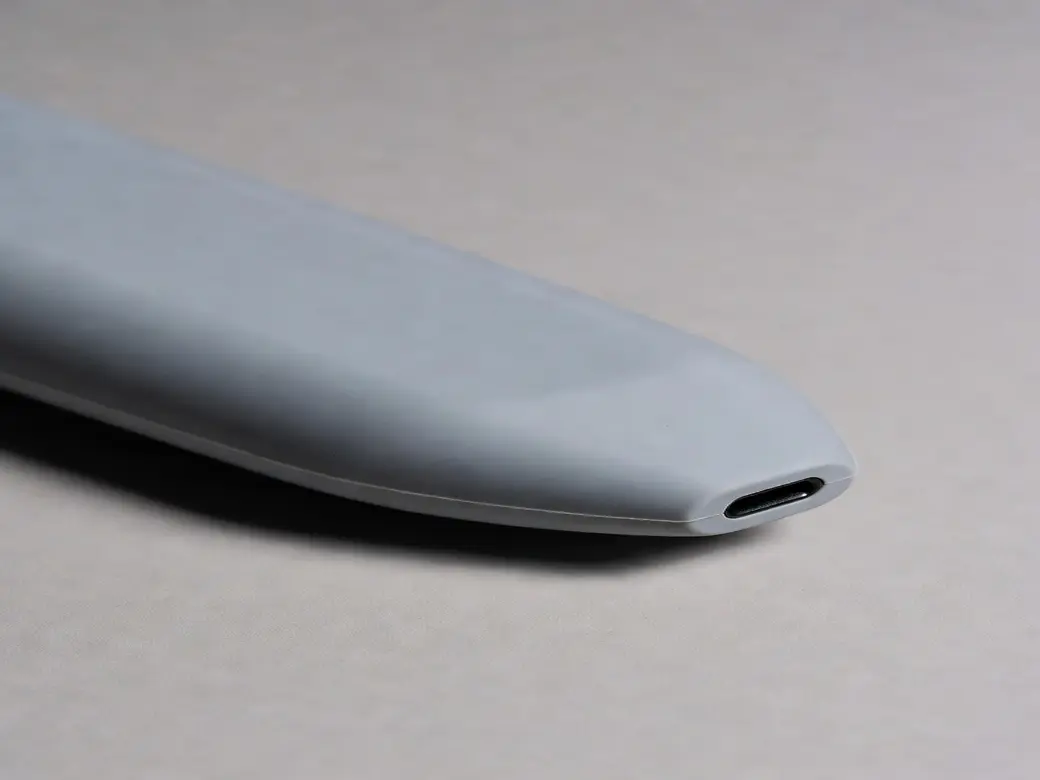
Some rechargeable products use a covered USB port. The protective cover may need to be fully inserted before the product is exposed to water. A cover that looks closed but is not properly seated could leave the opening vulnerable.
Other products use magnetic charging contacts on the surface. Visible metal contacts do not necessarily mean the internal enclosure is open. The charging connection may be external while the electronics remain sealed inside. The product’s rating—not the visual appearance of the contacts—should guide the decision.
Regardless of the charging design:
- Disconnect the charging cable before cleaning.
- Never charge the dildo while it is wet.
- Dry the charging area completely before reconnecting it.
- Inspect covers, contacts and surrounding material for damage.
- Follow the instructions supplied with that specific model.
These details should also be checked before purchasing any rechargeable product featured in a vibrating dildo guide.
A convincing “waterproof” claim is not simply a word in the product title. It should be supported by a recognizable rating, clear instructions and a design that remains in good condition over time.
What If a Product Has No IP Rating?
Not every water-resistant dildo carries a published IP rating. This is particularly common with inexpensive products, unbranded models and simple non-vibrating dildos.
The absence of an IP rating does not automatically mean the product will be damaged by a few drops of water. It does mean that the shopper has less verifiable information.
Before buying, look for three forms of evidence:
- Instructions from the manufacturer explaining how the product may be cleaned
- A clear statement distinguishing splashing, rinsing and immersion
- Warranty terms that do not contradict the advertised water protection
Physical appearance is not enough. A dildo may appear seamless while having a vulnerable charging port or poorly sealed button. If an electronic model has no rating and no detailed instructions, it is safest to treat it as splash-resistant rather than submersible.
For a manual dildo, check the construction. A solid, one-piece model is generally easier to evaluate than one containing glued decorations, separate inserts or unknown coatings.
Match the Rating to the Intended Use
Different activities expose a product to different amounts of water. Instead of asking only, “Is this dildo waterproof?” ask what kind of water contact you actually need it to tolerate.
| Intended use | What to check before use |
|---|---|
| Wiping with a damp cloth | Manufacturer-approved surface-cleaning instructions |
| Brief surface rinsing | Confirmation that running water is permitted |
| Cleaning around buttons or seams | Appropriate IP rating and instructions for those areas |
| Use in a shower | Explicit shower-use approval, not simply “washable” |
| Temporary immersion | An immersion rating plus stated depth and time limits |
| Longer bath use | Manufacturer-defined IPX8 conditions and operating instructions |
| Charging after cleaning | A completely dry charging area and disconnected power source |
A rating should never be separated from the manufacturer’s intended use. For example, an IPX4 product may tolerate splashes but should not be treated like a submersible dildo. An IPX8 model offers stronger immersion protection, but its permitted conditions still need to be checked.
Warning Signs in Waterproof Product Listings
Some product pages use reassuring language without supplying enough detail. Be cautious when you notice any of the following:
- “100% waterproof” with no rating, manual or testing information
- Different waterproof claims for the same model on different websites
- “Washable” being used as evidence that full immersion is safe
- A charging-port cover with no instructions explaining when it must be closed
- No identifiable manufacturer or customer-support contact
- Product images displaying an IP rating that is absent from the specifications
- Warranty terms excluding all water exposure despite a waterproof advertisement
- Statements such as “safe at any depth” or “can remain underwater indefinitely”
These inconsistencies do not prove that the product is defective. They indicate that the claim should be verified before water exposure.
For unfamiliar manufacturers, the same type of verification can be incorporated into a broader dildo brand evaluation process.
Do Waterproof Ratings Last Forever?
An IP rating applies to the product in its tested condition. It should not be assumed that every unit will retain identical protection after years of use.
Regularly examine electronic dildos for:
- Fine cracks in the outer material
- Separating seams
- Loose buttons
- Warped charging covers
- Corrosion or discoloration around charging contacts
- Damage caused by dropping the product
- Changes in the fit of removable compartments
Stop exposing the product to water if its enclosure appears damaged. A cracked outer shell can affect both hygiene and electronic safety, even when the motor continues to operate normally.
Storage also matters. Avoid placing heavy objects on a charging-port cover or leaving the dildo tightly bent if its construction is not designed for that position.
What to Do After Accidental Submersion
If a non-submersible electronic dildo falls into water, remove it promptly and switch it off if this can be done safely.
Do not immediately test the motor or connect the charger. Instead:
- Disconnect any cable or external power source.
- Dry the exterior with a clean towel.
- Position the product so water can drain away from openings.
- Allow it to dry completely in a ventilated area.
- Consult the manufacturer before attempting to charge it.
Do not use an oven, microwave or high-temperature hair dryer to accelerate drying. Excessive heat can damage the material, battery and internal seals.
If the product becomes unusually warm, develops an odor, makes unexpected sounds or shows signs of battery swelling, stop using it. Follow the manufacturer’s disposal instructions and your local rules for products containing rechargeable batteries.
Waterproof Dildo Buying Checklist
Before adding an electronic dildo to your cart, confirm the following:
- Is the exact IP rating shown?
- Does the manufacturer permit rinsing, shower use or immersion?
- Are maximum depth and duration stated?
- Must the charging-port cover be closed?
- Can the controls be operated while wet?
- Does the manual explain drying and charging?
- Are the product page, packaging and warranty consistent?
- Is customer support available if the claim is unclear?
A shorter product description is not necessarily a problem, but essential water-protection information should be specific and consistent.
Frequently Asked Questions
Can an IPX4 dildo be washed under a faucet?
IPX4 indicates splash protection, not immersion. Because a faucet can produce concentrated, continuous water pressure, follow the product’s cleaning instructions rather than assuming that any method of rinsing is acceptable.
Does IPX7 automatically make a dildo shower-safe?
IPX7 indicates temporary-immersion protection under specified test conditions. However, the manufacturer should still confirm approved real-world uses. Soap, heat, moving water and prolonged exposure may not match the test environment.
Is IPX8 always better than IPX7?
IPX8 represents immersion protection beyond IPX7 test conditions, but its exact depth and duration are defined for the individual product. Compare the manufacturer’s stated conditions instead of judging by the number alone.
Are all silicone dildos waterproof?
A solid, one-piece silicone dildo without electronics is generally washable and not dependent on an electronic waterproof enclosure. However, a silicone exterior does not automatically protect an internal motor, battery, seam or charging port. Always evaluate the complete construction.
Can I charge a waterproof dildo while it is wet?
No. Disconnect it from power before cleaning and allow the product—especially its charging area—to dry completely before charging. A waterproof-use rating does not mean the product is safe to charge near water.
Can lubricant affect a waterproof seal?
The IP rating describes resistance to water ingress, not compatibility with every lubricant or chemical. Use a lubricant approved for the dildo’s material and avoid allowing residue to collect around charging covers or seams. See our dildo lubricant compatibility guide for material-specific advice.
Final Thoughts
The best waterproof claim is one you can verify.
Start with the wording on the product page, confirm it through the IP rating, and finish by reading the manufacturer’s restrictions. “Water-resistant” should never be interpreted as permission for immersion, while “IPX8” should never be interpreted as unlimited protection.
Choosing the right rating helps protect the product’s motor and battery while making everyday care more predictable. When the description is unclear, ask the seller before placing the dildo underwater.
Ready to compare your options? Explore our waterproof and water-resistant dildos and check each product page for its construction, charging design and recommended cleaning method.