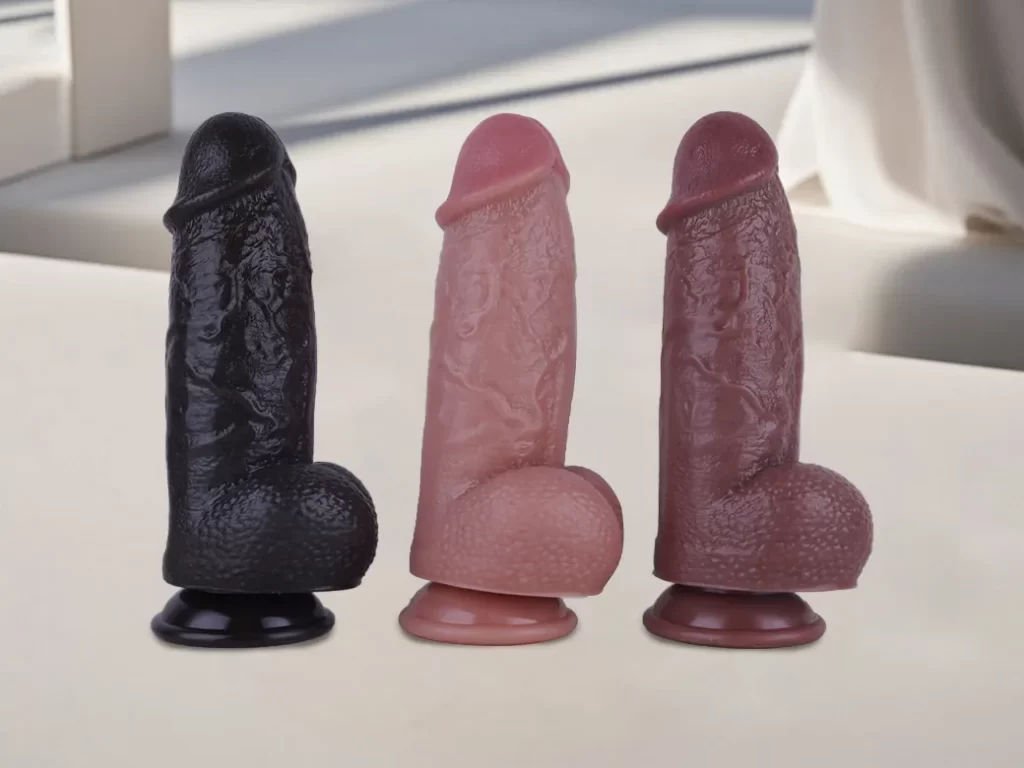


A Package Is a Set of Clues, Not a Safety Certificate
A dildo box can display a reassuring list of words—“body-safe,” “medical grade,” “waterproof,” “FDA registered,” or “tested.” The useful question is what each statement refers to, and whether the label gives enough detail to check it.
Read the package in layers: identify the body-contact material, check what the dildo is designed for, find care and compatibility instructions, and then examine any certification or performance claims. A polished badge can catch your eye; a specific material name, model number, manufacturer, and clear instructions give you more to work with.
Quick rule: Treat a broad claim as a prompt to look for details. A phrase or logo alone does not tell you the exact material, test scope, or intended use.
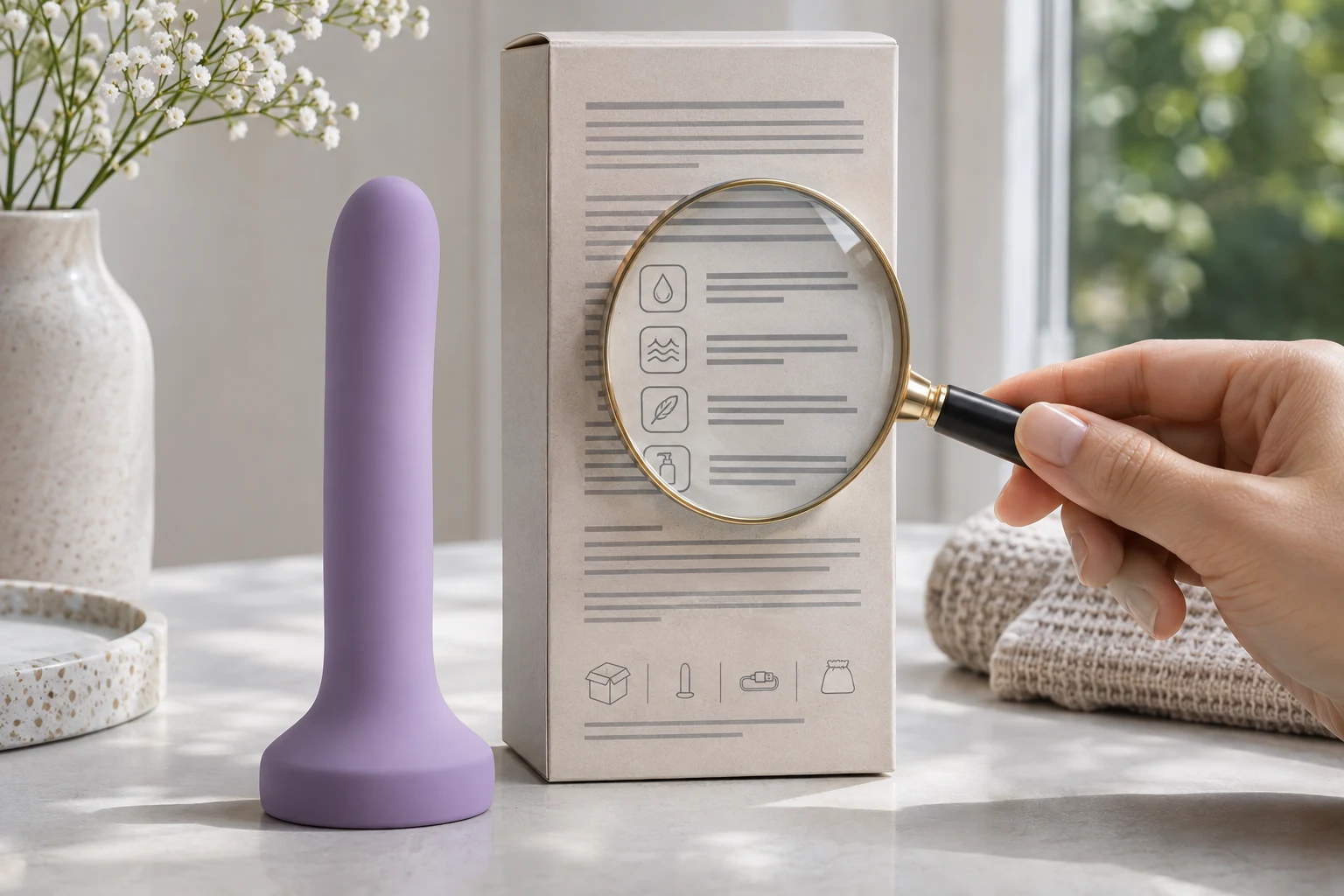
Start With These Five Label Checks
- Exact body-contact material: Does the label name the material that touches the body, rather than using only a feel or quality description?
- Construction: Does it identify a different core, coating, outer layer, or electronic component?
- Intended use: Does the description clarify whether the dildo is designed for external use, insertion, anal use, harness use, or mounting?
- Care instructions: Does it explain how to clean, dry, store, and use lubricant with this specific design?
- Traceable claims: For a certification or test claim, can you find the standard, report, tested part, issuing body, or responsible manufacturer?
Not every package prints every detail. Some information may be on an insert, the manufacturer’s site, or a model-specific product page. If the material or instructions remain unclear, ask the seller to confirm them for the exact model or SKU.
Packaging Words: What They Tell You—and What They Leave Out
| Label or claim | Useful interpretation | What to verify |
|---|---|---|
| “Silicone” | A claimed material family or surface material | Is the body-contact surface 100% silicone, a blend, a coating, or one layer over another material? |
| “Body-safe” | A broad safety claim | Which exact material, use conditions, care guidance, and supporting evidence does the maker provide? |
| “Medical grade” | A quality-sounding descriptor that needs context | Ask what grade or specification is meant, who verified it, and whether it applies to the finished dildo or only a raw material. |
| “Hypoallergenic” | A claim suggesting reduced allergy potential | Ask what testing or evidence supports it. No label can guarantee that every person will avoid irritation or allergy. |
| “Phthalate-free” | A claim about the absence of specified chemicals | Which phthalates were tested for, using what method, and for which component or batch? |
| “Waterproof” or “water-resistant” | A claim about exposure to water | Look for the exact rating or instructions: immersion, rinsing, shower use, seams, charging ports, and depth may be treated differently. |
| “FDA registered” or “FDA certified” | A regulatory-sounding phrase that can be misunderstood | FDA says a medical-device facility’s registration or device listing does not itself mean FDA approval, clearance, or authorization. |
| “CE” | A mark connected to applicable EU conformity requirements | Check what legislation applies and whether a declaration of conformity or supporting documents identify this model. |
| “ISO 3533 tested/compliant” | A reference to a sex-toy design and safety standard | Ask which model or component was assessed, by whom, and whether the claim is supported by documentation. |
These phrases do not all mean the same thing. A material description is different from a test result; a test result is different from a certification; and a regulatory mark should not be assumed to certify every possible quality or safety attribute.
How to Read the Material Line
Find the material that actually touches the body. A listing that says only “soft-touch,” “skin-like,” “premium,” or “real feel” describes appearance or sensation, not a precise material name. If the dildo has more than one layer, the package should ideally distinguish the outer surface from the core, coating, base, handle, or control parts.
For example, a soft outer layer around a firmer center can feel different from a single-material dildo. A powered design can also contain internal parts that affect cleaning and water exposure. Do not infer the whole construction from a front-of-box phrase such as “silicone dildo.”
When the label names silicone, look for clarification about whether it means solid or 100% silicone, a silicone blend, or a silicone coating over another material. Planned Parenthood recommends checking the care directions for the specific sex toy and distinguishes 100% silicone from silicone blends in its sex toy safety guidance. For more detail, see our guide to what “body-safe” means for sex toys.
Decoding Certification and Compliance Claims
“FDA registered” is not the same as “FDA approved”
The FDA explains that registration of a facility and listing of a medical device do not, by themselves, mean the facility or device has been approved, cleared, or authorized. This FDA distinction applies to medical-device registration and should not be stretched into a claim about every dildo or every product category.
If packaging says “FDA approved,” ask what specific device and intended use the claim refers to, and look for the exact name in the relevant FDA records. The FDA’s page on FDA registration, listing, and approval terms explains the difference.
CE marking is about applicable EU requirements
The European Commission says manufacturers are responsible for carrying out the applicable conformity assessment and preparing the required technical documentation and declaration. A CE mark is not a general award for luxury, durability, or “best quality.” Its relevance depends on which EU rules apply to the specific product.
For an electrical or rechargeable dildo, ask for the model-specific declaration or instructions where appropriate. Read the Commission’s overview of what CE marking means.
ISO 3533 is a standard, not a magic logo
ISO 3533:2021 is titled “Sex toys — Design and safety requirements for products in direct contact with genitalia, the anus, or both.” The ISO page describes the standard’s scope, including safety and user-information requirements for materials and design. A package that mentions the standard should still make clear what was assessed and how the claim is supported. The standard itself does not mean ISO has inspected or certified every item carrying a logo.
See the official ISO 3533:2021 listing for its scope and current status.
Check Intended Use, Size, and Care Instructions
Packaging may describe several uses, but confirm that the instructions match the design. If a dildo is intended for anal insertion, look for a suitable flared base or another secure retrieval feature. If it has a suction base, check which surface types are recommended and whether the maker gives specific mounting instructions.
Dimensions should distinguish total length from insertable length and give width or circumference when available. A photo or silhouette is not a measurement. If you need help comparing body-contact materials and care needs, our dildo cleaning guide covers material-specific care considerations.
For lubricant compatibility, follow the dildo and lubricant instructions together. Planned Parenthood notes that water-based lubricant is a broadly compatible option and cautions that silicone lubricant can damage some silicone sex toys. If a silicone dildo develops an unusual surface, read our guide to silicone cure problems and warning signs.
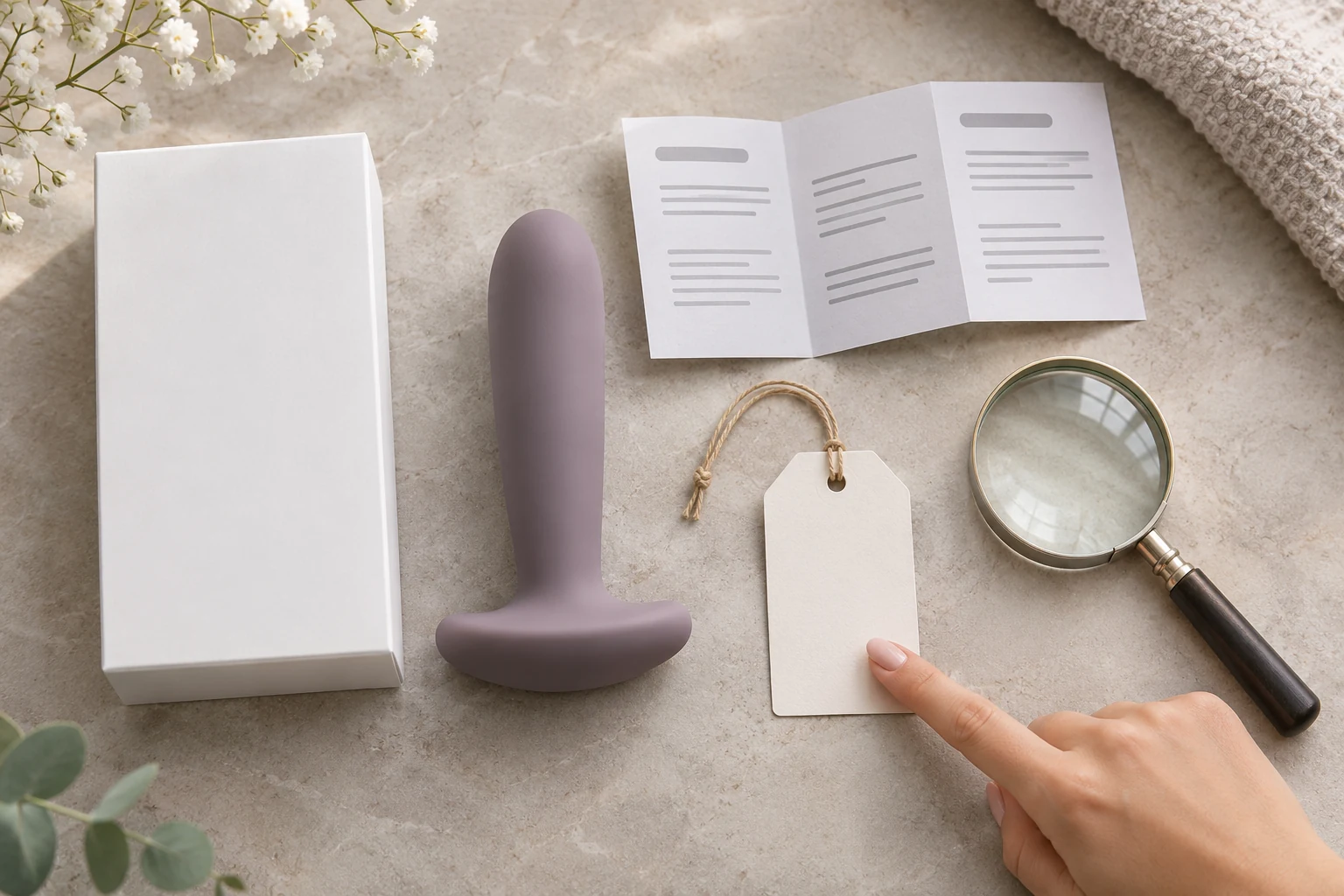
A Three-Minute Label Audit Before You Buy
- Match the model. Confirm the product name, SKU, size, color, and included components. Similar packaging can be used for different versions.
- Write down the body-contact material. If you cannot name it from the listing, ask the seller before purchasing.
- Separate claim from evidence. A badge, phrase, or QR code is a claim. Look for the named standard, test scope, issuing organization, test date, and the exact model covered.
- Check what “waterproof” means. Find the rating or exact care directions, especially for rechargeable or multi-part designs.
- Save the package information. Keep the leaflet, batch code, manufacturer contact, and purchase record in case you need care instructions or support later.
Pause and ask if the package names no material, gives no cleaning instructions, uses a regulatory badge without explaining it, or makes health or safety promises without product-specific support.
Common Packaging Red Flags
- The only material description is “premium,” “realistic,” “skin-like,” or “body safe.”
- A certification or testing logo appears without a standard name, test scope, or identifiable organization.
- “FDA approved” is printed without naming the device, intended use, or relevant record.
- The box says “waterproof,” but instructions warn against rinsing or give no guidance for ports and seams.
- The package and online product page list different materials or conflicting care directions.
- There is no manufacturer or seller contact information, model identifier, or usable instruction sheet.
A missing detail does not prove that a dildo is unsafe or counterfeit. It does mean you have less information to assess it. Ask the seller for a model-specific answer or choose a listing that makes its material and care instructions easier to verify.
FAQ: Dildo Packaging and Label Claims
Does “body-safe” mean the dildo is certified?
Not by itself. “Body-safe” is a broad claim, so look for the exact body-contact material, construction details, intended use, care instructions, and any evidence the manufacturer provides. Our body-safe guide explains why the phrase alone does not identify a material.
Is “medical-grade silicone” enough information?
It is not a complete material specification by itself. Ask which grade or specification the claim refers to, whether it describes the raw material or finished dildo, and what documentation supports it.
What does “phthalate-free” prove?
It is a claim about specified substances, not a full safety assessment of the dildo. If this matters to your purchase, ask which phthalates were tested for, what part was tested, and whether the documentation applies to the model you are considering.
Should every dildo have a CE mark?
No. CE marking applies where relevant EU legislation requires it. A mark should not be treated as a universal quality seal, and the relevant requirements depend on the product type and features.
What if the packaging and website disagree?
Pause before using the dildo. Photograph both versions, note the model or SKU, and ask the retailer or manufacturer which material and care instructions apply to your exact item.
Read the Details Behind the Badge
Packaging is most useful when it helps you identify the exact dildo, understand its body-contact material, use it as intended, and care for it correctly. Treat broad phrases and logos as starting points; verify them against model-specific information and credible documentation. If essential details are missing or contradictory, ask before buying.