


Begin with a two-minute choice
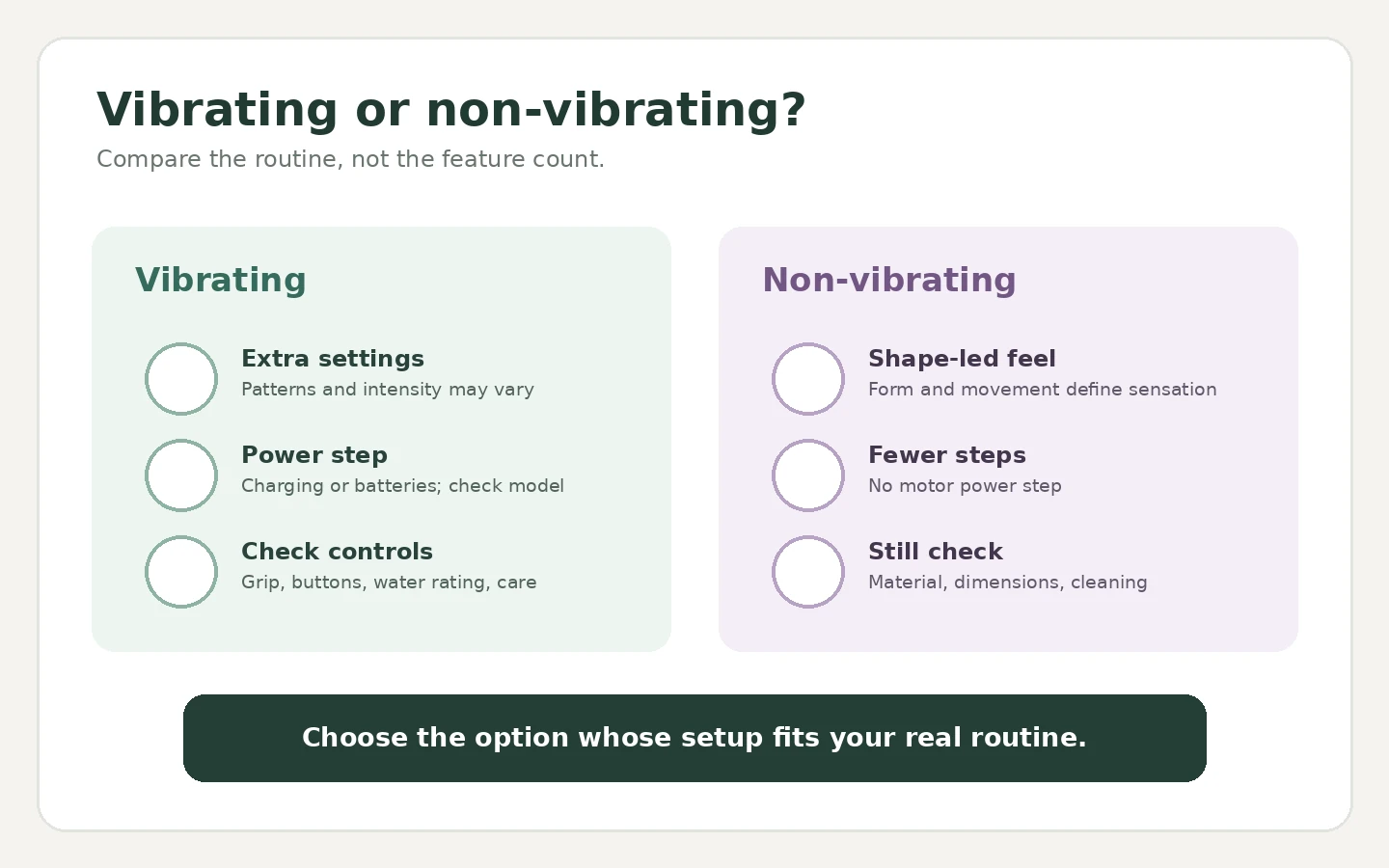
Before comparing models, decide what you want a motor to add. A vibrating dildo may provide motorized stimulation with selectable settings, but that feature also brings controls, a power source, and product-specific care. A non-vibrating dildo removes those electronic steps and puts the focus on shape, firmness, texture, and movement.
Neither type is automatically the better buy. A feature is useful when it answers a preference you actually have. If the appeal of vibration is vague, start by comparing physical fit and handling. If you already know adjustable vibration matters to you, focus on the controls and ownership details as closely as the settings themselves.
Fast decision: Choose a vibrating dildo when motorized stimulation is a specific priority and its controls and charging routine feel manageable. Choose a non-vibrating dildo when you want fewer operating steps and prefer to choose by shape, firmness, and grip.
Use this priority scorecard before opening product tabs
Give each factor a score from 0 to 2: 0 means it is not important, 1 means it would be nice, and 2 means it is a must-have. Score your own priorities first, then use the table to decide which specifications deserve the most attention.
| Priority | Your score | If you score this high… |
|---|---|---|
| Adjustable motorized sensation | 0 / 1 / 2 | Compare controls, settings, and how easily you can change them. |
| No charging or battery routine | 0 / 1 / 2 | Begin with non-vibrating designs or check whether a powered model’s charging setup fits your habits. |
| Easy grip and reachable controls | 0 / 1 / 2 | Prioritize handle width, weight, balance, button size, and button placement. |
| Low operating noise | 0 / 1 / 2 | Look for information about the exact model; do not assume all motors sound alike. |
| Simple cleaning and storage | 0 / 1 / 2 | Compare materials, interfaces, water rating, care instructions, and included accessories. |
| A particular shape or firmness | 0 / 1 / 2 | Compare dimensions and construction before deciding whether vibration matters. |
How to read your scores: If motorized sensation is your only high score, compare powered models—but keep the care and charging checks in view. If grip, simplicity, shape, or firmness scores higher, those factors should lead your comparison in either category. A tie is a useful result: it means you should compare specific designs rather than choose by category name alone.
Compare the whole ownership experience
| Stage | Vibrating dildo | Non-vibrating dildo | Question to ask |
|---|---|---|---|
| Before use | May need charging, battery replacement, or a control lock check. | No motor power step; inspect and prepare it according to its instructions. | How much setup do I want? |
| During use | Motor settings and controls add options; buttons may affect grip. | Shape, firmness, texture, and movement define the experience. | Which features do I expect to use? |
| Sound | The motor can make noise; amount varies by design, setting, and conditions. | No motor noise, though movement or suction can still make sound. | Do I need model-specific sound information? |
| Cleaning | Care depends on material, construction, water rating, ports, and controls. | Care still depends on material and construction. | Can I find clear instructions for this exact model? |
| Storage | May include a cable or control lock; prevent accidental activation as directed. | Fewer electronic accessories, but the material still needs appropriate storage. | Where will the dildo and accessories go? |
| Support | Charging or control issues may make warranty and seller support especially relevant. | Support still matters for material, construction, or delivery problems. | Can I identify the seller and warranty terms? |
Find your route through the decision
Different preferences point toward different specifications. Use this scenario matrix to decide what to inspect first; it is not a universal recommendation for every person.
| Your situation | Start with | Then verify |
|---|---|---|
| You specifically want adjustable vibration. | Button layout and settings | Power type, charging instructions, sound information, and care guidance. |
| You would rather not charge another device. | Non-vibrating options | If comparing powered models, identify the exact charging method and routine. |
| Your hand tires easily or you have limited reach. | Grip, weight, balance, and control access | Button size, operating pressure, handle width, and whether controls can be reached without changing grip. See our accessible dildo selection guide. |
| You care about sound and discretion. | Specific product sound details | Reviews or demonstrations for that model; a non-vibrating design has no motor noise, but other sounds are possible. |
| Shape and firmness are your main concerns. | Dimensions, curve, head shape, base, and firmness | Whether a motor adds a feature you actually want. Our soft vs. firm dildo guide explains how firmness affects handling. |
| You want a manageable care routine. | Material and construction | Seams, charging interfaces, water rating, and the manufacturer’s cleaning instructions. |
Read a vibrating dildo listing in four passes
Pass 1: Can you operate it comfortably?
Find the control area in the photos. Can you distinguish the buttons by touch? Can you reach them without shifting your grip? Is there a lock for storage, and does the listing explain how it works? Button count alone says little about usability. A few clearly placed controls may be more practical than many modes behind a small or hard-to-reach panel.
Compare weight and handle dimensions too. A control layout can look clear but feel awkward if the dildo is difficult to hold steadily. If grip or reach is important, ask the seller for close-up photos or model-specific measurements when the listing leaves these points unclear.
Pass 2: What is the power arrangement?
Powered models may use a built-in rechargeable battery, replaceable batteries, or a specific charging connector. Confirm what is included and follow the maker’s charging instructions. Cables that look similar are not automatically interchangeable. For connector details, see dildo charger types explained.
Think beyond the first charge. Will you remember to recharge it? Do you have a place to keep the cable? If the product uses replaceable batteries, can you identify the type from the listing? Those small ownership details can determine whether the powered feature fits your routine.
Pass 3: What does the water and care information actually say?
A motor does not tell you whether a dildo can be rinsed, submerged, or used around water. Look for a clear rating and instructions covering buttons, seams, ports, and charging covers. Do not infer water resistance from a smooth exterior or a closed-looking port. Our article on waterproof vs. water-resistant dildos explains why the wording matters.
Check that the care information applies to the complete design, not only its outer material. If a label uses broad terms without naming the body-contact material or giving care directions, consult our guide to reading dildo packaging and look for model-specific instructions.
Pass 4: How will you store it?
Confirm whether the dildo includes a travel lock and how the maker recommends preventing accidental activation. Consider the cable, charger, and any other accessories as part of the storage footprint. If the control area can be pressed while packed away, follow the manufacturer’s guidance for locking or storing it separately.
Evaluate a non-vibrating dildo by its physical design
Without motor settings, the shape and construction do more of the decision-making. Compare usable length, widest point or circumference, curve, head shape, base, and overall firmness. Product photos can make dimensions difficult to judge, so use the measurements and any scale reference rather than relying on a close crop.
Firmness and flexibility are related, but they are not the same thing: a dildo’s thickness and internal construction can change how much it bends or compresses. If control and shape retention matter, compare these details before deciding that a motor is the most important feature. A suction base, flared base, or harness-compatible base also serves a different purpose; select a base suited to the setup you intend to use.
“Non-vibrating” means there is no motor to manage. It does not necessarily mean the dildo is one-piece, has no seams, or needs no care. Verify the material and construction just as you would for a powered design.
Compare the hidden costs of each design
“Cost” includes more than the price shown on the product page. Use this ownership timeline to surface recurring effort before buying.
| When | Powered design: check for | Non-powered design: check for |
|---|---|---|
| At purchase | Included charger or batteries, warranty coverage, control features, and any compatibility notes. | Material details, dimensions, firmness, base type, and care directions. |
| Before each use | Charge level, lock status, and button familiarity. | Product condition and any setup requirements specified by the maker. |
| After use | Cleaning directions around interfaces and confirmation that the product is dry before charging or storage, as instructed. | Cleaning and drying appropriate to the material and construction. |
| Between uses | Safe storage for the dildo and cable; accidental activation prevention. | Storage compatible with the material and surface finish. |
| If something stops working | Support for the battery, controls, cable, or charging connection. | Support for defects in material or construction. |
This is not a claim that one type always costs more to own. It is a reminder to compare the specific model, included accessories, warranty, and care instructions rather than judging only by its feature label.
A product-page audit you can complete side by side
Open two listings and fill in the same details for each. If one listing leaves important rows blank, that is useful information: you may need to contact the seller or choose a listing with clearer specifications.
| Specification | Listing A | Listing B | Why it matters |
|---|---|---|---|
| Usable length / widest point | ________ | ________ | Photos and total length can obscure the dimensions that affect fit. |
| Firmness / flexibility description | ________ | ________ | Shape and construction affect handling regardless of motor type. |
| Control placement / settings | ________ | ________ | Important for powered designs and grip comfort. |
| Power / charger details | ________ | ________ | Confirms setup, accessories, and connector requirements. |
| Material / water rating | ________ | ________ | Guides care; do not infer it from appearance. |
| Cleaning / storage instructions | ________ | ________ | Shows whether the care routine fits your habits. |
| Warranty / support contact | ________ | ________ | Useful if controls, charging, or construction have an issue. |
Common comparison traps
- Choosing by mode count. A long list of settings is not a benefit if you do not plan to use them or cannot operate the controls comfortably.
- Assuming powered means waterproof. Water protection is model-specific. Check the rating and care directions.
- Assuming non-vibrating means maintenance-free. Every dildo needs care suited to its material and construction.
- Using photos as measurements. Camera angles, cropping, and scale can distort size. Compare stated dimensions.
- Expecting a motor to correct poor fit. Vibration adds a feature; it does not change whether a shape, firmness, or size suits your preference.
- Comparing noise by category alone. A non-vibrating design has no motor sound, but movement or suction may make sound. Motor noise varies by model.
- Ignoring the base and handle. These affect grip, positioning, mounting, or storage. They matter in both categories.
Pause before buying if: the listing does not identify the power type, the charging method is unclear, the water claim conflicts with the care instructions, or the seller cannot clarify which dimensions apply to the exact model.
Decision path: choose your next comparison
- If adjustable vibration is essential, compare control access and power first, then review sound, care, water rating, and warranty.
- If charging is a drawback, start with non-vibrating designs and compare shape, firmness, base, and grip.
- If you are undecided, shortlist one design from each category with similar dimensions and firmness. Compare the ownership details, not just the feature labels.
- If accessibility is central, prioritize handle dimensions, weight, balance, and control reach. Ask for missing measurements before deciding.
- If product information is incomplete, request clarification about the exact model instead of guessing from photos or generic claims.
Frequently asked questions
Is a vibrating dildo better than a non-vibrating dildo?
Neither is universally better. A vibrating dildo adds motorized stimulation and controls; a non-vibrating dildo removes those electronic steps. The better match depends on your priorities, preferred shape and firmness, and willingness to manage power and care details.
Are non-vibrating dildos quieter?
They do not make motor noise, but movement or suction can still make sound. A vibrating model’s noise depends on the specific design and setting, so look for information about that model when sound matters.
Are vibrating dildos more difficult to clean?
They may require attention around controls, seams, or charging interfaces. The right cleaning method depends on material, construction, and water rating. Follow the maker’s directions for the exact model rather than applying one method to every dildo.
Can I use a vibrating dildo with the motor off?
Some models can be used without activating the motor, but this depends on their design. Check the product description and manual. If you do not expect to use vibration, compare whether a non-vibrating design offers a shape or grip you prefer.
What should I check before buying a rechargeable dildo?
Confirm the charging connector, included cable, power instructions, control layout, water rating, cleaning directions, and warranty. Do not substitute a charger based only on how it looks.
Does a non-vibrating dildo need batteries?
A non-vibrating dildo has no motor power step unless the design includes another electronic feature. Check the listing and instructions to confirm the construction of the exact model.
What if I want vibration but the controls look difficult to reach?
Prioritize button placement, size, operating pressure, handle grip, and any alternative control method. If the listing does not explain these details, ask the seller before purchasing. Our accessible dildo guide includes more points to compare.
Let the trade-off decide
Vibration can add adjustable stimulation, but it also adds controls, power needs, and details to check during cleaning and storage. A non-vibrating dildo removes the motor routine but asks you to choose more carefully by shape, firmness, and handling. Use the scorecard and product-page audit to identify which trade-off matters less to you. Once that is clear, the category decision becomes much easier.