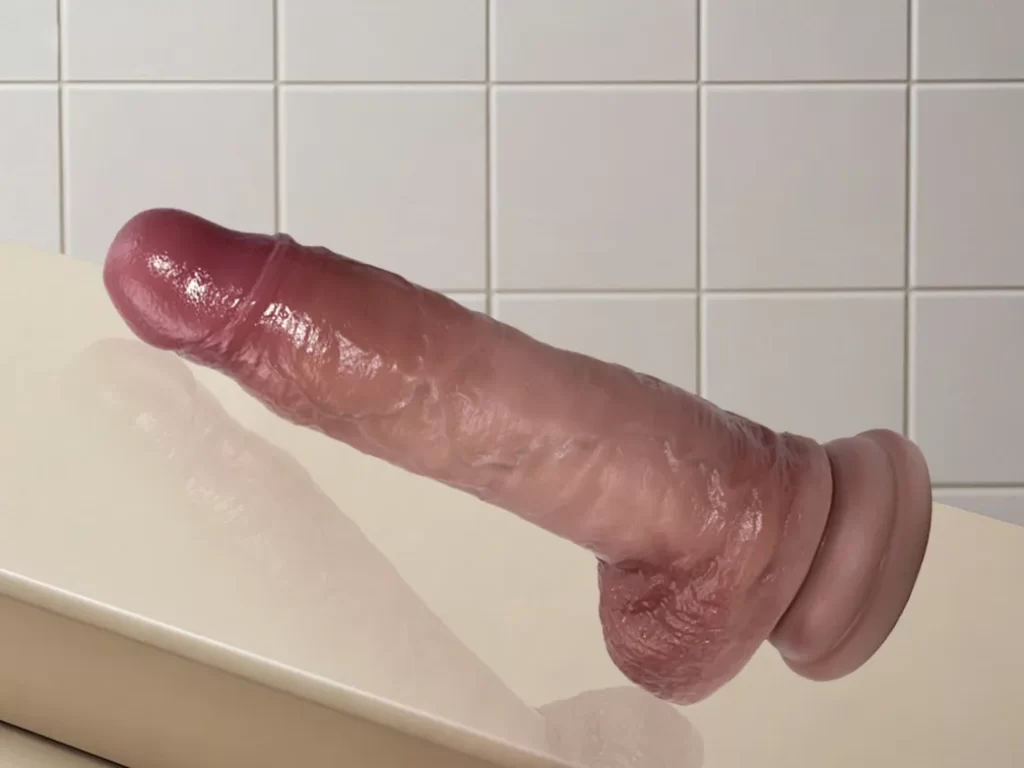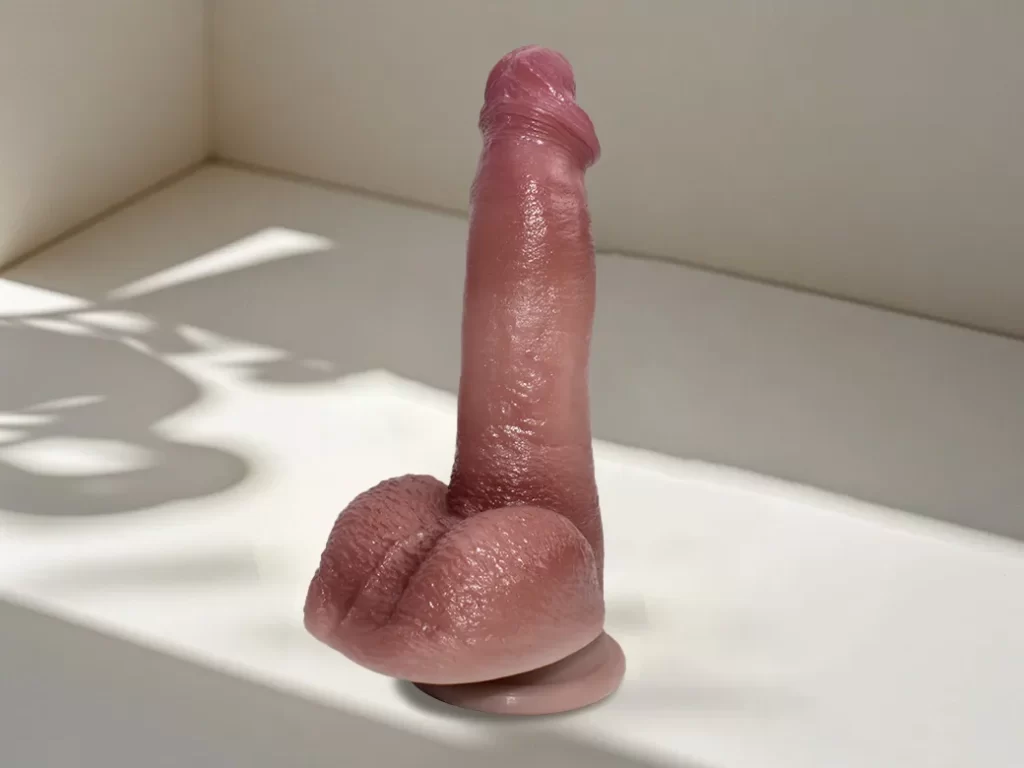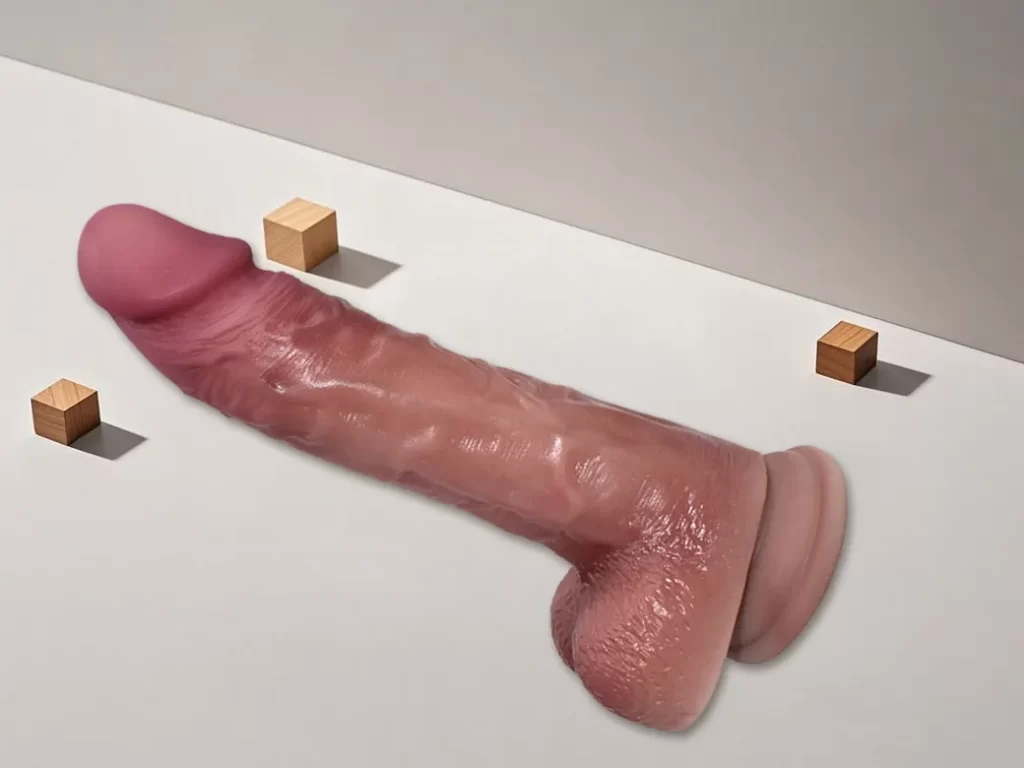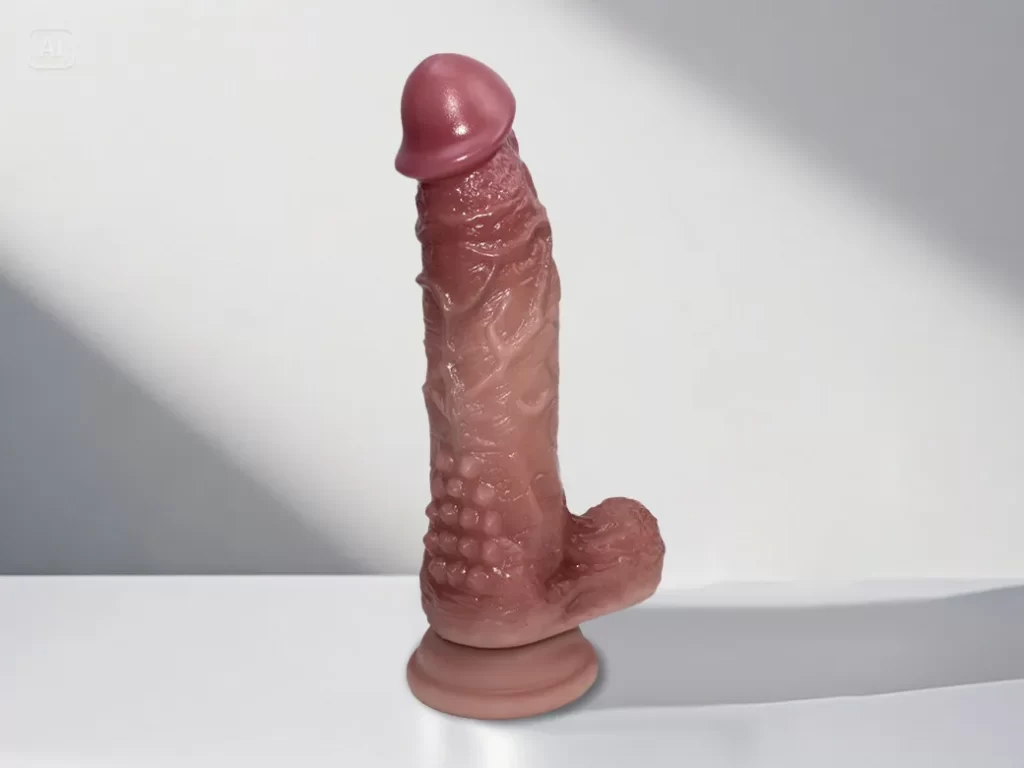

A tiny mark becomes important only after you determine what kind of mark you are actually looking at.
A small circular spot on a dildo may be a closed bubble beneath the surface, a shallow molding depression, an open pinhole, a texture detail, a pigment variation, or the beginning of physical damage. Under ordinary room lighting, several of these can look almost identical.
The distinction matters because a closed, stable cosmetic mark is a different situation from an opening that breaks the body-contact surface.
Do not poke, cut, stretch, squeeze, or puncture the area to find out what is underneath. Start with observation instead: good lighting, several viewing angles, photographs, and a comparison after normal cleaning and drying.
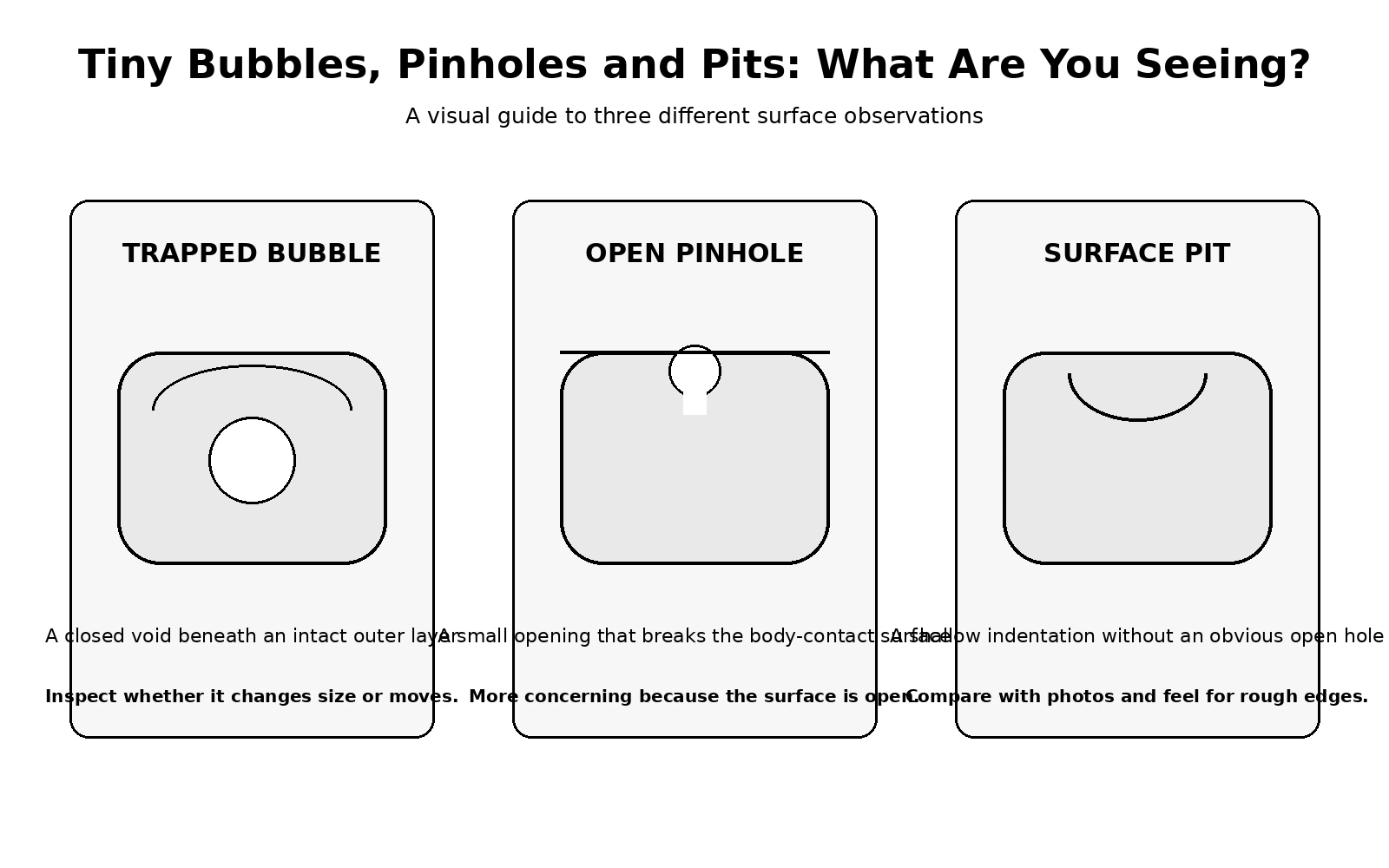
First Identify Which Type of Mark You Have
Before deciding whether a dildo is defective, separate three observations that buyers frequently describe with the same word: “hole.”
| What You See | What It May Be | Most Important Question |
|---|---|---|
| Round mark beneath a smooth surface | Possible trapped bubble or internal void | Is the outer surface completely intact? |
| Tiny visible opening | Pinhole, puncture or molding void reaching the surface | Does the opening break the body-contact surface? |
| Shallow depression | Surface pit, molding variation or pressure mark | Is it smooth, stable and closed? |
| Raised blister-like area | Possible trapped void, layer movement or delamination | Is it growing, moving or changing when the dildo flexes normally? |
| Irregular dark spot | Pigment variation, contamination or material change | Is it on the surface, inside the material, or removable during approved cleaning? |
The goal is not to diagnose the manufacturing process from appearance. A buyer normally cannot tell exactly how a mark formed. The practical goal is to decide whether the dildo has a closed cosmetic irregularity or an open, changing or structurally concerning defect.
Why Can Bubbles Form During Silicone Manufacturing?
Liquid silicone used in molding can trap air during mixing, transfer, filling or curing. Industrial silicone-processing guidance commonly discusses vacuum degassing because entrained air can otherwise remain in viscous silicone and form bubbles or voids.
For example, silicone manufacturer Smooth-On explains that high-viscosity silicone can retain air bubbles if it is not adequately degassed before curing. Its technical guidance on silicone degassing describes this as a manufacturing and casting issue. That information helps explain one possible mechanism, but it does not allow a consumer to determine how a particular dildo was manufactured.
Other manufacturing variables can also affect the finished appearance, including:
- How the liquid material flows through the mold
- The viscosity of the formulation
- Mold geometry
- Vent placement
- Injection or pouring technique
- Curing conditions
- Multiple layers or densities
- Pigment distribution
- Surface finishing after demolding
A tiny bubble therefore does not automatically prove poor manufacturing. Location, depth, surface integrity and whether the mark changes over time matter more to the buyer.
Important: You usually cannot determine whether a dildo was correctly degassed, cured or molded simply by looking at one small spot. Describe what you can actually observe rather than guessing at the manufacturing cause.
A Closed Bubble Is Different From an Open Pinhole
A closed bubble sits beneath an intact outer layer. The exterior may still feel smooth even though a small circular void is visible through translucent or lightly colored material.
An open pinhole reaches the surface. Even if the opening is extremely small, the continuous molded exterior has been interrupted.
This difference is more useful than asking whether the mark is one millimeter or two millimeters wide.
Characteristics of a Closed Bubble
A possible closed bubble may:
- Appear beneath a smooth surface
- Have a rounded or oval shape
- Remain the same size when viewed over time
- Be visible only at certain angles
- Have no sharp edge
- Show no liquid or residue
- Cause no change in surface texture
Do not repeatedly squeeze the area to make the bubble move. Excessive manipulation can turn a harmless observation into actual damage.
Characteristics of an Open Pinhole
An open pinhole may appear as:
- A tiny dark opening
- A small crater with a visible center
- A spot that catches a fingernail
- A hole surrounded by a thin edge
- A point where moisture or residue collects
- A small opening next to a seam or layer boundary
If you can clearly see that the surface is open, do not attempt to fill it with glue, silicone sealant, adhesive, nail product, wax or another home repair material.
Our article Can You Repair a Damaged Dildo? explains why covering a defect does not necessarily restore the original molded surface or cleanability.
Surface Pits Can Be Easy to Misread
A pit is usually a depression rather than a tunnel into the material.
Under front lighting, a shallow pit can look like a dark hole because the indentation creates shadow. That is why side lighting is useful.
Move a bright light across the surface rather than shining it directly toward the dildo. A shallow depression will often reveal its shape as the shadow moves.
Do not stretch the dildo until the pit opens wider. The purpose of inspection is to observe its existing condition, not force the material to reveal its weakest point.
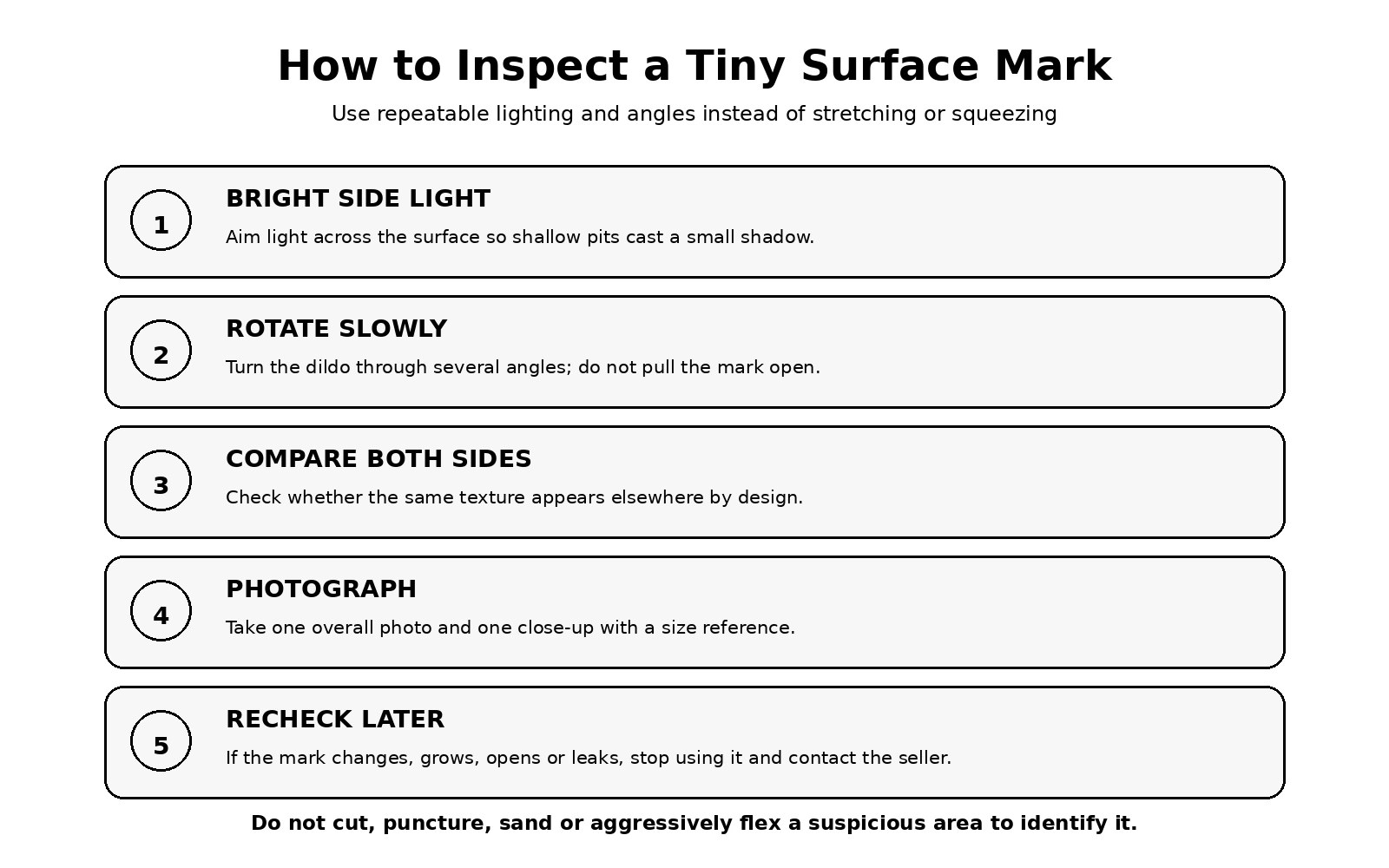
Use a Five-Minute Surface Inspection
You do not need laboratory equipment. A simple, repeatable inspection provides much more useful information than repeatedly pressing the same spot.
1. Clean and Dry the Dildo as Directed
Lubricant, soap, lint and water can distort the appearance of small surface details.
Use the cleaning method recommended for the dildo, rinse when required, and allow it to dry completely before inspection.
If you are inspecting a newly purchased dildo, first follow the steps in our New Dildo Checklist.
2. Use Bright Side Lighting
A phone flashlight or desk lamp positioned to the side can make raised and recessed areas easier to distinguish.
Look at the mark from at least three angles.
3. Compare the Opposite Side and Nearby Texture
Realistic dildo designs may contain molded pores, veins, folds and intentionally irregular texture.
If the same small depressions repeat consistently across the surface, they may be part of the molded finish rather than isolated damage.
4. Take Photographs
Take:
- One photograph of the entire dildo
- One close-up of the mark
- One side-lit photograph
- One image with a ruler or neutral size reference nearby
Do not press the ruler directly into soft material.
5. Compare Later Rather Than Manipulating It
If the mark is unclear but the surface appears closed and intact, record it and compare again later.
A stable one-millimeter cosmetic mark and a bubble that steadily enlarges are different situations.
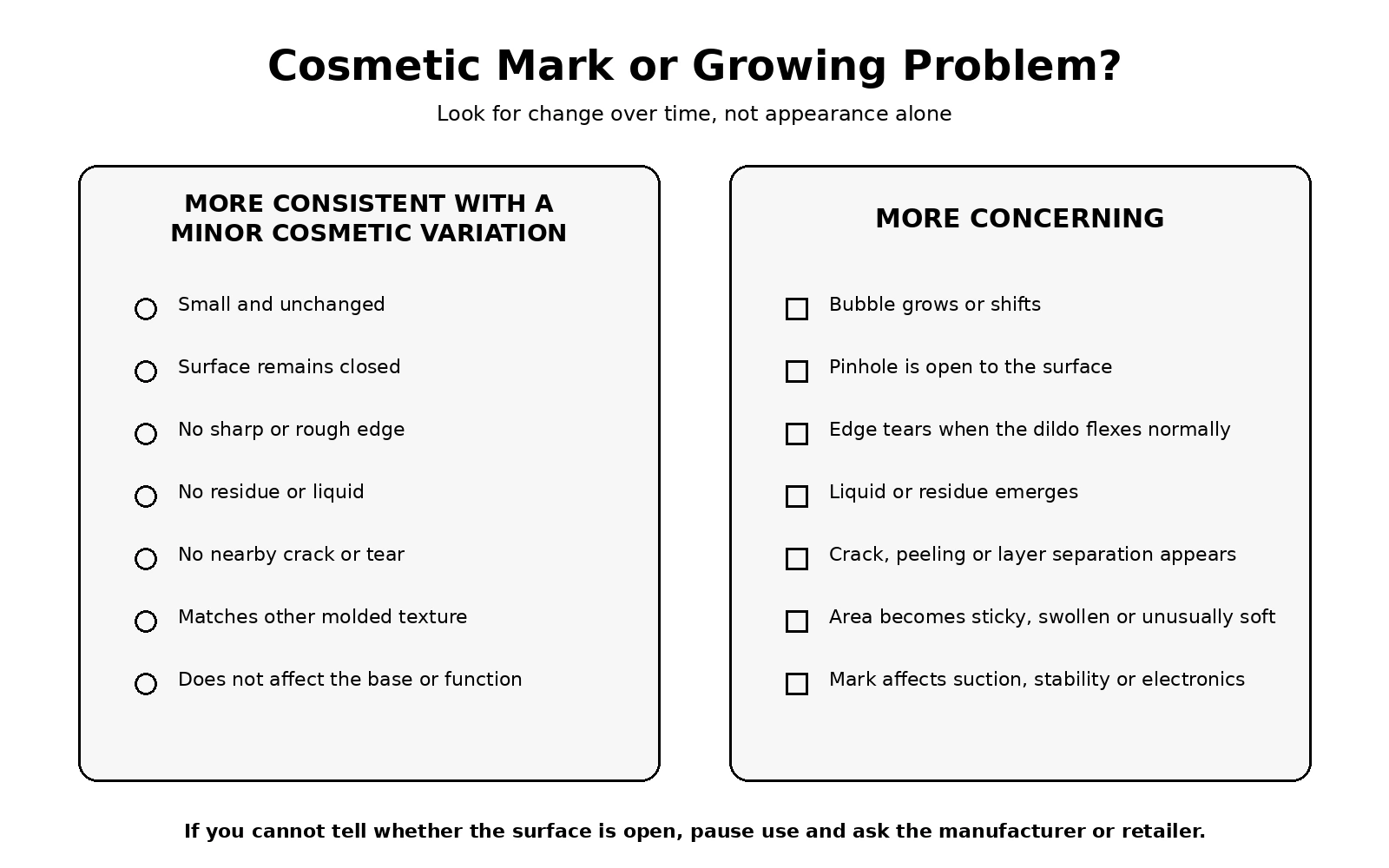
What Makes a Bubble More Concerning?
Size alone is not the best indicator.
A larger but completely stable internal bubble may be less concerning than a tiny opening located beside a tear.
| Observation | More Consistent With a Cosmetic Variation | More Concerning |
|---|---|---|
| Surface | Smooth and closed | Open hole, tear or rough edge |
| Size | Unchanged | Growing or spreading |
| Material around it | Same firmness and texture | Sticky, swollen, thin or unusually soft |
| Nearby structure | No crack or separation | Crack, seam opening or layer movement |
| Residue | None | Liquid, oily residue or unexplained material emerges |
| Function | No effect | Affects suction, structure or electronic housing |
Location Matters
The same small bubble may deserve different attention depending on where it appears.
Middle of a Thick Shaft
A small closed mark inside a thick section may remain purely cosmetic if the outer layer stays intact and the mark does not change.
Near the Tip
The tip often flexes more than thicker areas. A surface opening or thin section here deserves closer inspection because repeated bending may place more stress on it.
Where the Shaft Meets the Base
This transition can experience leverage during handling and suction use. A bubble accompanied by cracking, tearing or movement at the shaft-to-base connection is more important than an isolated visual mark elsewhere.
Along a Mold Line
A small mark beside a seam or mold line should be checked to determine whether the line remains closed.
A smooth visible line can simply reflect the manufacturing process. A gap that separates when the dildo moves normally is different.
Inside a Dual-Density Layer
Dual-density construction can make internal features easier to see because a soft exterior may be translucent.
A small isolated bubble does not automatically mean the layers are separating. However, a growing pocket, sliding outer layer or expanding void may indicate a different problem.
If the outer layer appears to move independently, compare it with our guide to dual-density dildo layer separation.
Do Tiny Bubbles Mean the Silicone Was Not Fully Cured?
Not necessarily.
An air bubble and a cure problem are different manufacturing concepts.
Trapped air concerns a void in the material. Curing concerns the chemical transformation of the silicone system into its finished elastic state.
A consumer normally cannot prove either process from one visual feature.
Our guide Is My Silicone Dildo Fully Cured? explains why tackiness, odor or appearance alone cannot certify or diagnose curing quality.
Pay more attention if the bubble appears together with:
- Persistent gummy areas
- Material transferring onto a clean cloth
- An oily film that repeatedly returns
- Peeling
- Cracking
- Major unexpected softness
- A strong new odor combined with other changes
Those signs justify contacting the retailer or manufacturer, but they still do not let a buyer identify the exact manufacturing failure at home.
Can a Bubble Grow Over Time?
A mark that appears unchanged for months should be evaluated differently from one that becomes visibly larger.
Possible changes worth documenting include:
- The circle becomes wider
- The bubble moves toward the surface
- The exterior becomes raised
- A previously closed area opens
- A crack develops from the edge
- The surrounding material becomes thinner
- A second void appears beside the first
Take photographs from the same distance and angle whenever possible. This is much more reliable than trying to remember whether the spot “looks bigger.”
Do Not Pop a Bubble
If a bubble is trapped beneath an intact surface, deliberately puncturing it creates a new surface defect.
Do not use:
- Needles
- Pins
- Knives
- Scissors
- Razors
- Drills
- Hot tools
You do not gain useful manufacturing information by opening the bubble, and you may create a surface that is harder to evaluate or clean.
Do not turn inspection into a destructive test. If the only way to discover what is beneath the surface is to damage the dildo, stop and ask the manufacturer instead.
What If the Pinhole Was There When the Dildo Was New?
Document it before use.
Photograph:
- The complete dildo
- The pinhole from directly above
- The mark from the side
- The package or model information
- The SKU or batch code if available
Then contact the seller and ask whether the feature is expected for that model.
A useful support message might say:
I noticed a small open-looking pinhole on the shaft immediately after unpacking the dildo. I have not used or modified it. The opening is approximately 1 mm wide and the surrounding surface appears intact. Can you confirm whether this is an expected manufacturing feature or whether the product should be replaced?
That description is more useful than saying “the silicone is defective,” because it reports what you observed without guessing at the cause.
What If the Mark Appears Only After Several Months?
A newly appearing opening deserves more attention than an unchanged cosmetic feature documented from the beginning.
Review what changed around the same time:
- Cleaning method
- Lubricant
- Storage conditions
- Exposure to heat
- Contact with another material
- Repeated folding or compression
- Stretching around a specific area
- Damage from a sharp object
Do not automatically assume the mark originated during manufacturing if it was not visible when the dildo was new.
Could a Pinhole Trap Moisture?
An open surface feature is harder to evaluate than a closed indentation because liquid can potentially enter areas that are not easy to inspect.
That does not mean every microscopic surface texture is dangerous. The relevant question is whether the feature is part of the intended molded texture or an unintended opening in what should be a continuous surface.
If you are unsure whether a small dark spot is contamination rather than a manufacturing mark, compare it with Can Dildos Grow Mold?.
Do not repeatedly soak an unexplained hole in stronger cleaners in an attempt to “sterilize inside” it. Ask the maker whether the surface is intended to be open.
What About Glass, Metal and Hard Plastic Dildos?
Bubbles and pinholes are most commonly discussed in relation to molded soft materials, but other dildo materials have their own inspection concerns.
| Material | Surface Features to Examine |
|---|---|
| Silicone | Closed bubbles, pinholes, pits, tears, tackiness and layer changes |
| TPE / TPR | Pits, tears, sticky areas, deformation and surface changes |
| Glass | Chips, cracks, sharp edges and structural inclusions that affect integrity |
| Metal | Sharp machining defects, damaged coating, corrosion-like changes or loose components |
| Hard plastic | Cracks, damaged seams, rough molding points and loose housings |
A mark that is normal for one manufacturing process should not automatically be treated as normal for every material.
When You Should Stop Using the Dildo
Pause use and request product-specific advice when you observe any of the following:
- An open hole in the body-contact surface
- A bubble that is visibly enlarging
- A blister-like area that shifts under normal movement
- A crack extending from the mark
- Peeling or delamination
- Liquid emerging from the area
- A sticky or gummy patch around it
- An unusually thin section
- A tear beside the base
- A defect affecting suction stability
- An opening near electronics or charging components
The presence of one of these signs does not tell you exactly why the dildo changed. It tells you that the issue has moved beyond a simple visual imperfection.
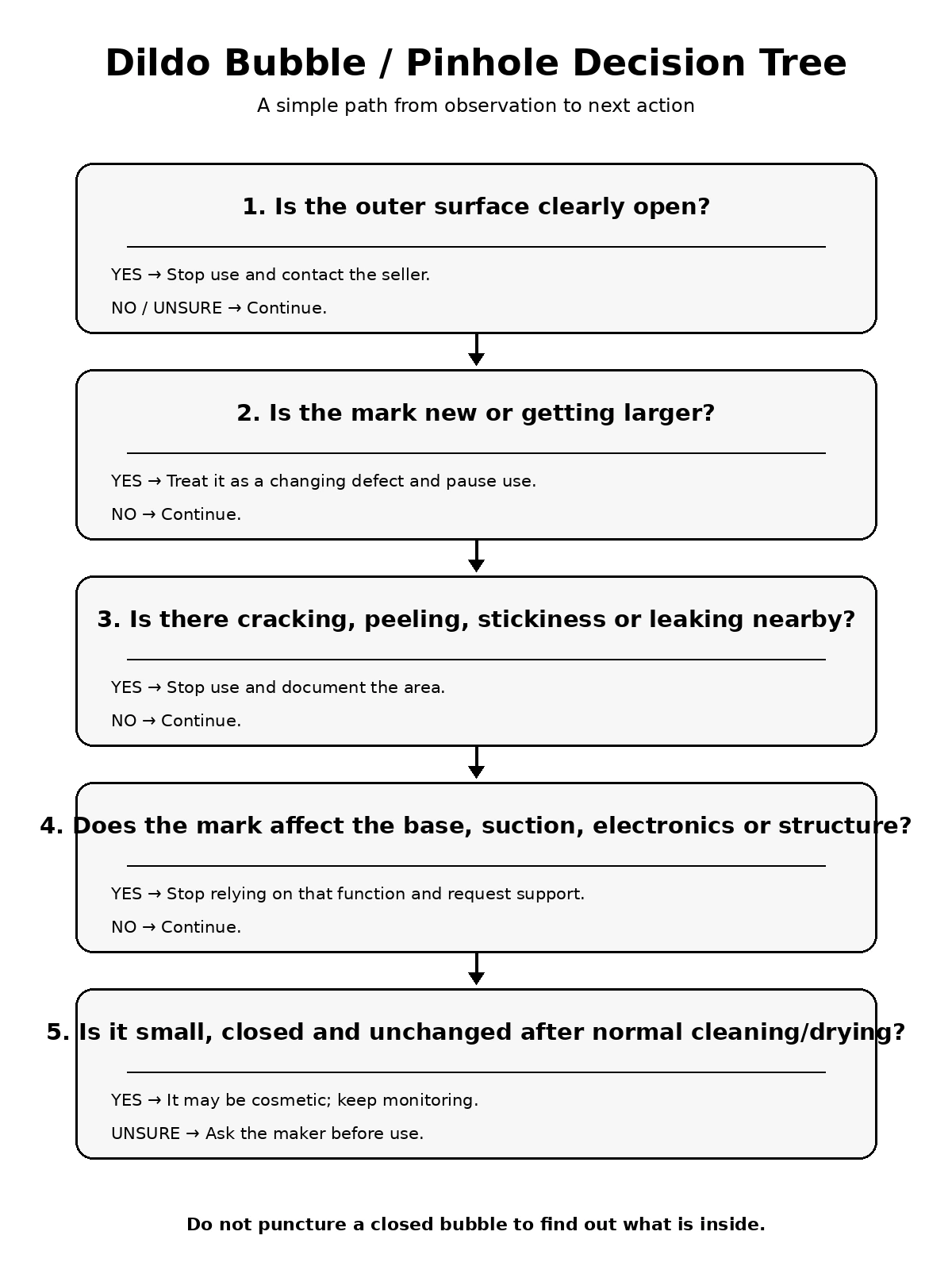
Questions to Ask the Seller or Manufacturer
If the mark is present on a new dildo, send clear photographs and ask specific questions:
- Is this surface feature expected for this model?
- Is the mark open or intended to be closed?
- Does the product pass the manufacturer’s normal quality standard?
- Should the dildo be replaced?
- Does the defect affect cleaning instructions?
- Is the affected area part of a layered construction?
- Is there a warranty or replacement process?
Keep the package, order information and model identifier until the question is resolved.
Our article How to Read Dildo Packaging explains which product details are useful when contacting a manufacturer.
Frequently Asked Questions
Are tiny bubbles in a silicone dildo normal?
Small internal bubbles can occur in molded silicone products, but appearance alone does not establish whether a particular bubble is acceptable. Check whether the outer surface is intact, whether the mark is stable and whether the manufacturer considers it within specification.
Is a tiny pinhole the same as an air bubble?
No. A trapped bubble may remain beneath a continuous outer layer, while a pinhole is an opening that reaches the surface. The surface condition matters more than the name used to describe the mark.
Can I use a dildo with one small pinhole?
If the hole clearly breaks the body-contact surface, pause use and ask the manufacturer or retailer whether the product should be replaced. Do not attempt to seal it yourself.
Can I pop a bubble inside a silicone dildo?
No. Puncturing an intact surface creates damage and does not provide a useful consumer test of manufacturing quality.
Does a bubble mean the silicone is undercured?
Not necessarily. Air entrapment and curing are different processes. A bubble alone cannot confirm a cure problem.
Why does the bubble look bigger when I bend the dildo?
Flexible material can change shape when bent, making an internal void look temporarily wider. Do not repeatedly bend the area specifically to enlarge the bubble. Compare it while the dildo rests naturally.
What if there are many tiny bubbles?
Multiple bubbles may reflect manufacturing or material characteristics, but consumers cannot determine the exact cause visually. If the pattern concerns you—especially if bubbles reach the surface—document it and ask the seller before use.
Is a shallow pit a defect?
Not always. A small smooth depression may be a cosmetic molding variation or intentional texture. It becomes more concerning if it is open, rough, expanding, cracking or otherwise changing.
Can I fill a pinhole with silicone glue?
Do not attempt a home repair unless the manufacturer gives specific instructions for that exact dildo. Adhesive can cover the appearance without restoring the original molded surface.
How can I tell whether the hole is actually open?
Use side lighting and several viewing angles after the dildo is clean and dry. Do not insert a pin, fingernail or tool into the mark. If you still cannot tell, send a close-up photograph to the manufacturer.
The Most Useful Question Is Whether the Surface Is Still Intact
Not every tiny mark on a dildo deserves the same reaction.
A stable internal bubble, a shallow cosmetic pit and an open pinhole may look similar in a photograph, but they represent different surface conditions. Begin by checking whether the body-contact surface remains continuous.
Then look for change over time.
If the mark remains small, closed, smooth and unchanged, it may be a cosmetic manufacturing variation. If it opens, grows, leaks, tears, becomes sticky or appears alongside structural damage, stop treating it as a visual imperfection and contact the retailer or manufacturer.
The safest inspection is non-destructive: clean, dry, illuminate, photograph, compare and ask.