


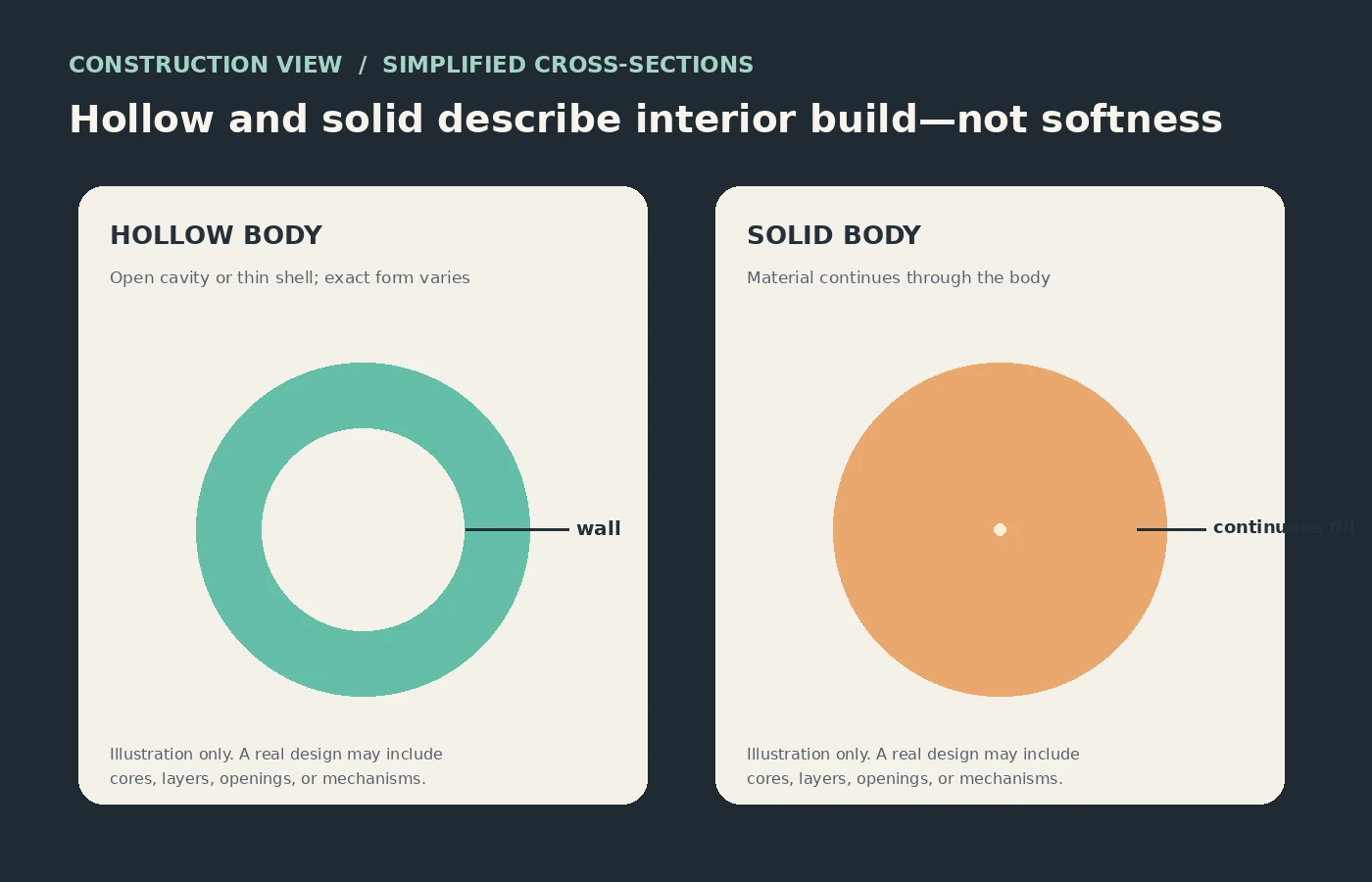
“Hollow” and “solid” sound like simple opposites, but a listing may use those words for very different dildo designs. One hollow dildo may be a sleeve with an open cavity designed to fit over an anatomy or attachment; another may have an inflatable chamber or a partially hollow shaft. A solid dildo may be one continuous material, or it may still contain a firmer core, layers, or powered parts.
Before comparing weight or flexibility, clarify what the manufacturer means by construction. This guide separates interior build from material and firmness, then shows what to check for fit, control, cleaning, and storage.

First, define what the listing means by hollow
A hollow design has an interior cavity or chamber, but the cavity’s purpose differs by product. A sleeve-style dildo may be open at one end and intended to fit over a penis or compatible attachment. An inflatable dildo uses an air chamber that changes shape when inflated. Some specialty designs may be hollow only through part of the shaft or may include internal supports.
Those are not interchangeable uses. A sleeve needs a clear fit range and instructions for how it is worn or mounted. An inflatable dildo needs product-specific directions for operating and cleaning its valve and chamber. A hollow-looking base does not prove that the shaft is hollow, and a small opening does not mean the entire interior is accessible for cleaning.
If the listing simply says “hollow,” look for a diagram or ask: Where does the cavity begin and end? Is it open or sealed? Is it meant to fit over something, accept an attachment, or hold air? Does the inside contact the body, and how is it cleaned and dried?
Hollow vs. solid at a glance
| Feature | Hollow construction | Solid construction |
|---|---|---|
| Interior | Contains an open cavity or chamber; access and purpose vary. | Material fills more of the body, though cores or layers may still be present. |
| Weight | May weigh less than a similarly sized solid design, but components and material thickness matter. | May weigh more at similar outer dimensions, but size and material still determine actual weight. |
| Flex | A thin wall may flex or collapse more easily; reinforced edges or internal supports can change this. | May feel more consistent, but “solid” alone does not guarantee rigidity. |
| Fit | Cavity dimensions, opening stretch, and compatibility may be central to use. | External dimensions and base style are usually the main fit details. |
| Cleaning | Interior surfaces may need special attention and full drying if the cavity is accessible. | Usually has fewer interior surfaces, but seams, texture, and material instructions still matter. |
| What the label does not tell you | It does not identify material, safety, or exact flexibility by itself. | It does not prove one-piece construction or reveal every internal component. |
The table describes tendencies, not guarantees. A small solid dildo can be lighter than a large hollow model, and a thick-walled hollow design may be more supportive than a very soft solid one. Compare the complete design and its stated purpose rather than choosing from one word.
Weight and handling: construction is one factor
Removing material from the interior can reduce weight compared with a similar outer shape made with a thick, continuous body. But a hollow dildo may still include a thick shell, a reinforced rim, a rigid attachment, a pump, or other components that add mass. Size, material density, and construction all contribute.
Weight also affects handling differently depending on where it sits. A long, top-heavy shape may feel less balanced than a shorter design with the same total weight. A light hollow sleeve can still feel awkward if the opening stretches unevenly or the product shifts during use. Check whether the manufacturer provides a weight and whether the product has a handle, flared base, suction cup, or compatible mount.
For a closer look at balance and handling, see how dildo weight affects control and stability. If the concern is firmness rather than mass, compare soft and firm dildos separately.
Flexibility: hollow does not mean soft, solid does not mean rigid
A hollow wall can bend or compress, especially if it is thin or made from a flexible material. The result depends on wall thickness, cavity shape, shaft length, and any internal support. Some hollow designs are deliberately flexible; others are intended to hold a particular shape. A solid silicone dildo can also be soft and bendable.
Keep three questions separate when reading a listing:
- What is the material? Silicone, TPE, glass, and other materials have different properties and care needs.
- How firm is the surface? Firmness describes resistance to pressing or compression.
- How is the interior built? Hollow, solid, layered, core-supported, or inflatable describes construction.
Dual-density is a construction description too: a softer outer layer may surround a firmer center. That is different from a hollow cavity. Our dual-density vs. solid silicone guide explains that distinction. For the manufacturing side, see how dildos are made.
Fit checks for sleeve-style and inflatable designs
If the hollow dildo is designed as a sleeve, fit depends on more than the outer length. Check the opening diameter or stretch range, usable cavity depth, shaft shape, and whether the sleeve is designed for the intended attachment. A design that is too loose may shift; one that is too tight may not fit as described. Follow the manufacturer’s sizing guidance instead of stretching the opening to test its limits.
For inflatable dildos, confirm how the pump, valve, and chamber work before use. Inflate only as directed and do not assume that adding more air will make the dildo safer, firmer, or better fitting. If a chamber leaks or the dildo will not hold its intended shape, stop and refer to the instructions or contact the seller. Our guide to inflatable dildo valve and air-leak problems covers those troubleshooting signs.
For solid designs, check external dimensions, base type, and intended use. If you plan to use a harness or suction mount, confirm compatibility with that exact setup. A solid interior does not guarantee that a dildo will fit every harness or stay attached to every surface.
Cleaning and drying: the cavity changes the routine
Follow the care instructions for the exact material and construction. A hollow design may have an interior surface that is hard to reach, rinse, or dry completely. If the cavity is open and intended to be cleaned, check the instructions for how to access the full inside. Do not assume that a surface wash cleans a concealed chamber or that a hollow product can be submerged.
For a sleeve, examine the opening and inner wall for folds or narrow areas where moisture can remain. Let the dildo dry fully before storage, using the method recommended by the maker. For inflatable or powered designs, keep water away from valves, electronics, and sealed joints unless the instructions explicitly allow washing or immersion.
A solid dildo usually has fewer internal surfaces to maintain, but it still needs cleaning based on material, texture, seams, and any attached components. See our material-specific dildo cleaning guide before choosing a cleaner or drying method.
Care rule: If you cannot tell whether the cavity is open, sealed, or washable, ask the manufacturer before putting water or cleaner inside it.
What to inspect before and after use
Use this quick condition check to spot issues that matter more on a hollow design:
- Opening or rim: Look for tearing, splits, permanent stretching, or a rough edge.
- Inner wall: Check for sticky areas, residue that will not rinse away, trapped moisture, or material changes.
- Shape: Notice whether the wall collapses, folds, or stays distorted in a way that differs from the listing.
- Connections: Inspect any valve, seam, base, attachment, or join for looseness or separation.
- Storage: Avoid folding or compressing a hollow wall unless the maker says the design can be stored that way.
Stop using the dildo if you find a tear, exposed component, separation, a sharp edge, or a change that cannot be cleaned or explained. Do not patch the opening with household glue, tape, or sealant; these may alter the material and make the surface harder to clean. Our first-use inspection checklist has a broader delivery check.
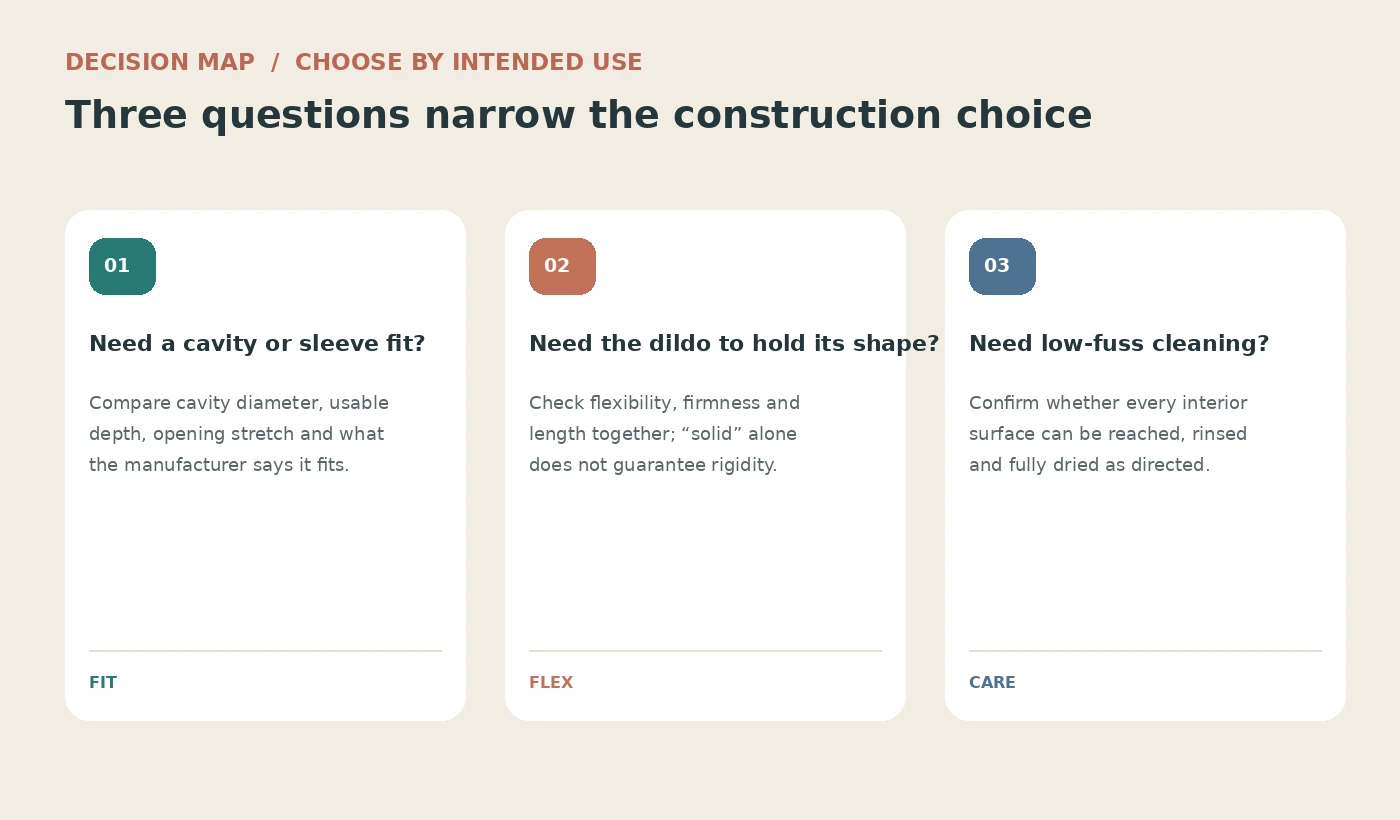
A three-question buying filter
- Do you need a cavity? If yes, identify its purpose, dimensions, opening, and compatible fit before comparing other features.
- How much shape support do you want? Review firmness, flexibility, shaft length, and wall thickness—not just “hollow” or “solid.”
- Can you maintain it properly? Confirm the cleaning and drying method, especially for interior surfaces, valves, and sealed parts.
Then verify material, base design, and intended use. For labels and claims that are unclear, see our guide to reading dildo packaging.
Frequently asked questions
Are hollow dildos lighter than solid dildos?
They may be lighter than a similarly sized solid design, but wall thickness, material, base, and internal components all affect weight. Compare listed weights when available.
Does a solid dildo always feel firmer?
No. Solid describes the interior build, not the surface firmness. A solid silicone dildo can still be flexible, while some hollow designs have thicker or reinforced walls.
Is every hollow dildo a sleeve?
No. Some are sleeves, while others may use an inflatable chamber or a partial cavity. Check the product description to learn what the opening or chamber is for.
Can I turn a hollow dildo inside out to clean it?
Only if the manufacturer says that exact design can be turned inside out. Forcing it may stretch or tear the wall. Use the stated cleaning method or ask the maker.
Does “solid silicone” mean there is no core?
Not necessarily. Listings use construction terms differently. Ask whether “solid” means one continuous silicone body or whether the dildo includes a firmer center, support, or other component.
Can I store a hollow dildo folded?
Do not assume it can be folded safely. Follow the storage directions and avoid sharp creases or pressure that could permanently distort the wall.
Choose the build you can fit and care for
Hollow construction is useful when the design requires a cavity, sleeve fit, or inflation chamber. Solid construction may offer a more continuous body, but it does not automatically mean heavier, firmer, or simpler in every case. Start with the intended function, then compare the actual dimensions, material, flexibility, base, and cleaning directions. The best choice is the construction whose fit and care requirements match how you plan to use it.