


When a harness-mounted dildo feels wobbly, slips forward, or points downward, the problem may be at one of three places: the dildo-to-ring connection, the harness-to-body fit, or the flexibility of the shaft itself. Matching these parts before use makes setup easier and helps protect both the toy and the harness.
This guide explains how to check O-ring size, where to measure a dildo, why base shape matters, and how to test the assembled setup. Always follow the specific harness and toy maker’s instructions; O-ring dimensions and compatibility rules vary by product.
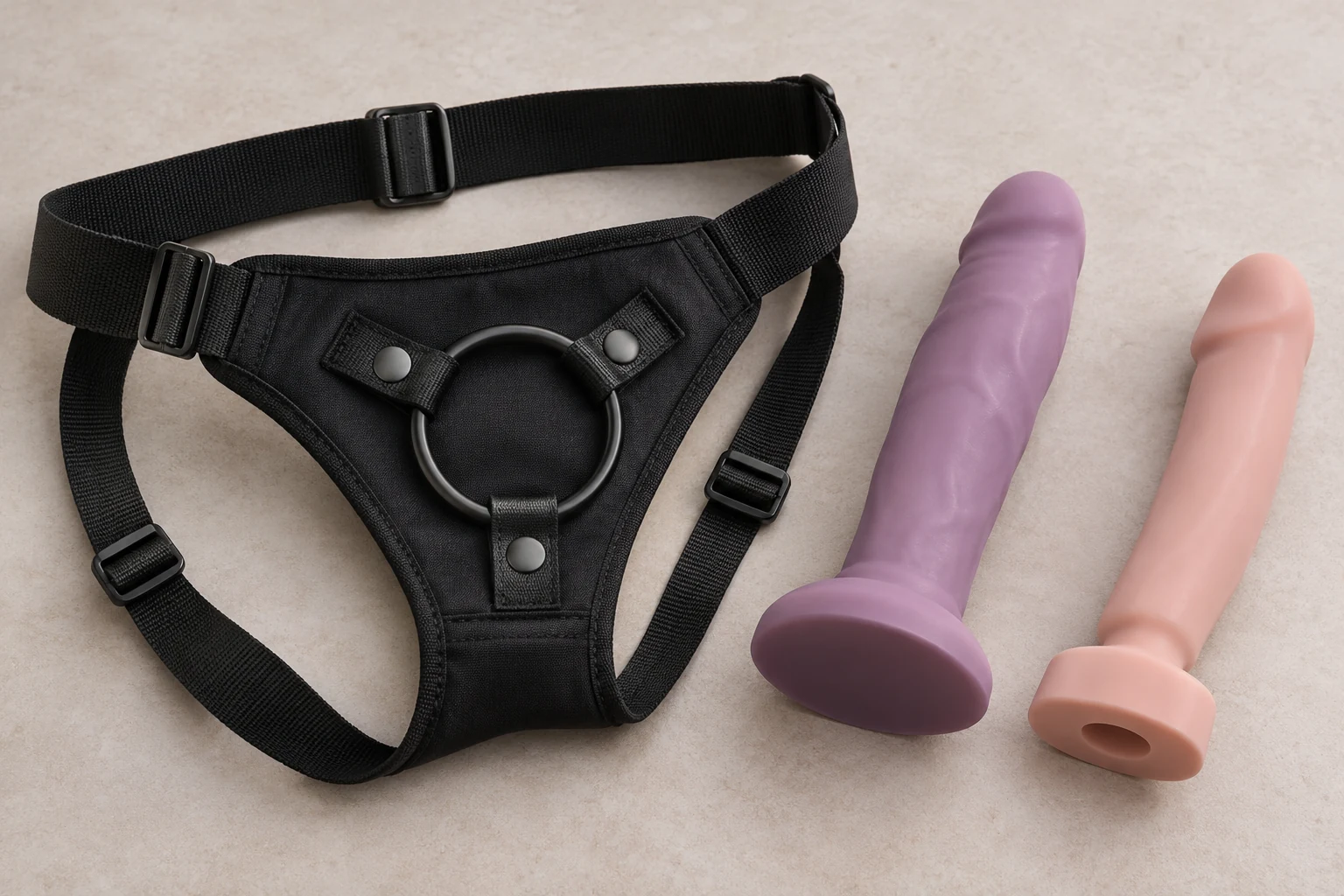
First, identify what is moving
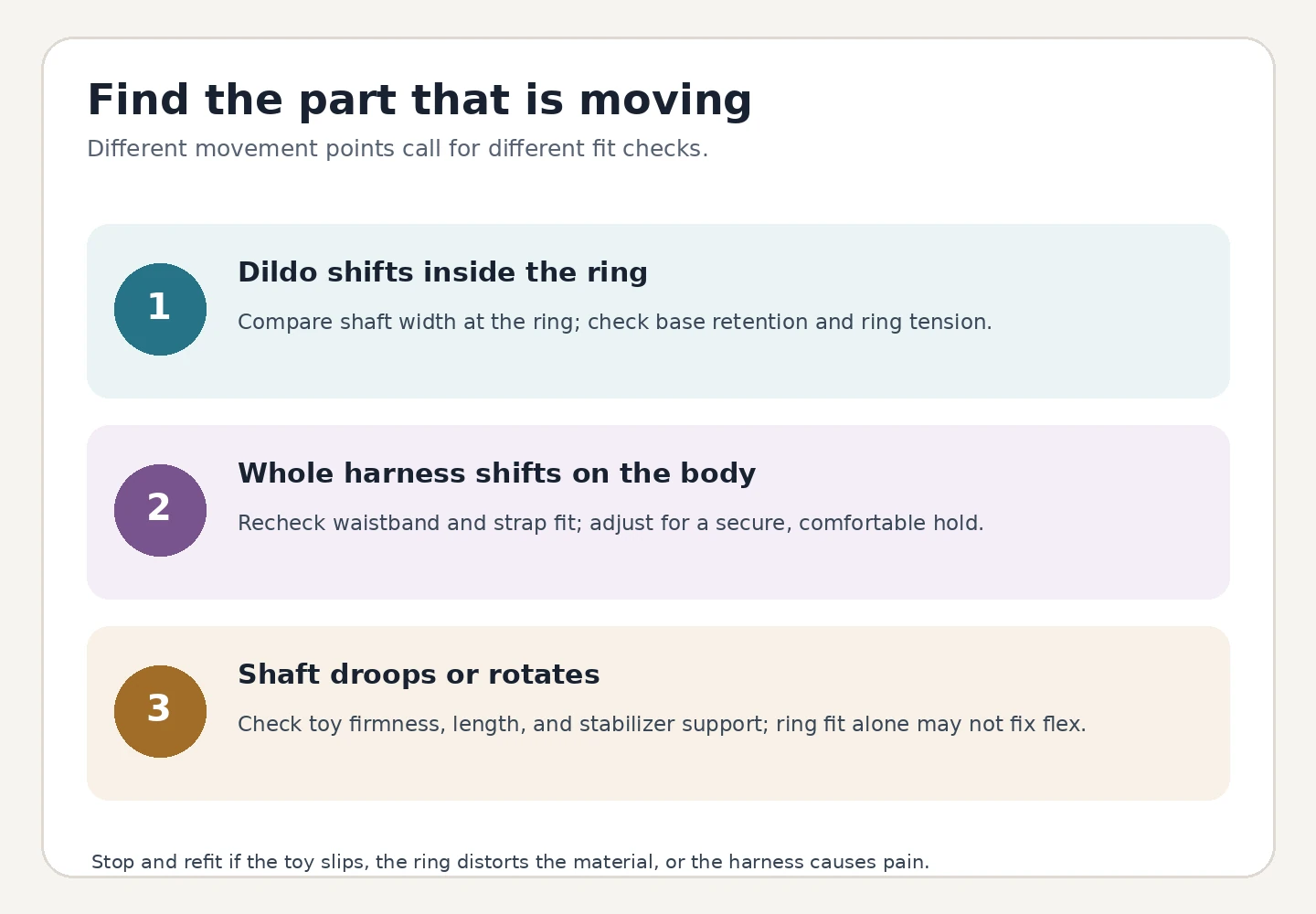
“The dildo doesn’t fit” can describe several different problems. Notice which part shifts before changing anything:
| What you notice | Likely check | First adjustment |
|---|---|---|
| The dildo slides or rotates inside the O-ring | Ring opening, shaft size at the contact point, and base retention | Recheck the manufacturer’s compatibility chart; try a compatible ring or stabilizer |
| The whole harness moves on the wearer | Waistband, leg straps, panel position | Adjust the harness so it stays put while remaining comfortable |
| The base stays in place but the shaft droops | Toy firmness, length, weight, and support | Try a firmer or shorter toy, or an approved support insert |
| The ring stretches, twists, or damages the toy | Ring too small, incompatible attachment point, or unsuitable material | Stop; do not force the toy through |
How an O-ring holds a dildo
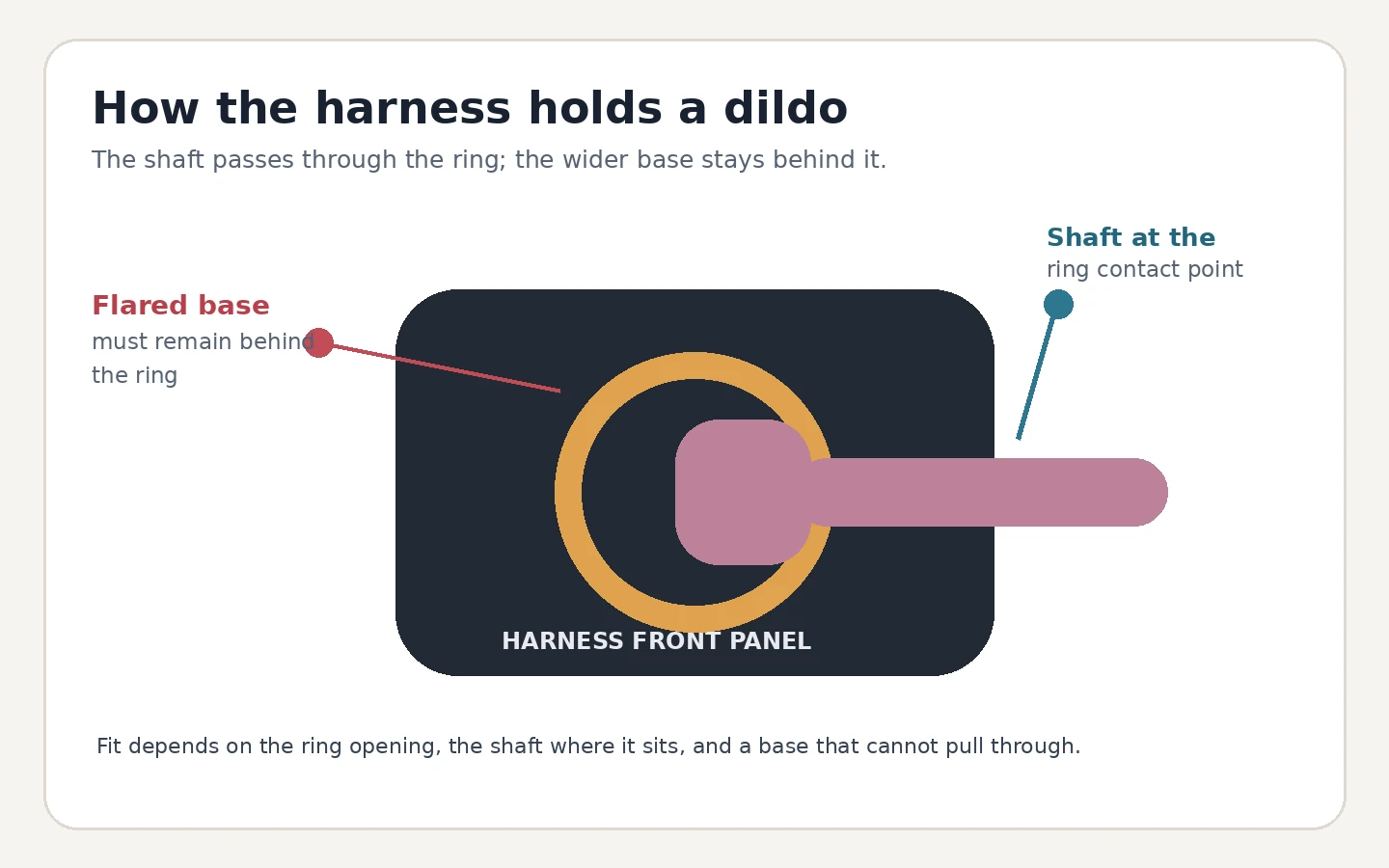
In a traditional O-ring harness, the dildo’s shaft passes through the opening while its wider base stays on the wearer’s side of the ring. The ring and front panel help hold the base in place. Other harnesses use pockets, straps, or proprietary attachments, so this explanation applies only when the harness uses an O-ring or a similar opening.
A product described as “harness compatible” still needs to match the exact harness. The toy needs a suitable attachment area, and the base must not pass through the opening during movement. A label alone does not tell you whether a particular ring size and base geometry work together.
Measure the right places
Before choosing a ring, look for the harness maker’s stated usable opening and the toy maker’s minimum ring requirement. If those details are missing, ask the seller or maker rather than assuming a universal size.
- Measure the opening. Check the inside diameter or usable opening of the ring as the manufacturer defines it. Flexible rings may behave differently from rigid rings.
- Measure the shaft where it will sit. This is usually the section near the base that passes through the ring, not the widest part of the head. Follow the toy maker’s measurement method.
- Check the base. Confirm that its shape and dimensions keep it behind the ring. A broad, stable flange may behave differently from a rounded or narrow base, even when the shaft width is similar.
- Compare the specified ranges. Check both products’ compatibility notes. Do not rely on an unrelated brand’s “standard” dimensions.
One measurement can be confusing: diameter and circumference are not interchangeable. If a listing gives circumference but the harness gives ring diameter, convert carefully or ask the manufacturer to confirm the match. For sizing terms, see our dildo size guide.
Ring size: secure without forcing
A ring that is too small can compress or scrape the shaft and may strain fabric or stitching. A ring that is too large can allow the toy to shift or rotate. The right fit is the one the harness maker specifies for the particular toy, with the base retained and no harmful squeezing.
Some harness makers offer interchangeable rings or stabilizer inserts for a narrower toy. Use only a component designed for that harness. An insert may reduce wobble or help support the base, but it cannot make an incompatible base safe if the toy can still pull through.
- If the toy will not pass through easily, stop instead of stretching or pushing it through a fixed ring.
- If the ring is loose, check the correct attachment point and whether the harness supports an approved stabilizer.
- If the ring or toy deforms, discontinue that combination and confirm compatibility.
Base shape matters as much as shaft width
The base is the part that prevents the toy from drawing through the ring. Check the actual base, not only the shaft measurement. A base that is narrow, very soft, angled, or unusually rounded may not stay seated the same way as a wider, flatter base.
Do not trim or reshape a base to make it fit. Removing material can compromise retention, expose internal layers, or damage the toy. If the base does not stay securely behind the ring, choose a toy designed for that harness or use an attachment recommended by its maker. Read more about why trimming a dildo base can create fit and safety problems.
Check harness fit on the body
Even a well-matched ring and dildo can feel unstable if the harness itself shifts. Adjust waist and leg straps in small steps. The panel should stay aligned during gentle movement, while the waistband remains comfortable and does not dig in, restrict breathing, or cause numbness.
Fit varies across harness styles and bodies. Use the size chart for the specific model, especially if the harness uses thicker fabric or limited stretch. A heavier or longer toy can also increase leverage on the panel. Our guide to how dildo weight affects control and stability covers that tradeoff.
Assemble and test the setup
- Read both products’ instructions and confirm the ring size and harness compatibility.
- Place the toy through the ring using the method recommended by the maker. Do not twist, stretch, or force it through.
- Check that the base lies flat behind the ring and cannot slip through with a gentle pull.
- Put the harness on and adjust it until the panel stays aligned without discomfort.
- Move gently through the positions you expect to use. Recheck for rotation, slipping, material compression, or strap movement.
- Stop and refit if the toy shifts, the base pulls toward the opening, the fabric strains, or the harness causes pain.
A gentle fit check is not a guarantee against every movement, so pay attention during use and pause if anything starts to slip. If a dildo repeatedly comes loose, our troubleshooting article on why a dildo keeps slipping out separates harness fit from other causes.
Choose a setup by your main priority
| Priority | What to look for | What to verify |
|---|---|---|
| Simple first setup | A kit sold as a matched harness-and-toy combination | That the included size and attachment are suitable for your use |
| Use toys you already own | Interchangeable O-rings or a maker-approved stabilizer | Each toy’s shaft position, base retention, and listed minimum ring size |
| Less shaft movement | A supportive front panel and a toy with suitable firmness | Weight, length, and whether the support is compatible with your harness |
| More adjustability | Replaceable rings or an adjustable attachment system | How the ring locks in place and which toy sizes are explicitly supported |
For any toy you plan to use anally, confirm that it has an appropriate flared base. A harness ring does not replace the toy’s own safety stop.
Common fit mistakes
- Assuming all O-rings are standard: opening sizes and attachment systems vary. Use the specific product specifications.
- Measuring the head instead of the ring contact area: measure where the shaft actually passes through the opening.
- Checking the shaft but ignoring the base: the base must remain securely behind the ring.
- Using force as a fit test: forcing can damage the toy or harness. Stop if it resists.
- Overtightening the harness: more tension is not automatically more stable; discomfort is a sign to adjust or choose another style.
- Expecting the ring to support a very flexible shaft: the ring anchors the base, but it cannot remove all bending or droop from a soft toy.
Frequently asked questions
Do all harnesses fit all dildos?
No. Ring size, attachment style, shaft dimensions, base shape, and harness construction all affect compatibility. Check both products’ specifications.
Should the O-ring be smaller than the dildo?
There is no safe universal rule independent of the product. Compare the maker’s stated ring opening with its recommended toy range. The toy should not need to be forced through, and the base must remain retained.
Can I use a larger ring if my toy is narrow?
Possibly, if the harness maker provides a compatible stabilizer or insert for that ring and toy. Without approved support, a loose fit may allow the dildo to move or rotate.
Why does the dildo droop even though the base is secure?
The shaft may be very soft, long, or heavy for the amount of support the harness provides. A firmer or shorter toy, a supportive panel, or a maker-approved stabilizer may help. See our guide to using a soft dildo in a harness.
Can I stretch a fixed O-ring to make a toy fit?
Do not force or overstretch it. The ring, stitching, or toy can be damaged. Choose a compatible opening or a harness with replaceable rings.
Takeaway
A reliable harness fit is a three-part match: a ring that suits the shaft at its contact point, a base that stays behind the ring, and a harness that sits comfortably and holds its position. Verify the exact dimensions, test the assembled setup gently, and stop if anything slips, distorts, or hurts.
For more buying and fit advice, browse our dildo guides and care articles.
Further reading
- RodeoH harness size chart and O-ring guidance (manufacturer-specific compatibility advice).
- RodeoH FAQ: choosing a dildo for its harness.
- New York Toy Collective O-ring guide.