
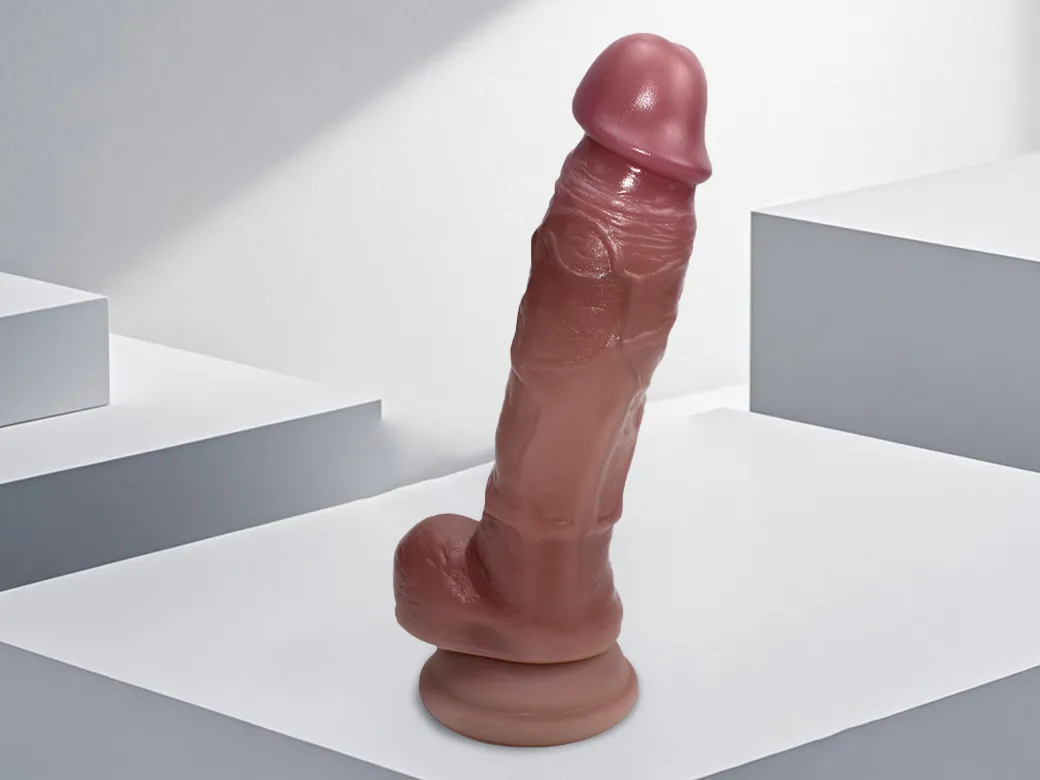
You clean your dildo, leave it to dry, and later notice a pale haze across the surface. Or perhaps a fine white powder has collected around the base, inside textured grooves, or along the shaft.
The first reaction is often to assume that something is wrong with the material.
That is possible, but it is far from the only explanation.
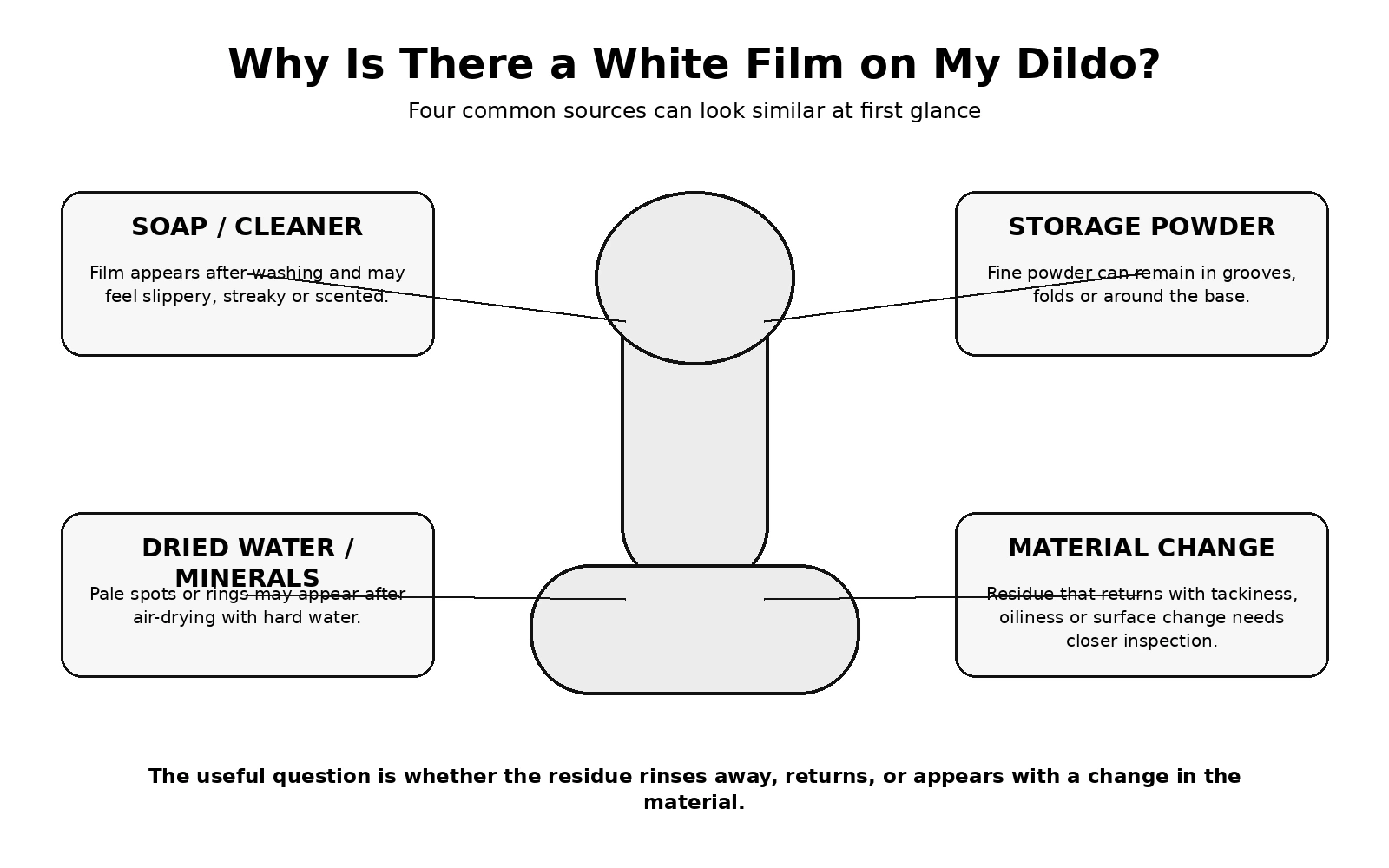
A white film can come from soap residue, dildo cleaner, storage powder, dried water minerals, lubricant residue, lint, or changes occurring at the material surface. Several of these can look almost identical in a photograph.
Instead of identifying the problem by color alone, look at three things:
- When the residue appears
- Whether it rinses away
- What the surface feels like underneath it
Those clues provide a much better starting point than simply asking, “Why is my dildo turning white?”
Start With the Timing, Not the Color
When the residue first appears is one of the strongest clues.
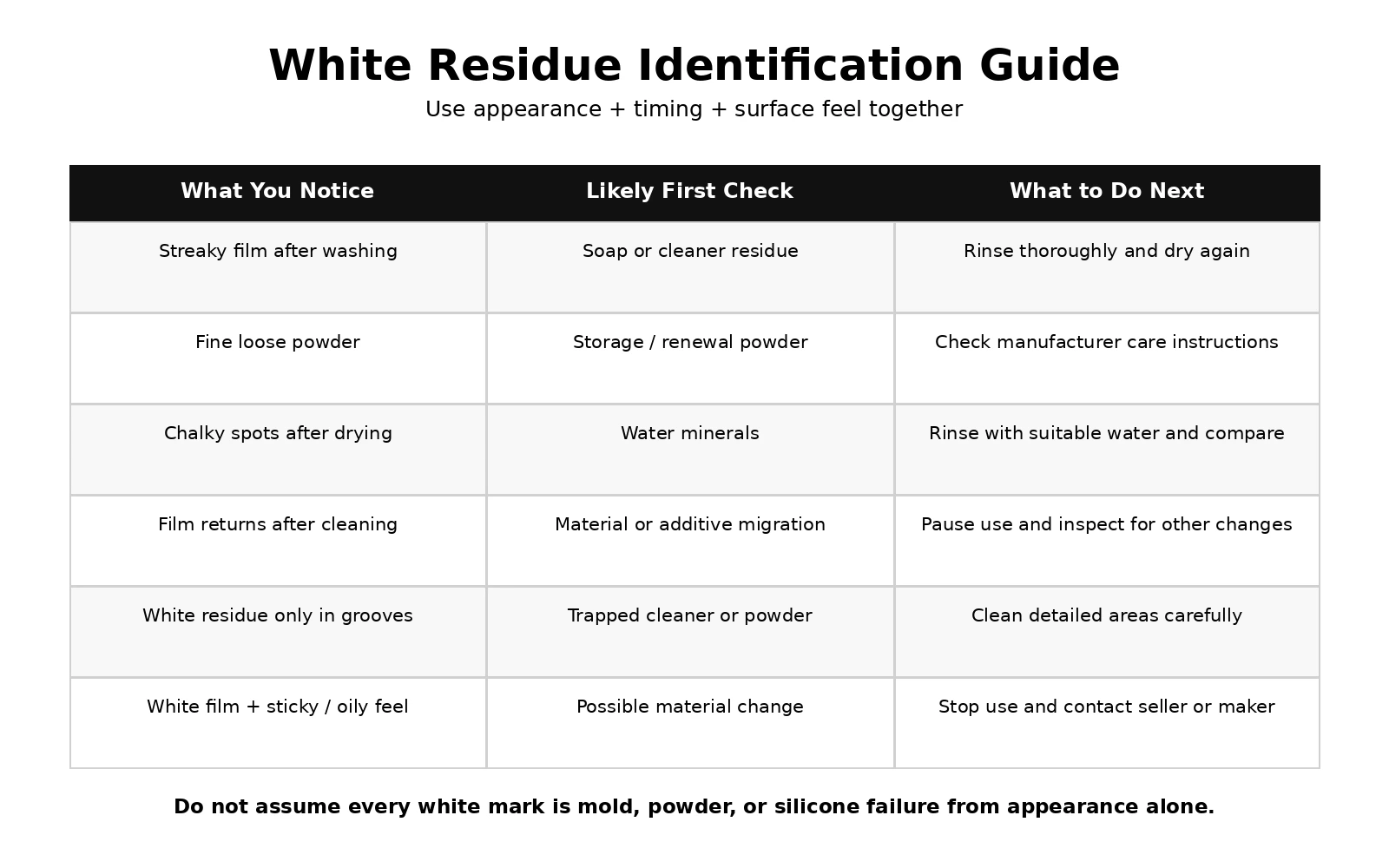
| When the White Film Appears | First Possibility to Check | Useful Next Step |
|---|---|---|
| Immediately after washing | Soap or cleaner residue | Rinse thoroughly and dry again |
| Only after air-drying | Dried water minerals | Compare after rinsing with different suitable water |
| After removing it from storage | Storage powder or residue from the container | Inspect the pouch or box separately |
| After lubricant dries | Lubricant residue | Compare the dried lubricant separately |
| Returns shortly after every cleaning | Persistent residue or material-related change | Inspect texture, oiliness, odor and stability |
| Appears months after purchase | Storage, cleaning history or material change | Compare with the dildo’s original condition |
A film that appears immediately after washing should therefore be investigated differently from one that repeatedly returns on an older dildo.
Soap Residue Is One of the Simplest Explanations
More soap does not necessarily mean a cleaner dildo.
Soap can remain in realistic veins, wrinkles, textured heads, recessed lettering, suction-cup rims and other detailed areas if the surface is not rinsed thoroughly.
Once the water evaporates, the remaining cleaner may appear as:
- A pale film
- Thin streaks
- White lines around textured details
- A cloudy surface
- Powder-like deposits
Fragranced cleaners may leave both a visible film and a noticeable scent.
If the residue appears only after cleaning, compare the smell and feel of the dried film with the cleaner itself.
Useful test: If ordinary approved rinsing removes the entire film and it does not return until the next wash, cleaning residue is more plausible than permanent material deterioration.
For a complete material-by-material cleaning routine, see How to Clean a Dildo Properly.
Storage Powder Can Look Like Material Damage
Some soft dildos are packaged or maintained with powder to reduce tackiness or help protect their surface during storage.
This is particularly relevant to certain soft elastomer formulations. It does not mean every dildo needs powder.
If a manufacturer supplies or specifically recommends a renewal or storage powder, follow those instructions for that exact dildo.
Do not assume a silicone dildo needs powder merely because another soft dildo does.
Storage powder tends to behave differently from a permanent surface change. It may:
- Feel dry rather than oily
- Collect more heavily inside grooves
- Transfer easily to your fingers
- Rinse away relatively easily
- Reappear only after you intentionally apply more
If the dildo arrived covered in white powder, check its package and care leaflet before removing or replacing the powder.
The guide How to Read Dildo Packaging explains which material and care details are worth looking for.
Hard Water Can Leave Pale Marks After Drying
If the dildo looks clean while wet but develops pale spots as the water evaporates, the water itself may be contributing.
Water containing dissolved minerals can leave visible deposits when droplets dry. On a smooth dark dildo, even small deposits can be obvious.
Typical patterns include:
- Small pale circles where droplets dried
- Cloudy patches
- Thin chalk-like lines
- Residue concentrated around the underside of a base
The pattern often follows individual droplets rather than the molded structure of the dildo.
A Simple Comparison
If the dildo’s instructions allow ordinary rinsing:
- Photograph the existing marks.
- Rinse the dildo using its approved method.
- Let it dry in a clean location.
- Observe whether the same water-spot pattern appears again.
Do not start using acidic household descaling products simply because a surface looks chalky. A cleaner suitable for a shower door or kettle is not automatically appropriate for a dildo.
Lubricant Can Dry Into a White or Cloudy Residue
Some lubricants become less transparent as their water content evaporates.
The remaining ingredients may collect around:
- The underside of the head
- Prominent veins
- Ridges
- Textured sections
- Base edges
- Any recessed area where lubricant pools
If the white film appeared after using a different lubricant, place a small amount of that lubricant on a suitable disposable surface and observe how it looks after drying.
This comparison can be much more informative than repeatedly washing the dildo.
White Residue and Dust Are Not the Same Problem
Loose lint can sometimes resemble powder, especially on black or dark-colored silicone.
Look closely.
Lint generally has visible fibers. A dried film tends to form streaks, spots or a continuous haze.
If tiny hairs and fibers keep collecting on an otherwise normal silicone surface, see Why Does My Silicone Dildo Attract Dust and Lint?.
That is a different issue from residue that appears to be emerging from the dildo itself.
What If the White Film Keeps Coming Back?
This is where the investigation changes.
Suppose you:
- Clean the dildo according to its instructions
- Rinse it thoroughly
- Let it dry completely
- Store it separately
…and the same white or cloudy coating repeatedly returns.
Now inspect the material underneath rather than focusing only on the residue.
Ask:
- Has the dildo become sticky?
- Does it feel oily?
- Has the firmness changed?
- Is the surface peeling?
- Are cracks forming?
- Has the color changed?
- Has the odor changed?
- Does residue transfer onto a clean surface?
A film that returns together with physical material changes deserves more attention than an ordinary removable water spot.
Could the Material Be “Blooming”?
In polymer and rubber manufacturing, ingredients within some formulations can sometimes migrate toward a surface over time. This general phenomenon is often described as surface migration or blooming.
However, consumers usually cannot determine the chemistry of an unidentified dildo from appearance alone.
If a manufacturer identifies a particular material formulation and explains that a removable surface deposit is expected, follow that manufacturer’s care directions.
Without that information, do not automatically label every white film as “silicone bloom,” “plasticizer,” or another technical phenomenon.
The more useful observation is:
The residue returns after approved cleaning, and the surface now feels different from when the dildo was new.
That is useful evidence to send to the manufacturer even if you cannot identify the underlying chemistry.
Does a White Film Mean Silicone Is Not Fully Cured?
No conclusion like that can be made from white residue alone.
Curing is a manufacturing process. A consumer cannot confirm incomplete curing simply because a dildo looks cloudy or has surface residue.
Pay more attention when the film appears together with persistent changes such as:
- Localized gummy areas
- Material transferring to another surface
- Unexpected oiliness
- Peeling
- Cracking
- Major changes in texture
If curing is your concern, use the separate guide Is My Silicone Dildo Fully Cured? rather than treating a white film as proof by itself.
Run This Six-Step Check Before Reaching a Conclusion
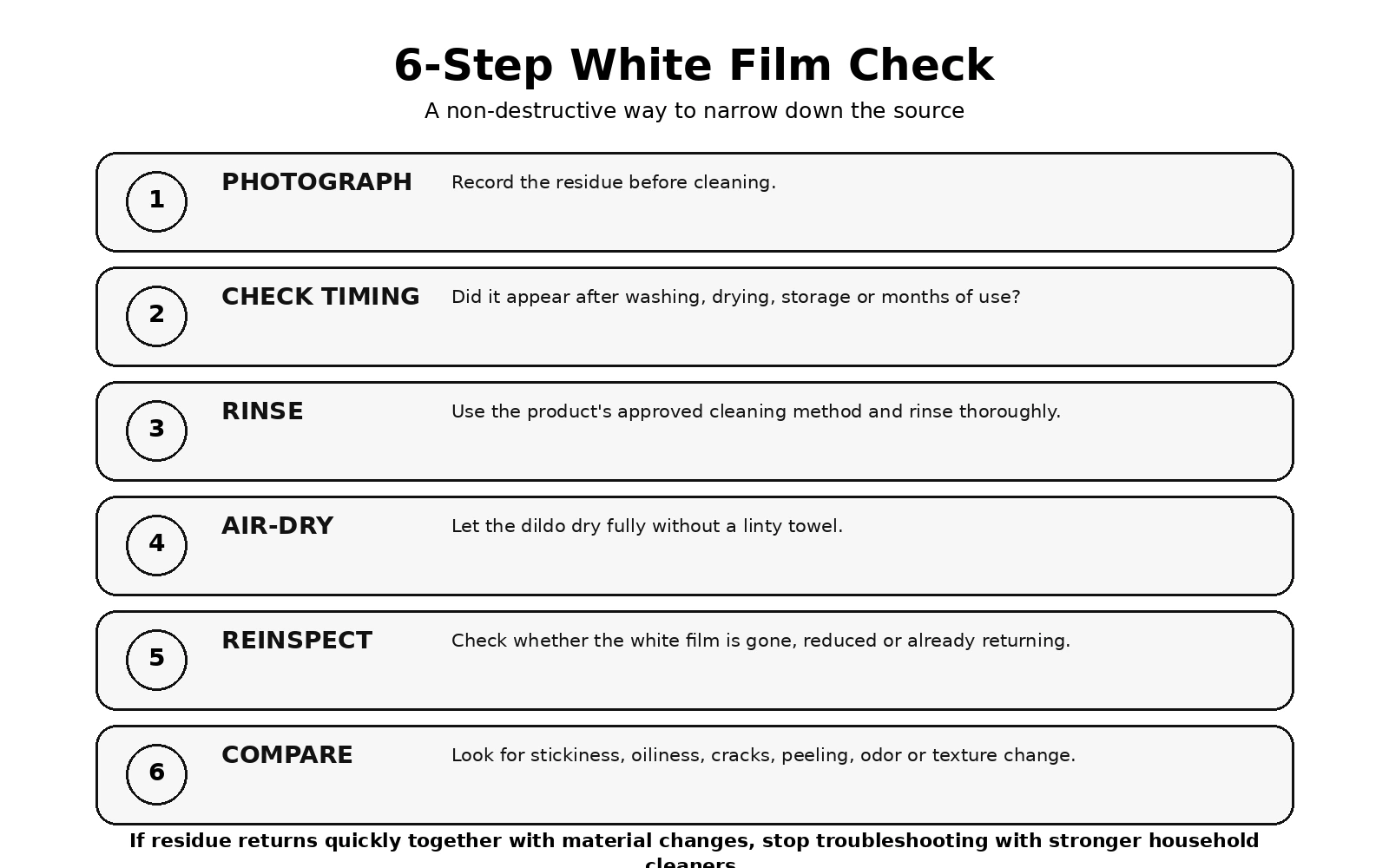
1. Photograph It Before Cleaning
Take a clear photograph of the entire affected area.
Close-up photographs are useful, but also take one wider image so you remember where the residue occurred.
2. Record When It Appeared
Ask whether you first saw it:
- After washing
- After drying
- After applying lubricant
- After taking the dildo out of storage
- After a long period without use
- After switching cleaners
3. Clean According to the Dildo’s Instructions
Do not immediately move to stronger chemicals.
Use the method recommended for the dildo’s known material and construction.
4. Let It Dry Completely
Avoid immediately rubbing the surface with tissues or lint-producing towels because that introduces another variable.
5. Inspect Again Under Strong Light
Determine whether the residue:
- Disappeared completely
- Became lighter
- Remained unchanged
- Returned shortly after drying
6. Compare the Surface Condition
Look beyond the color.
Check firmness, tackiness, oiliness, cracks, peeling, swelling and odor.
White Residue vs Possible Mold
A white mark should not automatically be labeled mold.
Dried soap, lubricant, water minerals, powder and lint can all create light-colored spots.
| Observation | Residue Is More Plausible | Needs More Investigation |
|---|---|---|
| Cleaning | Completely rinses away | Persists or repeatedly returns |
| Pattern | Water spots, streaks or powder | Irregular growth-like area |
| Surface | Unchanged underneath | Cracked, porous or deteriorating |
| Odor | Normal for the dildo or cleaner | New persistent musty odor |
If you are dealing with suspicious spots rather than a uniform film, read Can Dildos Grow Mold?.
Do Not Use Aggressive Cleaning Just Because the Residue Is White
A mysterious film can encourage increasingly aggressive experiments.
Avoid automatically using:
- Undiluted bleach
- Household disinfectants
- Acetone or solvents
- Perfume
- Essential oils
- Abrasive powders
- Scouring pads
- Magic erasers
- Sandpaper
- Very hot water unless specifically permitted
A method designed for ceramic, glassware or household countertops may damage a soft dildo.
Do not make troubleshooting harder: introducing stronger chemicals can create discoloration, odor or texture changes that did not exist before.
Different Materials Require Different Expectations
| Dildo Material | What to Consider When White Residue Appears |
|---|---|
| Silicone | Check for cleaner residue, water deposits and whether the underlying silicone has changed in texture. |
| TPE / TPR | Check whether the manufacturer recommends renewal powder and watch for tackiness, oiliness or deformation. |
| Glass | Soap and mineral spots are often easier to isolate because the surface itself is hard and non-flexible. |
| Stainless steel | Investigate dried water, cleaner and surface contamination while also inspecting for unusual damage. |
| Unknown soft material | Avoid guessing at the care method. Identify the material from packaging or ask the seller first. |
When Should You Stop Using the Dildo?
A removable powder or water spot does not automatically mean a dildo needs replacement.
The situation becomes more concerning when the residue is only one part of a larger material change.
Pause use and contact the retailer or manufacturer if:
- The film returns rapidly after appropriate cleaning
- The dildo becomes sticky or gummy
- Oil repeatedly appears on the surface
- The outer layer begins peeling
- Cracks or open pinholes develop
- The dildo swells or changes shape
- The surface transfers material onto a clean cloth
- A strong new odor develops
- Layers begin separating
- The material cannot be identified
Document the condition before attempting anything stronger.
What to Send Customer Support
Give the seller enough information to distinguish a simple care issue from a possible dildo defect.
Include:
- Dildo name and SKU
- Purchase date
- Stated material
- When the residue first appeared
- Cleaning method used
- Lubricant used
- How the dildo was dried
- How it was stored
- Whether the residue rinses away
- Whether it returns
- Whether the surface feels different
- Clear photographs
A useful description is:
A thin white film reappears after the dildo has been cleaned, rinsed and completely dried. The residue is most visible around the shaft and base. I have attached photos before and after cleaning. Can you confirm whether this is expected for this material?
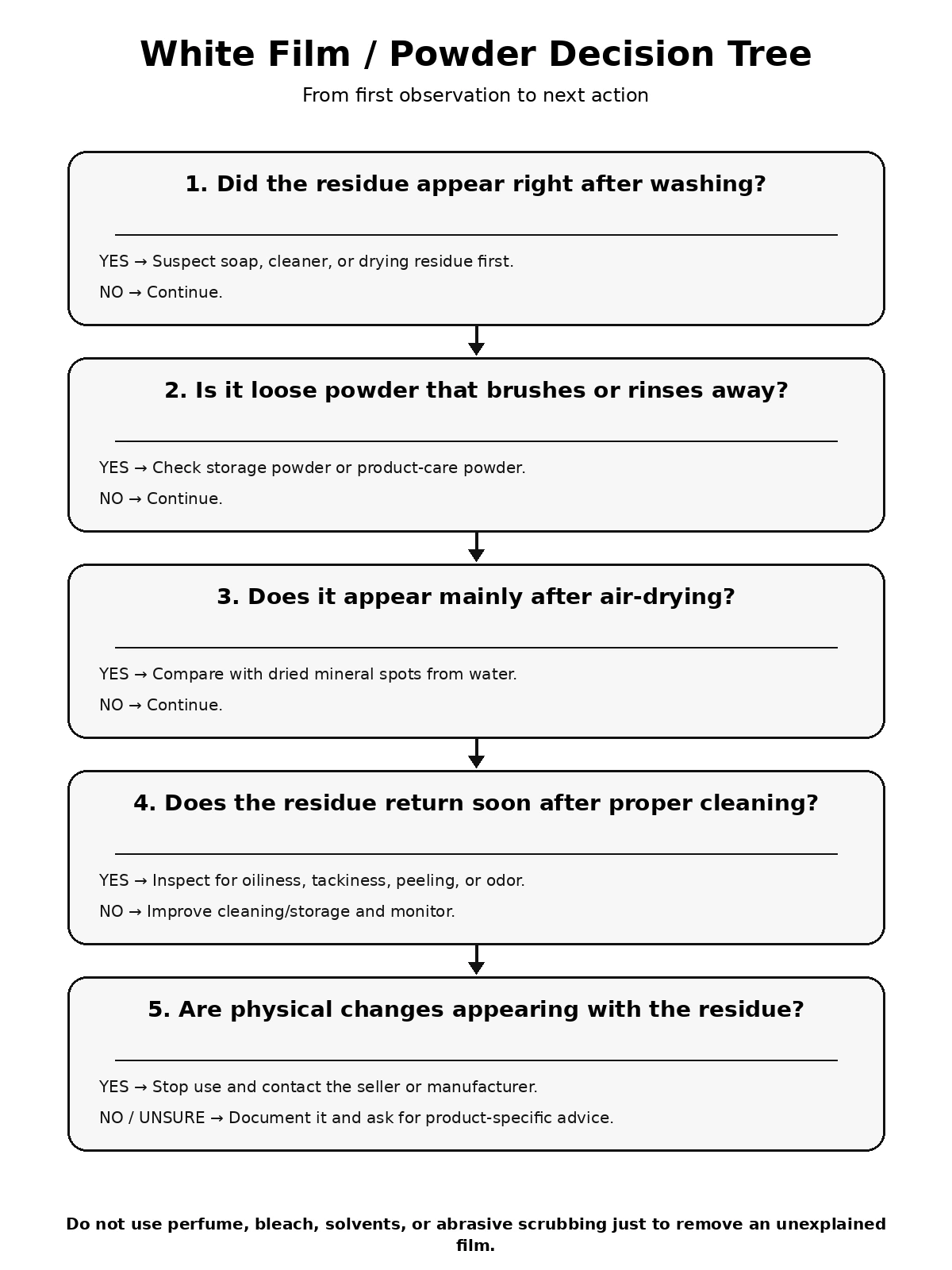
Use This Decision Tree
Frequently Asked Questions
Why does my dildo have white stuff on it after washing?
Soap, dildo cleaner or dissolved minerals in the rinse water may dry onto the surface. Rinse it according to the manufacturer’s instructions and compare the dildo after complete drying.
Why is there white powder on my silicone dildo?
Check whether the powder came from packaging, storage, cleaner, water residue or another material. Silicone generally should not be powdered simply because dust sticks to it unless the manufacturer specifically instructs otherwise.
Does white residue mean my dildo is moldy?
No. Color alone cannot identify mold. Soap, lubricant, lint, storage powder and water minerals can all look white. Persistent growth-like spots or musty odor require a different investigation.
Can hard water leave marks on a dildo?
Yes. When mineral-containing water evaporates, visible pale deposits can remain on some surfaces, particularly dark, smooth dildos.
Why does the white film keep returning?
If it returns after correct cleaning, rinsing and drying, inspect whether the dildo has also become sticky, oily, cracked, peeling or otherwise different. Contact the manufacturer if the condition persists.
Should I use cornstarch on my dildo?
Only when the manufacturer recommends an appropriate renewal or storage powder for that specific dildo. Do not assume that care instructions for one soft material apply to silicone or another material.
Can dried lubricant turn white?
Some lubricant formulas can leave cloudy or pale residue as components remain after evaporation. Compare a small dried sample of the lubricant separately if you suspect this is the source.
Can I scrub off the white film?
Aggressive scrubbing is not a good diagnostic method. Follow the dildo’s approved cleaning instructions and avoid abrasive pads or household surface cleaners.
Does a white coating mean silicone is deteriorating?
Not by itself. A coating becomes more concerning when it repeatedly returns and is accompanied by changes such as tackiness, oiliness, cracking, peeling or altered firmness.
Should I replace a dildo with white residue?
Not automatically. If the residue is clearly removable and the dildo returns to its normal condition, replacement may not be necessary. Persistent residue combined with physical deterioration deserves manufacturer evaluation or replacement.
Do Not Diagnose the Dildo From the Color Alone
White residue is a clue, not a diagnosis.
If it appears directly after washing, investigate the cleaner. If it develops as water droplets dry, consider mineral deposits. If it is loose powder from storage, check the manufacturer’s care instructions. If it appears after lubricant use, compare the lubricant separately.
The situation becomes more significant when the residue repeatedly returns despite proper care and the dildo itself begins changing.
That is the point where you should stop trying stronger cleaning methods and start documenting what is happening.
Clean, rinse, dry, inspect and compare. Those five actions usually tell you much more than the color of the residue alone.