

The point where a dildo’s shaft meets its base can be easy to overlook in product photos. Yet that short transition—sometimes called the neck, collar, or junction—can affect how the lower shaft bends, how force reaches the base, and whether the design sits well in a hand, harness, or mounting setup.
There is no single “best” neck shape. A flexible transition may be intentional, while a broad transition may feel more supportive. The useful question is whether the design matches the way you plan to use the dildo and whether the junction looks consistent with the manufacturer’s description.

What the neck or junction actually is
In this guide, “neck” means the section between the main shaft and the base. It may be narrow and flexible, wide and gradual, or barely distinct from the rest of the design. The term is descriptive rather than a standardized product measurement, so brands may use different names—or not name the area at all.
The transition can also contain more than one structural element. A dildo might have a suction-cup base, a harness plate, a flared safety base, a decorative base, or a powered housing. The exterior shape alone cannot tell you how the interior is built. A photo can help you compare proportions, but it cannot confirm material layers, a hidden core, or approved use.
If the base looks misshapen or has changed over time, see our guide to a curling or warped dildo base. If the listing gives a hardness number, our Shore hardness guide explains why geometry and construction can still affect how a finished dildo behaves.
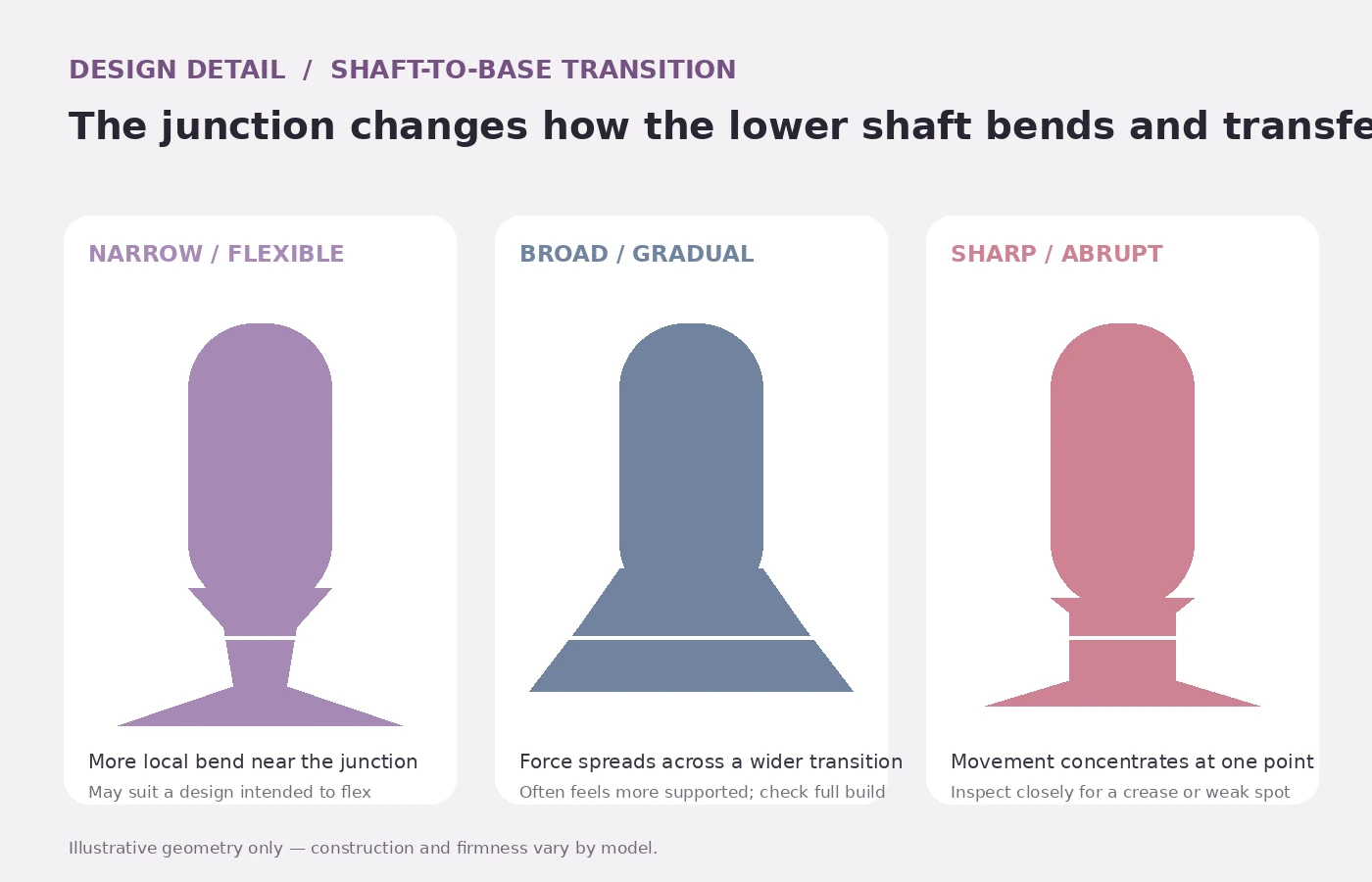
Three transition profiles—and what they may suggest
| Profile | Possible feel or behavior | What to check |
|---|---|---|
| Narrow or flexible neck | The lower shaft may bend more readily near the base. | Look for a smooth curve under gentle pressure and check whether the listing describes the dildo as flexible. |
| Broad or gradual transition | The lower shaft may feel more supported, depending on material and internal structure. | Check whether the wider area affects harness fit, clearance, or how you hold the base. |
| Sharp or abrupt step | Movement may be concentrated around a distinct change in width. | Inspect for a molded seam, sharp edge, crack, or newly formed crease; compare with product photos. |
These are design observations, not performance guarantees. A broad junction is not automatically rigid, and a narrow neck is not automatically weak. Material formulation, shaft length, wall thickness, internal support, weight, and the direction of force all contribute. Two dildos with similar-looking necks may behave differently.
Why the transition affects bending and control
When a shaft bends, the movement does not always spread evenly from tip to base. A narrow section may flex more than a thicker section made from the same material. A long shaft can also create more leverage than a short one, making a small movement at the tip more noticeable near the base.
This is why a firmness label cannot explain every movement characteristic. Firmness describes resistance to compression; flexibility describes how easily the shaft bends. Length and shape influence leverage, while a core or layered build can add support. The soft-versus-firm dildo comparison can help separate those characteristics when you are comparing options.
Quick distinction: A smooth, gradual bend that matches the product’s intended flexibility is different from a sudden hinge point that appears after damage or changes over time.
For powered or internally supported dildos, do not force a bend just to test the neck. Follow the manufacturer’s instructions, and stop if you hear a new click, feel a hard edge under the surface, or notice that the exterior moves independently of the core. Our guide to signs of a possible internal-core problem covers those warning changes in more detail.
Handheld, harness, and mounted use are different fit questions
A neck shape that feels convenient to hold may not be ideal for a harness opening. In handheld use, the base and lower shaft can provide a place to steady or angle the dildo. In a harness, the shaft diameter near the opening, base width, plate design, and ring size determine whether it stays positioned. With a suction-cup mount, the cup’s seal and the shaft’s leverage are separate issues.
- For handheld use: Check whether you can comfortably grasp the base or lower shaft without pinching a narrow section.
- For harness use: Compare the harness maker’s opening or O-ring range with the dildo’s measurements and base design. “Harness-compatible” alone may not tell you the exact fit.
- For suction mounting: Check the cup and mounting surface separately from the neck. An attached cup does not guarantee that the shaft will stay at a particular angle.
If the dildo shifts in a harness, use our dildo slipping troubleshooting guide to distinguish a fit issue from a flexibility issue. For hands-free attachment, compare the suction-cup stability troubleshooting guide.
How to inspect a product listing before buying
Product pages often photograph the head and full shaft more clearly than the base junction. Use the following checks to fill in that missing detail without assuming what the design does.
- Find a side-view photo. Look for the point where the shaft begins to widen into the base, and see whether the transition appears narrow, broad, or stepped.
- Check the stated use. Confirm whether the dildo is intended for handheld use, harness use, suction mounting, or another setup.
- Compare measurements at the relevant point. A harness fit depends on the section that passes through the ring, not merely the widest shaft measurement.
- Read material and construction details. Look for explicit statements about solid or hollow construction, layers, cores, or flex. Ask the seller if the information is missing.
- Review care and warranty terms. Do not assume that bending, heating, trimming, or repairing the junction is permitted.
If you need to compare a harness fit
Measure the shaft at the point that would sit inside the harness opening, and compare that figure with the harness maker’s stated ring or aperture size. Also check that the base is designed to remain behind that opening and that the junction can sit without being compressed or folded. Do not force a wide or rigid transition through an opening that is too small; compression can distort the shape and make removal awkward. When a listing omits the relevant measurements, ask the seller for the shaft width at the mount and the base dimensions for that exact size.
This is a fit check, not a universal formula: harness styles vary, and a particular shape may be designed for a plate, pocket, or proprietary attachment rather than a simple O-ring.
Need a wider selection of shapes to compare? Browse the dildo collection, then compare the product’s specific dimensions and stated use rather than choosing by silhouette alone.
After delivery: normal flexibility or a reason to pause?
Before first use, inspect the junction in even light and compare it with the listing photos. Gently handle the dildo only as its instructions allow. A planned flexible neck should generally return in a way consistent with the product description; a sudden crease, split, exposed layer, or new loose-feeling connection deserves attention.
Stop using the dildo and contact the seller or manufacturer if you notice cracking, peeling, separation, a sharp edge, a protruding internal part, or a structural change that was not present on arrival. Photograph the area and keep the packaging if you may need support. Do not cut, sand, glue, heat, or clamp the base to “correct” its profile. Those steps can alter the surface or weaken a joint. For base damage and safer next steps, read why trimming a dildo base can be risky.
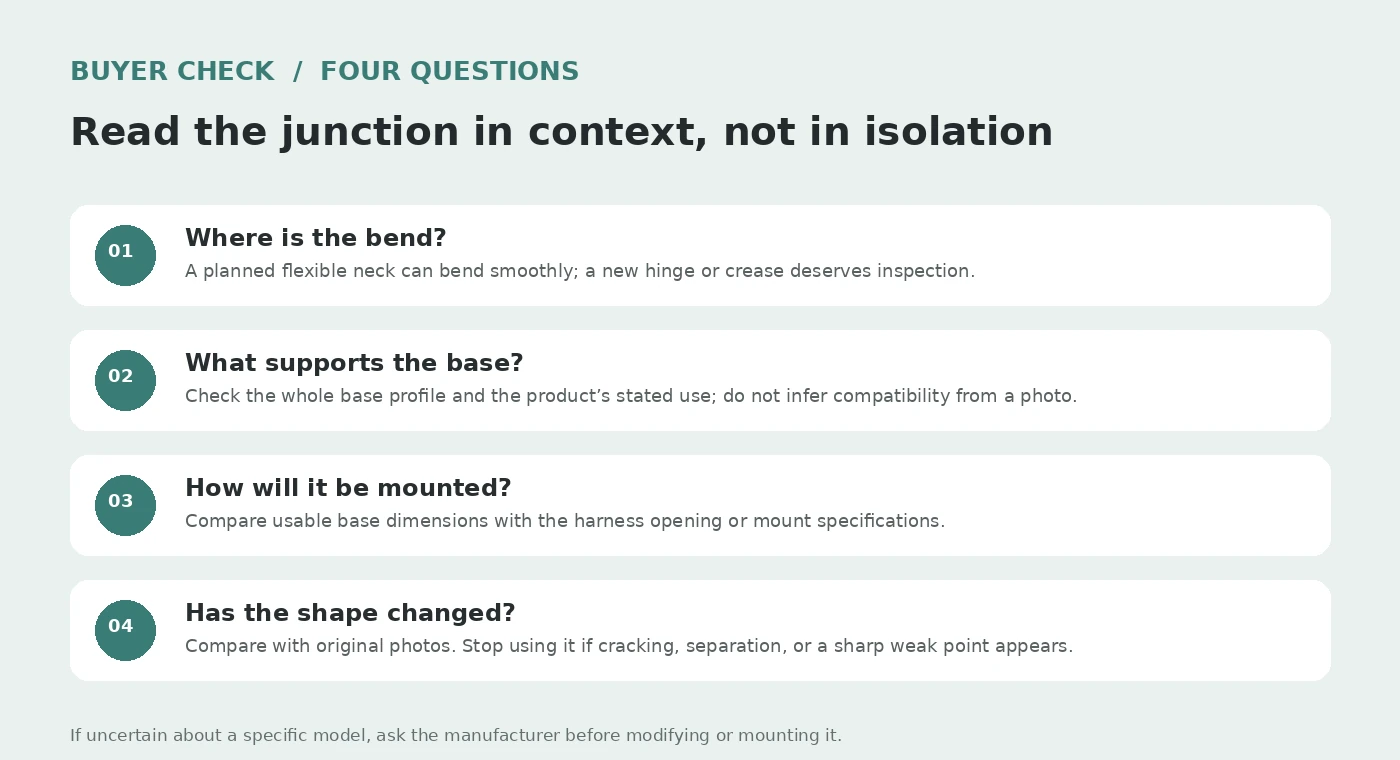
Common interpretation mistakes
- Assuming thicker always means stronger. A thicker transition may still be soft, hollow, layered, or designed to flex.
- Treating every bend as a defect. Some products are intentionally flexible. Compare the behavior with the description and original shape.
- Using the base silhouette as a compatibility promise. Harnesses and mounts have their own dimensions; verify the fit directly.
- Judging the material from the outside. A seamless appearance does not prove that the shaft and base are one uniform piece.
- Testing with force. Aggressive bending can damage a product and does not provide a reliable quality test.
Quick buyer decision card
| Your priority | What to compare | Question to ask |
|---|---|---|
| More controlled lower-shaft movement | Neck width, shaft length, material, stated flexibility | Where is the intended flex point? |
| Harness fit | Base profile, ring/opening range, shaft width at the mount | Does this exact base fit my harness system? |
| Hands-free placement | Mounting method, cup or plate, shaft leverage and weight | Is the product designed for this direction of loading? |
| Confidence in condition | Photos, seams, junction symmetry, return policy | What should I do if the junction arrives misshapen? |
Frequently asked questions
Does every dildo have a neck?
Every shaft meets a base or lower structure, but the transition may not be narrow or visually distinct. “Neck” is a convenient descriptive term, not a universal product specification.

Is a narrow dildo neck more likely to break?
Not necessarily. Risk depends on material, construction, dimensions, use, and condition. Do not infer durability from appearance alone, and avoid bending beyond the maker’s directions.
Can I make a flexible neck firmer?
There is no reliable home method to change firmness safely. Heating, chilling, inserting supports, or modifying the base can damage the dildo or change how it behaves. Choose a design with the firmness and support you want.
Can I use a narrow-neck dildo in a harness?
Possibly, if the product and harness are designed to fit together. Confirm the opening or O-ring dimensions, the base profile, and the maker’s compatibility information before use.
What if the junction bends sharply when new?
Compare it with the product photos and instructions. If it appears damaged, has a crease or split, or does not match the described construction, pause use and ask the seller or manufacturer to assess it.
Choose the transition for the job
The shaft-to-base junction is a small feature with several jobs: it connects two parts of the design, influences where flex occurs, and may affect how the dildo sits in a hand, harness, or mount. Start with your intended setup, then verify the dimensions and construction details that matter for that use. If the listing does not explain them, ask before buying; a close-up photo is helpful, but it is not a substitute for compatibility information.